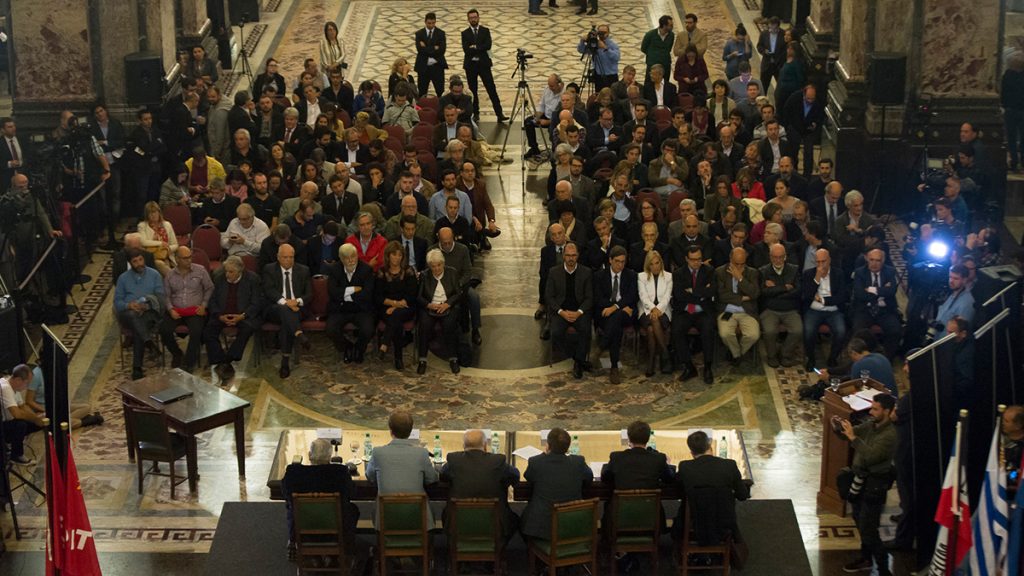
In the Hall of the Lost Steps in the Legislative Palace, the leaders of the six Uruguayan political parties signed the Ethical Pact against disinformation April 26, 2019. Photo courtesy of: Departamento de Fotografía del Parlamento del Uruguay.
Seven years ago, Uruguay got serious about disinformation. It mattered

Journalists built coalitions with competitors, politicians, academics and others to hold presidential campaigns accountable
Sally Stapleton has worked as a news leader and photo editor with the Minneapolis Star Tribune, Miami Herald, Boston Globe and The Associated Press, first as Latin America photo editor and later becoming the deputy in charge of AP Photos. From 2016 to 2019, she was the managing editor of the Pittsburgh Post-Gazette, which was awarded the 2019 Pulitzer Prize for Breaking News Reporting for coverage of the Tree of Life synagogue massacre. Currently, she participates in workshops on journalist safety and disinformation in the U.S. and Latin America.
After a lifetime in journalism, a realization shook me. The biggest stories I’d covered had the element of intentional lies or disinformation that produced violence, trauma and death: The Rwandan genocide against the Tutsi in 1994, which was prodded by Rwandan media leaders who sowed division and cheered on violence; the Sandy Hook Elementary School massacre and Alex Jones’ disinformation attack against the families of the dead children and school staff; the Tree of Life synagogue massacre with the killer’s conspiracy theories posted on social media, and the Stop the Steal refrain leading up to the Jan. 6, 2021, U.S. Capitol attack.
The goal of journalist fact checkers has been to lessen the harm of disinformation by correcting falsehoods and spreading truth farther and louder. The idea that we could keep it at bay was delusional and naive.
However, seven years ago, Uruguay took on this challenge. Data would indicate two simultaneous and separate initiatives launched by journalists did exactly that.
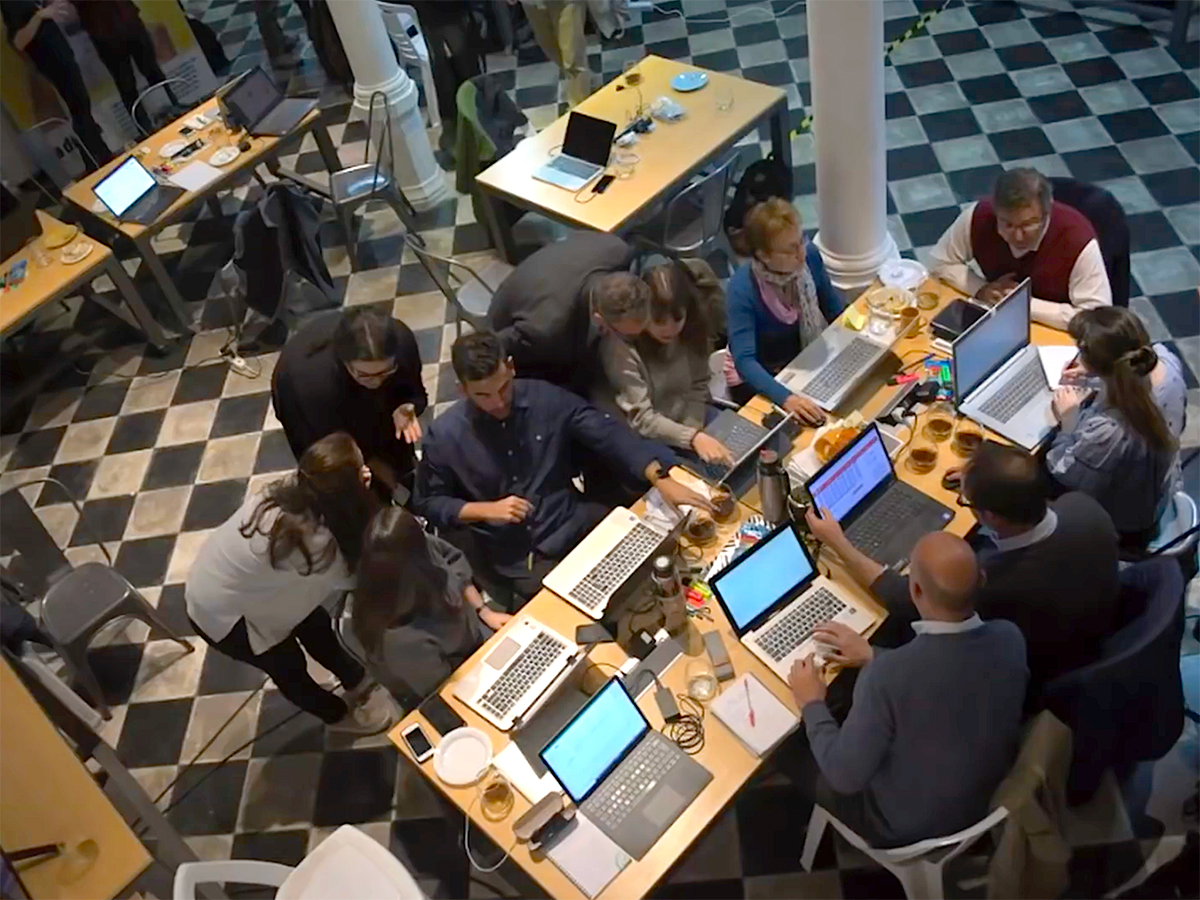
Driven by the same end goal to diminish disinformation in Uruguay, two unrelated alliances launched in early 2019, prior to the presidential election campaign. Verificado.uy was born when media competitors formed a fact-checking project, and El Pacto Ético began when the Uruguayan Press Association union group got the six Uruguayan political party leaders to sign an ethics pact to refrain from and call out disinformation.
While what worked in a country of 3.5 million people might not work elsewhere, what Uruguay showed is that collaboration is the way forward and the rest of us can learn from their story.
From conflict comes consensus
The country was forged in the early 1800s as a buffer between historically antagonistic neighbors Brazil and Argentina. Uruguay was tormented throughout the 19th and early 20th centuries by violent civil conflict. There was a military dictatorship from 1973 to 1985. That absence of freedom and its return only heightened the importance of collaborative problem solving among Uruguay’s institutions to reinforce democracy.
Now the motto: consensus rather than confrontation.
Why would a country that has a minimal problem — and to date, not a target of Russian or China disinformation campaigns — go to such lengths in 2018 leading up to the 2019 presidential campaign and follow that up in 2024 in the most recent presidential election? Why would Uruguayan politicians, journalists, civil society experts and academics put that kind of effort into a problem it didn’t have?
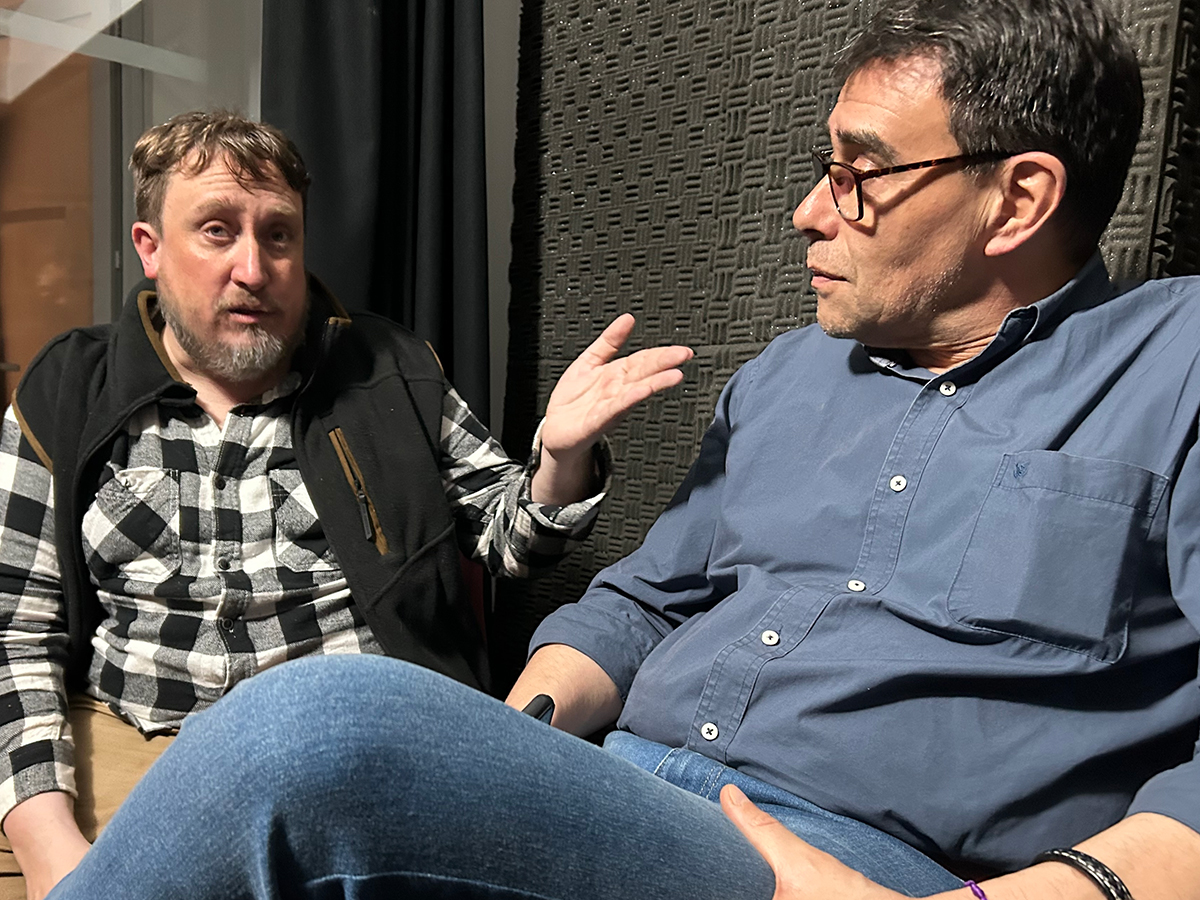
Martín Aguirre, a fourth-generation journalist and the director of El País, the largest-circulation news organization in Uruguay, said there was something a bit different about the lead up to the 2019 presidential campaign. A political unknown who had left the country when he was 12 returned as an interloper with massive amounts of money to run for president on the conservative National Party platform.
Candidate Juan Sartori was married to the daughter of Russian billionaire Dmitry Rybolovlev, a fertilizer magnate. Rybolovlev was named on a list of Russian oligarchs in Putin’s good graces in January 2018, according to a U.S.Treasury Department unclassified watchlist document released to congressional committees. Rybolovlev was in the news 10 years earlier when he paid $95 million for a Palm Beach estate for which Donald Trump paid less than half that amount four years earlier. The sale, the buyer and the seller made headlines worldwide.
“We are very proud of our political system, and our political parties, that you have to earn your spot there,” Aguirre said. “I think here people still don’t like somebody that comes from abroad and wants to buy his way to power.”
The launch of Verificado.uy
This was the backdrop to the 2019 campaign and the genesis of Verificado.uy, the coalition of Uruguayan media outlets, civil society experts, academics and university students working to verify information on social media as well as the candidates’ speeches and debates.
The idea for a fact-checking initiative made up of the breadth of the country’s news landscape came from the original founders of la diaria, the country’s No. 2 news outlet in circulation. The job of its co-founder and general manager, Damián Osta, is to keep the news cooperative afloat and moving forward. His colleagues call him “the idea guy.” In that vein, new ideas for initiatives are discussed and refined in group discussions, as was Verificado.uy.
“What I can tell you is that I saw with great concern electoral processes where public opinion was manipulated, where Cambridge Analytica had already wreaked havoc in elections in neighboring countries,” Osta said. “So what motivated me was to try to preserve the informative quality of an electoral process and the democratic coexistence that is so valued in Uruguay.”
Osta got funding from Google, Facebook (now Meta), and later from the Poynter Institute. He says inspiration for the initiative came from earlier work by Brazil’s Comprova, a Brazilian Association of Investigative Journalism project, and Mexico’s Verificado 2018, a collaborative election fact-checking project.
To launch the initiative, the Verificado.uy members got together for a two-day seminar in April 2019 in which journalist, educator and media ethics commentator Dan Gillmor was invited to lead a session. Gillmor co-founded the News Co/Lab at Arizona State University’s Walter Cronkite School of Journalism and Mass Communication.
“I thought it was, in a way, it was pathbreaking for journalism because journalists are so proprietary and non-collaborative outside their own organizations, which has only begun to change once the business collapsed,” Gillmor said.
“You know, Uruguay had this possibility of getting it right where it’s not something that could happen in a lot of places.”
Talking about the lack of action in the U.S. among the media, Gilmor added: “All but a very, very tiny number of organizations even understand the threat (of disinformation) much less have reacted to it in the appropriate way and I hope it isn’t too late.”
Making El Pacto Ético: luck, timing and a ‘godfather’
Simultaneously, but with no overlap among the players, the idea evolved for APU, the union of Uruguayan media and communications workers, to bring together the leaders of the six Uruguayan political parties to agree that each would refrain from sowing disinformation during the presidential election campaign. Longtime journalist friends Fabián Cardozo and Luis Curbelo, who had recently been elected to APU’s leadership, thought it was possible to make this happen.
It was easy to get immediate buy-in from the leadership of two of Uruguay’s biggest political parties, Frente Amplio and the National Party. But there was no money to make their idea happen.
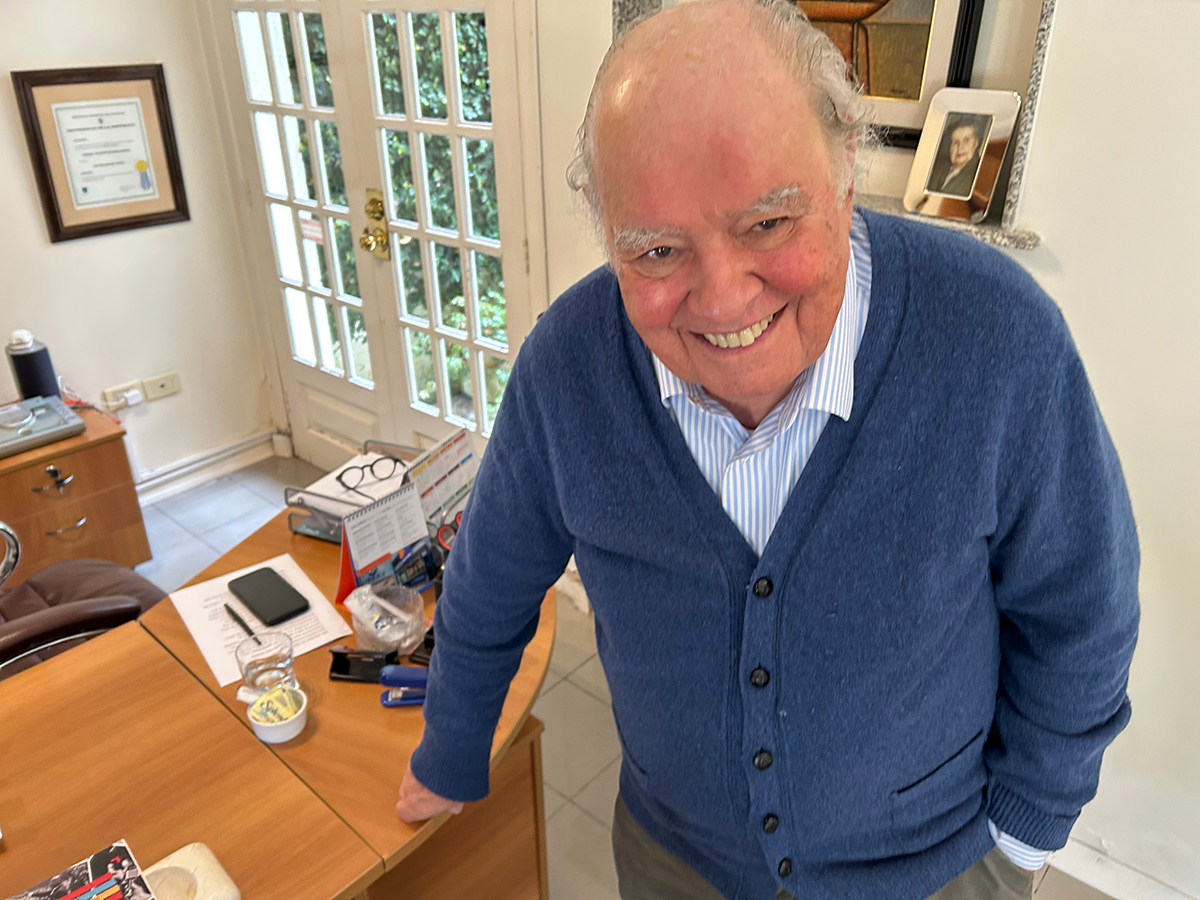
That is, not until Cardozo read a “Noticias Uruguay” story about Enrique V. Iglesias, in which the Uruguayan elder statesman talked about the importance of doing something about disinformation. He was quoted as saying, “Something must be done, I don’t know what, but the negative forces that want to disrupt democracy are an enemy that must be confronted.”
Cardozo was euphoric as he realized that Iglesias quickly could solve all of APU’s problems to put the ethical pact in place. “He is the former Ibero-American Secretary General. Former multi-term president of the Inter-American Development Bank. Former foreign minister of Uruguay,” says Cardozo. “A personality from Uruguay and from around the world… And indeed, he became our godfather.”
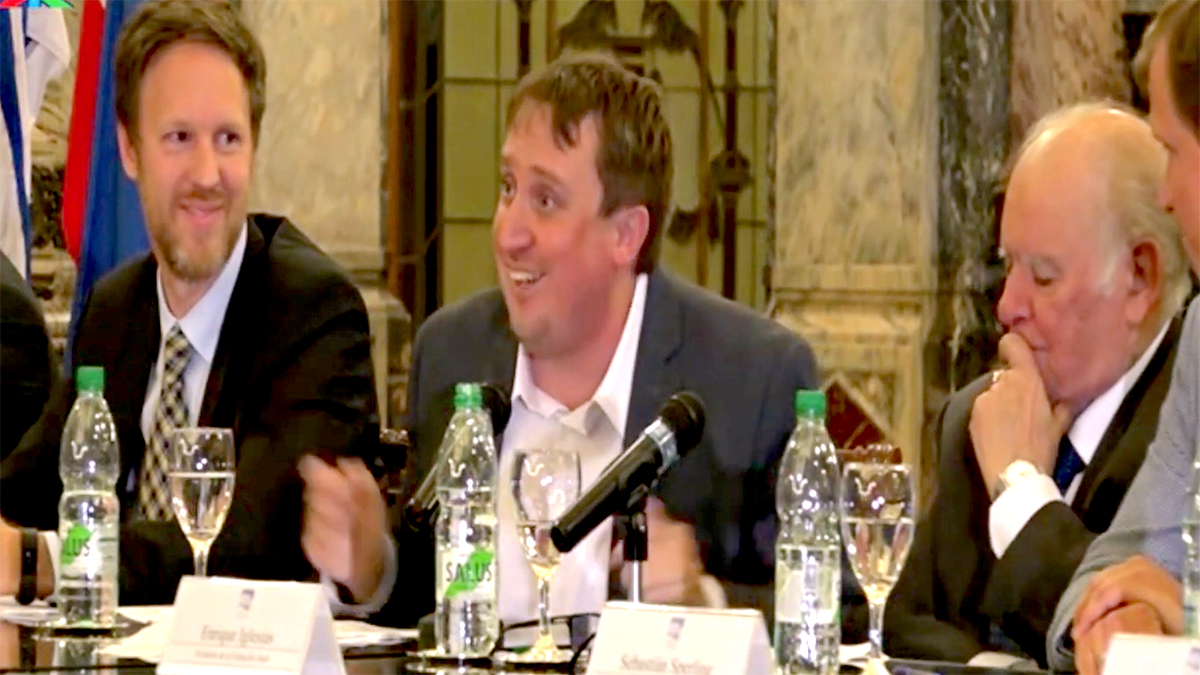
Within two days, he and Curbelo got an appointment with Iglesias. And that’s when Iglesias rallied the United Nations Development Programme (UNDP), UNESCO, the German Friedrich-Ebert-Stiftung Foundation in Uruguay as well as Iglesias’ nonprofit Astur Foundation to finance the project. More than an official signing ceremony, it also included training for journalists and disinformation literacy education throughout Uruguay’s 19 departments.
Cardozo alternates between laughter and awe as he retells that meeting with Iglesias. “In four calls, he achieved what we wanted to do. And that’s where a process began. It became a reality. That was it.” The public signing ceremony took place 2 ½ weeks later.
Iglesias is the linchpin that made the anti-disinformation movement happen among the political parties. “I am not a philosopher or psychologist, I’m an aspiring economist” is his self-effacing way of explaining his life and long trajectory as a public servant. UNESCO’s Guilherme Canela, who joined forces with and provided funding for the initiative, called Iglesias “an iconic figure.” El País’ Aguirre said, “He’s respected by all sides.” And the director of la diaria Radio Lucas Silva, who had a leadership role in Verificado.uy, called Iglesias “the best of us.”
Tech companies Google and Apple and social media platforms Facebook (now Meta) and Twitter (now X) participated. “Even the platforms, they were super excited. They came to the Pacto Ético and they were there in the audience,” said Stefan Liller, the UNDP representative in the country then.
How effective were the efforts?
The most tangible sign of results five years later is a November 2025 research study detailing Uruguay’s incredibly low number of disinformation cases — a mere 27 — debunked in the two months leading up to the 2024 presidential election campaign, according to AFP Factual. Sofía Montero, a consultant in communication strategy and professor at the Universidad de Montevideo, is the lead author in the research study. It notes that no disinformation attempts were linked to a third-party state attack. Latin America hasn’t been so fortunate with Uruguay’s neighbors being the victims of Russian and Chinese disinformation.
APU and the political parties returned to the grand hall of the Legislative Palace five years later in April 2024 for the public signing of the second iteration of the ethical pact. In attendance at the event and again providing funding were UNDP and UNESCO.
Google and Facebook were among the financial supporters for Verificado.uy and sat in on discussions surrounding the political parties’ ethical pact in 2019. They were nowhere to be seen five years later. “They were feeling guilty in 2018 and 2019,” la diaria’s Lucas Silva said. He took a long pause. “And then they stopped feeling guilty.”
The Verificado.uy initiative was envisioned only for the 2019 election. The fact-checking project showed all the players involved that although extremely competitive, the Uruguayan press groups worked together well. Osta agrees the project evaluation is positive, with a caveat: “…In reality, I’m not optimistic about the capacity of this type of instrument to stop disinformation.”
What it did produce is a press bond that wasn’t as strong prior to Verificado.uy. According to Natalia Uval, a highly regarded editor and founding member of la diaria, this encouraged them to form an informal press group “Encuentros de Periodistas” that discusses issues affecting journalists. Their collective goal is to anticipate and prevent rather than just respond after the fact.
And yet, Uruguay is among those countries where polling indicates that the media has taken a hit in public confidence.
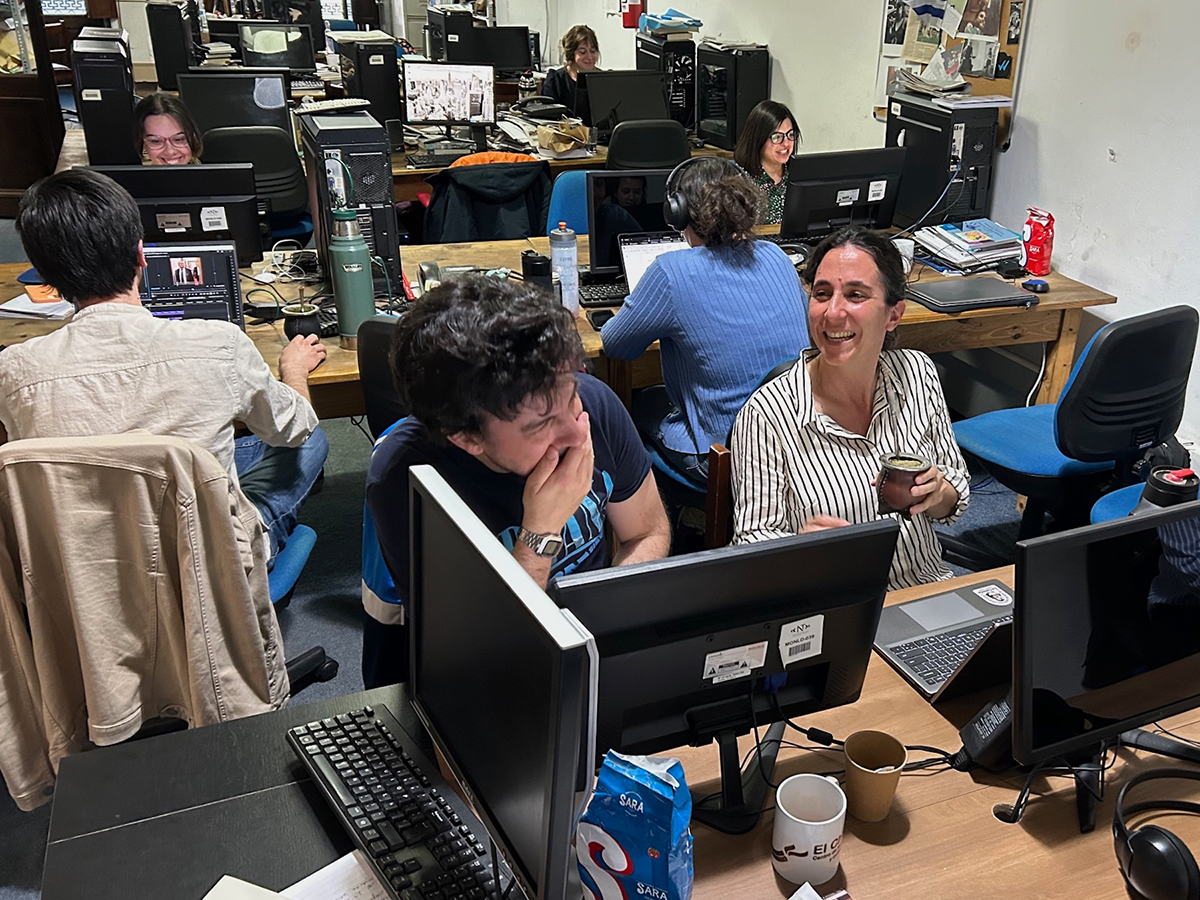
The “2022 World Values Survey of Uruguay” was conducted by the private social research and polling group Equipos Consultores, which worked along with government entities in surveying the public’s confidence in Uruguayan institutions. The data showed among the most significant declines in confidence were linked to the media, concluding “both ‘the press’ and ‘television’ have undergone a significant loss of trust between 1996 and 2022, with 68% of the respondents saying they had little or no confidence in the media.”
Not everyone saw the value of the Uruguayan journalists’ union APU’s effort among political parties to abstain from disinformation attacks. la diaria’s Osta criticized the political parties’ ethics pact as “a meeting convened by the labor union of the press with the political party leaders, who later did what they wanted. It didn’t have a real impact.” But Montero sees it as valuable as “it’s a sign of the system that this won’t go here. To me, it’s really important.”
During this period, Guilherme Canela was UNESCO’s Communication and Information Regional Adviser for Latin America and the Caribbean. He explained that UNESCO was working on a similar project in Indonesia, and they took advantage of the lessons learned in Uruguay.
Isn’t it within the realm that the U.S., drowning in disinformation, might figure out a collaborative effort that could attack the problem?
Gillmor is pessimistic: “There would be not only no appetite, there would be active hostility from the American journalism business to something like that and that’s a sad reality of what has happened to journalism.”
Seven years ago, Uruguayan journalists provided a masterclass on how to build collaborations to mitigate disinformation.
The rest of us have work to do.
If you’re interest in learning more
The Tree of Life synagogue massacre coverage by the Pittsburgh Post-Gazette
- Reed, Paula, et al. “Dozens of federal, state charges filed against shooting suspect Robert Bowers.” Pittsburgh Post-Gazette [Pittsburgh], Oct. 27, 2018.
_____
Who is Dmitry Rybolovlev?
Following the release of the Treasury Department’s Russia list, Democratic senators Ron Wyden and Cory Booker argued the 2008 sale “warranted further scrutiny” and asked that Treasury Secretary Mnuchin share documents and property sale warrants related to Trump’s Palm Beach property sale to Rybolovlev. He was not included on a U.S. sanctions list.
- Report to Congress, “Countering America’s Adversaries Through Sanctions Act of 2017,” Jan. 29, 2018.
- Statement from the Senate Finance Committee, “Wyden Requests Financial Records Related to Dmitry Rybolovlev and Purchase of Trump Palm Beach Property,” Feb. 9, 2018.
- Statement from Senator Cory Booker, “Booker Urges Mnuchin to Provide More Information on Trump Administration’s Ties to Russian Oligarch,” Feb. 14, 2018.
______
The story that launched El Pacto Ético, a profile of Enrique V. Iglesia
- Cariboni, Diana, “Enrique Iglesias: pacto contra las mentiras,” Noticias Uruguay, April 12, 2019.
______
The Uruguayan Press Association video from the April 26, 2019 ceremony of the signing of El Pacto Ético
- APU – STCS Facebook post, “En abril del 2019 Uruguay fue ejemplo para el mundo con la firma del pacto ético del sistema político contra la desinformación,” April 27, 2020.
______
The research study entitled “Overview of Disinformation in Election Campaigns: The Uruguayan Case 2024 in the Hispanic American Context”
- Montero, S., Rodríguez-Virgili, J., & Fernández, C. B. (2025). La desinformación en las campañas electorales: el caso uruguayo 2024 en el contexto hispanoamericano. Revista de Comunicación Política, 7, e250708.
______
An Uruguay survey measuring confidence in institutions, including media
- Equipos Consultores, pgs. 55 – 57 & 66, “Estudio Mundial de Valores, Uruguay – 2022.”
Cite this article
Stapleton, Sally (2026, Feb. 18). Seven years ago, Uruguay got serious about disinformation. It mattered. Reynolds Journalism Institute. Retrieved from: https://rjionline.org/news/seven-years-ago-uruguay-got-serious-about-disinformation-it-mattered/