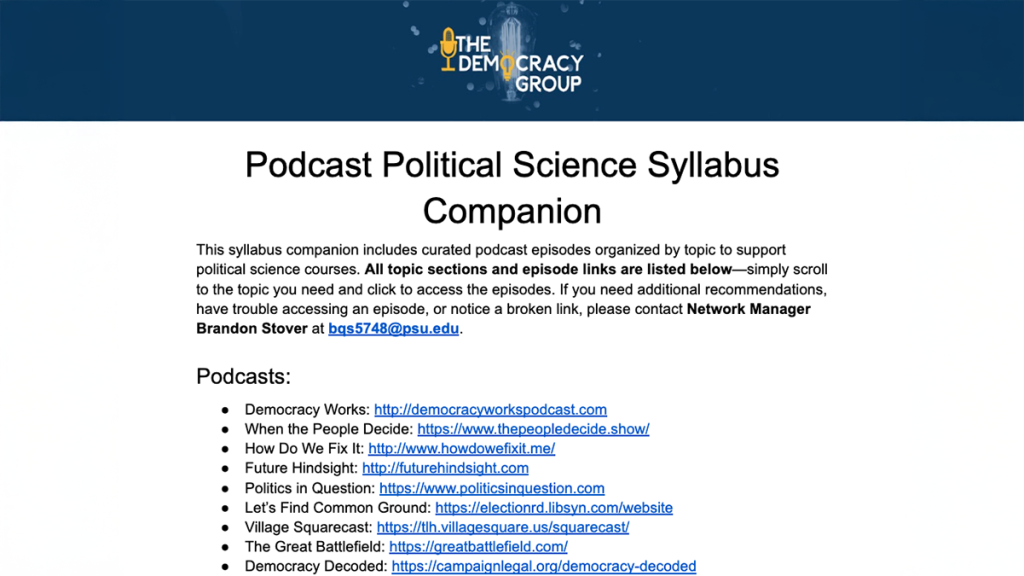
The Democracy Group launched a syllabus guide to help educators incorporate a variety of democracy-related podcasts into their courses.
Building a syllabus companion to help educators integrate podcasts into their classrooms

A conversation with Jenna Spinelle and Brandon Stover
The Democracy Group is a podcast network of 18 shows that focus on democracy and civil engagement. Jenna Spinelle, host and producer of the Democracy Works podcast and communications lead for Penn State’s McCourtney Institute for Democracy, and Brandon Stover, the digital content specialist for the McCourtney Institute and podcast network manager for the Democracy Group, came together to create a curated list of podcast episodes educators could use in their classrooms.

This syllabus guide covers topics relevant to educators in the political science field. It is based on textbooks for Introduction to American Politics, which Spinelle found was pretty similar across most schools. Although the syllabus first started with the Democracy Works podcast, Spinelle and Stover worked together to expand it to the entire podcast network.
Madiha: What elements were most important when creating the Democracy Works podcast?
Spinelle: We tend to lean more into our academic expertise and look at the big picture of ‘okay, these things are happening. Why are they happening? What’s underneath them?’ And then my interest in particular is in democracy and political reform, so people working on gerrymandering and money in politics and that kind of thing, so some of that makes its way into the show, as well. The thing I hear most often from listeners is that they feel hopeful after listening, that it’s kind of a nice counterbalance to the rest of the political information environment.
Madiha: What would you say to educators who struggle with adding podcasts into their curriculum?
Spinelle: If you haven’t used a podcast in your class before, from what I have seen students respond well. They really like being able to listen when they’re walking around campus or on the bus, doing their laundry, at the gym or whatever it is that they’re doing, and I find that there’s a much more robust discussion when they’ve listened to something, as opposed to if they’ve read it. Of course, not to say that podcasts are going to ever replace textbooks, but I think you can add some variety for students.
Madiha: If another news organization wants to do something similar, and they don’t have the connections that you do with higher ed, do you have any suggestions of how to get started and how to build those relationships?
Spinelle: The first thing I would say is to figure out what educational discipline most closely maps to the work that you want to share. And what college major is closest to what you’re doing. And so from there you can go to the professional organizations for that field, like in our case, it would be the American Political Science Association and some others like that. They often have newsletters or other communication channels with their members that journalists could use to put themselves on their radar.
Madiha: Was there anything that made the syllabus easy for educators to use?
Spinelle: Yes, to know that these shows are all coming from reputable organizations, we’ve already listened to them, we know that they’re classroom appropriate. You know they’re coming from a place of learning, not a place of trying to persuade people to one opinion or another, which I know can be problematic in some places, more so than others.
Madiha: What did the process look like for going through the different shows and figuring out how to match it by topic?
Stover: Some of our podcasts have transcripts, so I could quickly go through and search through their transcripts to see if a topic matched. But other ones don’t, so I had to start listening through some of the episodes and I found that to be very inefficient with 20 different podcasts and multiple different topics. So, I started to use AI to help me search through the episodes. The nice thing about AI is that it doesn’t go through the entire catalog, especially newer versions of ChatGPT, where it’ll search actual website links. I can drop in our website links, and I’ll say, ‘feed me three episodes related to this specific topic’, and it’ll give me those episodes. It usually searches the titles first, and then it will go through the descriptions and sometimes through the transcripts. Then, I would have to go through and either quickly listen or skim through it to see if it actually did match, or if it had a transcript, I could quickly read through that.
I also found out that if you do too much of this in one chat, it freaks out and won’t want to load the chat. What the AI does is it reads your entire chat before it does its thinking, so if you’ve been doing this a bunch, it’ll read everything it’s done before it gives you an answer – which is really helpful for you to get the same format of responses and depth that you want searched. But eventually it’s too much for it to think through.
Here are two examples of prompts that Stover used in ChatGPT:
Find up to 3 episodes from the How Do We Fix It? podcast (http://www.howdowefixit.me/) related to Congress and Legislative Branch.
Find up to 3 episodes from The Context podcast (https://kettering.org/thecontext/) related to interest groups (a group of people that seeks to influence public policy on the basis of a particular common interest or concern.).
Madiha: What did you incorporate to make this syllabus helpful for educators?
Stover: We wanted a quick way for all the links and all the topics to be in one area so we made the Word document that just has the links so that they can quickly take that and just drop it into their syllabus. Something that we’re thinking about doing now is sort of an email-based course that’s kind of like onboarding – like, hey, here’s the syllabus, and now here are ways that you can use it and give them different ideas. [For example,] you can put it in your syllabus this way or assign podcasts this way, or we can suggest different projects or exercises you can do in combination with an episode.
Madiha: What is one helpful thing for people to know if they are interested in doing a similar project?
Stover: We think a lot about meeting people where they are. What I mean by that is a lot of times when you’re trying to grow a podcast, you’re thinking about how to market and where else can you show this in front of people, but the people that want to listen to podcasts listen to podcasts and the people that are on social media want to stay on social media. So that means, if you’re promoting your podcast on social media they don’t want to make that jump. So this same idea goes for education as well. Don’t try and bring people to where you’re educating. Go to where they’re already being educated, and put your material there.
Editor’s Note: This interview has been edited for clarity and brevity.
Sign up for the Innovation in Focus Newsletter to get our articles, tips, guides and more in your inbox each month!
H2
Cite this article
Madiha, Ishrat (2026, Feb. 10). Building a syllabus companion to help educators integrate podcasts into their classrooms. Reynolds Journalism Institute. Retrieved from: https://rjionline.org/news/building-a-syllabus-companion-to-help-educators-integrate-podcasts-into-their-classrooms/