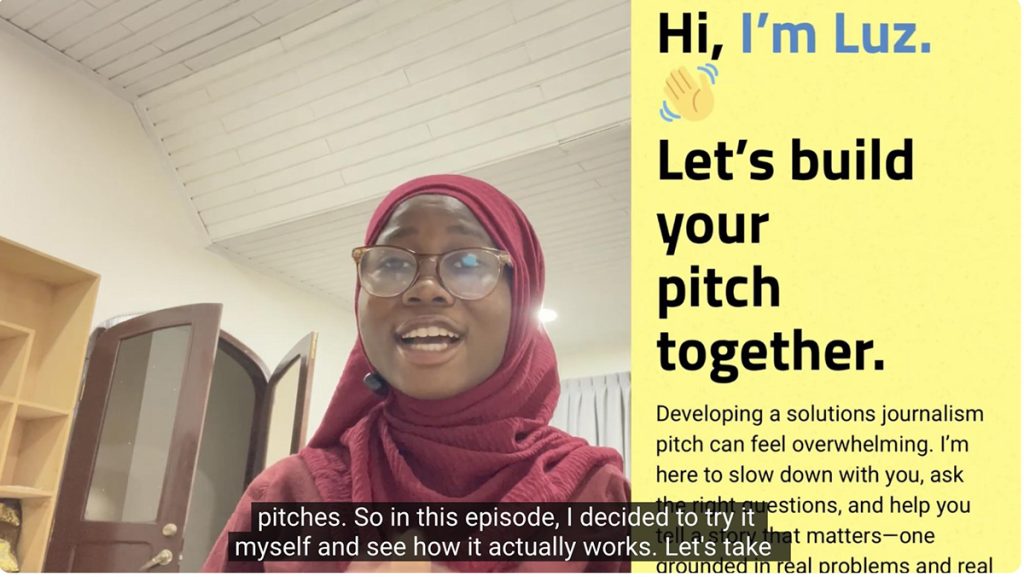
Screenshot from the Solutions O’Clock episode where journalists explore how Luz can help them refine their solutions story idea.
How journalists around the world are using our solutions chatbot

In January 2026, we launched LuzLab.org — a free, trilingual, publicly available chatbot that guides journalists as they develop solutions journalism story ideas in Spanish, English or Portuguese. The bot, built in collaboration with the Reynolds Journalism Institute and our team at El Colectivo 506, is trained in the solutions journalism pillars: response, evidence of impact, insight / lessons learned, and limitations. LuzLab also connects journalists with resources for further learning about solutions journalism.
Two months later, we wanted to share how this friendly sloth has had an impact on journalists, editors, grantmakers, and journalism professors. We followed Luz through Costa Rica, Peru, Nigeria, India, and beyond.
Using LuzLab in a call for proposals: Costa Rica and LatAm
Following the official launch event for Luz in February, we held a call for proposals at the LatAm SoJo Fund. One requirement to apply: Luz had to be used to polish the pitch. We also asked the journalists who applied to send us feedback on their experience with Luz, and to attach a copy of their chat with us. (To protect journalists’ privacy, we do not have access to chats from LuzLab.org unless a journalist chooses to share it with us.)
As with all of our calls for proposals at the Fund, this one was available only to journalists who have already registered with us, meaning that they’ve already received at least basic training from us or another recognized source. Therefore, the journalists using the chatbot in this context were not new to solutions journalism. We were curious to see whether, despite their prior knowledge, Luz would still have something to offer.
“I had a clear idea going in, but [Luz] helped me organize the structure for my proposal,” says Cinthia Cherres, from Peru, who proposed a story about moor conservation in Peru. She asked Luz for help with pain points on her story, such as the fact that she hadn’t been able to find information about the flow rate of rivers in the moors; Luz offered suggestions about how to mitigate this lack of information, such as looking for studies with general data about the importance of moors in regulating water sources, or including testimonials or observations to boost the qualitative evidence in the story where quantitative data is scarce.
“It helped me feel better about a question I had and gave me recommendations that… confirmed how I should proceed with the story. I will definitely use it again because it gives me all the guidelines and questions I need to create a solutions story structure.”
“It was very useful,” says Agustina Bordogoni, another experienced solutions journalist in Argentina who proposed a story about a nonprofit organization that helps senior citizens learn to play and manufacture drums as a way to bring people together and alleviate loneliness. “First, it helped me see the points I could improve or perspectives I should incorporate. Then, it helped me check if I was on the right track with some of my ideas.”
Two key pillars of solutions journalism are insights / lessons learned and limitations. It can be hard for a journalist who is still in the pitching phase, and therefore has not yet fully reported on the response, to predict what challenges and limitations the facilitators of the response might have encountered. It was interesting to see that Agustina asked Luz to help her brainstorm potential challenges for the response she had outlined. Luz offered suggestions such as long-term financial sustainability, participant retention, and difficulty in measuring the psychological and social impact of the program.
Of the 19 journalists who applied, many mentioned the built-in character limit as a limitation when using Luz. This is a limitation within Open AI. Adjustments have been made to ensure that Luz responds effectively when people enter long texts, explaining the limitation and prompting them to break down their queries into the component pieces of solutions journalism rather than pasting an entire pitch or long narrative into the chatbot.
However, the journalists said that the tool was very helpful and that they plan to turn to it again in the future. One even said that it will be helpful to her whole newsroom, which has decided to adapt a solutions focus across much of its work.
“It takes you step by step to break down your work with respect to the five key elements to validate a Solutions Journalism project: Problem, Response (Solution), Evidence, Limitations, and Insights/Transferability,” writes Paola Chavely Torres Nahuatlato, from Mexico, who proposed a story about solid waste management. “It helped me tremendously in building my pitch; it helps you narrow down the scope and is useful for summarizing the proposal. It’s easy to use, and I definitely plan to use it again because now at Escenario Tlaxcala our editorial guideline encourages us to focus on solutions in the journalism we do, so Luz is a great virtual editor for us with this approach.”
Training and pitch development across a newsroom: Peru
Norte Sostenible, a digital media outlet in Piura, Peru, reached out shortly after the launch of Luz Lab to ask if it would be possible for us to conduct a SoJo training for a group of journalism students who have just joined their newsroom. We did so, and requested that the participants follow up on the training by using Luz to apply what they’d learned to new story ideas.
Hearing from this group of journalism students was valuable because, unlike the members of our SoJo Fund who applied to the call for proposals, these journalists were brand-new to solutions journalism. When they first used Luz, they had just received their very first training. How would the chatbot respond to their needs?
Andy Garay, one of the trainees who used the chatbot afterwards to develop their very first solutions pitches, said that going into the chatbot, he was still wrapping his head around how a sojo piece works—something we’ve seen again and again in our training over the years, and one of the reasons we wanted to develop Luz. He said the chatbot “helped me understand a bit better what solutions journalism is all about. Because I meticulously started asking how to frame the answer, about evidence, limitations, and transferability.”
“It helped me understand that journalism isn’t just about showing the problem, its causes and consequences,” says Analí Valencia Calle. “It’s always better when there’s a solution to the issue. It’s about knowing the story behind it, the key players, the limitations, and the opportunities.”
“I used Luz Lab to organize my ideas and better understand how to approach my proposal from a solutions journalism perspective,” says Gabriel Calderón. “Initially, I had doubts about how to differentiate between the problem and the solution, and how to better support my pitch with evidence.”
Gabriel adds that Luz also helped him better understand an essential element of sojo: “It allowed me to understand that it’s not just about telling a positive story. It’s about critically analyzing whether the solution works and with what evidence.”

A tool for professors: Nigeria and India
Dr. Rasheed A. Adebiyi is an associate professor in the Department of Mass Communication at Fountain University, Osogbo, Nigeria. He’s also a part of the Solutions Journalism Network’s global community of certified solutions journalism trainers. He put Luz to work in his classroom shortly after the launch, and told us about the experience. (His student Barakah A. Biliaminu also reviewed the tool in an episode of their YouTube series, Solutions-O-Clock.)
“I currently teach a second-year undergraduate course [with] 64 students, most of whom are being introduced to solutions journalism for the first time,” he writes. “This means they are still grappling with understanding the core pillars such as response, evidence, limitations, and insights—and, more importantly, how to translate ideas into structured story pitches.”
The professor introduced Luz approximately five weeks into the course, when students were asked to develop story ideas based on issues within their own environment—particularly issues related to university life. Rasheed said what stood out about the chatbot was how naturally it fit into the learning process.
“Students began interacting with Luz by inputting rough, sometimes poorly structured ideas, and the chatbot guided them step-by-step into refining those ideas into clearer solutions journalism pitches,” Rasheed said. “More importantly, the types of questions Luz asks—especially around evidence, limitations, and transferability—help students move from vague ideas to more structured, viable pitches.”
He provided a few examples of specific stories that groups of his students were grappling with as they used the tool.
“One group explored the issue of high student failure rates and proposed peer-led tutorials as a response,” he says. “Luz did not simply accept their input; instead, it prompted them to clarify the problem, strengthen their evidence (beyond testimonials), and think critically about limitations such as tutor availability and student engagement. This back-and-forth interaction pushed students to think more deeply than they typically would at this level.”
He notes a quality in Luz that was very important to us in developing the tool: that she does not leap into creating pitches for users, but rather focuses on asking questions to help the user align the story idea with the four pillars of solutions journalism.
“One particularly important observation is that Luz consistently positions itself as an assistive tool rather than a generative one,” says Rasheed. “When a student attempted to use it to write a full story, it declined and redirected the student toward developing the pitch instead. This was very important pedagogically, as it reinforces originality and critical thinking rather than dependence on AI for content generation. Another strength is the built-in SoJo guidance. Many of my students are new to the concept, so having the principles embedded within the interaction made it easier for them to learn by doing. In essence, Luz functioned not just as a tool, but as a form of guided instruction—almost like an additional teaching assistant in the classroom.”
A limitation that the professor noted is one that we hope to address over time by adding more training materials to the platform: the fact that the tool does require some previous familiarity with solutions journalism before use.
“Students still require some level of prior orientation to solutions journalism concepts to fully benefit from the tool,” he writes. “Without that foundation, some initially struggled to respond effectively to the prompts. However, once they became familiar with the framework, the quality of their engagement improved significantly.”
Our priority for adding to the platform in the coming months will be the Spanish-language asynchronous training materials for our Latin American Solutions Journalism Fund community, since the Solutions Journalism Network already offers a wide range of materials, particularly in English. However, as we add the training sequence for the LatAm SoJo Fund to the site, we will keep Dr. Adebiyi’s comments in mind and look for ways that the site in general, and the chatbot in particular, can more effectively guide users to basic SoJo training materials throughout the conversation.
“Luz helped my students to think more critically, engage more deeply with their ideas, and better understand how to structure a solutions journalism pitch,” writes Rasheed. “I see strong potential for its continued use, especially in classrooms where students are just beginning to learn how to develop rigorous and impactful story ideas.”
Another certified solutions journalism trainer, Joydeep Dasgupta, says that he has already shared LuzLab with more than 800 journalists in his trainings and speeches.
“While I regularly introduce Solutions Journalism in my training sessions, this time, I also brought in Luz as a resource,” Joydeep writes. “At THK Jain College in Kolkata in India where I was invited to speak on AI in Journalism during their Annual Conclave, I briefly introduced both Solutions Journalism and Luz. The students seemed genuinely interested, and I noticed a good level of engagement when exploring Luz.”
“In another session with over 800 journalists from Madhya Pradesh and Chhattisgarh (States of India), I spoke about Solutions Journalism and highlighted Luz during the Q&A segment. It was encouraging to see their curiosity grow, and Luz appeared to help simplify the concept for many of them. These interactions made me feel that introducing Luz alongside Solutions Journalism adds clarity and sparks meaningful interest among participants.”
These responses from Rasheed Adebiyi and Joydeep Dasgupta are part of many others from members of the Solutions Journalism Network’s global certified trainer community. Several trainers have noted they are including information in the tool in upcoming papers, book chapters, and more.
Send us your feedback
Everyone, everywhere, is cordially invited to give Luz a try and to send us our feedback. Users can also toggle between the three languages offered and read more about solutions journalism, the Latin American Solutions Journalism Fund and the Reynolds Journalism Institute. Luz is freely accessible to all, keeping with the Reynolds Journalism Institute’s mission of providing free, practical and innovative resources to the journalism community.
If you are an editor, trainer, or journalism professor, we would particularly appreciate hearing about your experience applying the tool. Please contact us at katherine@elcolectivo506.com.
Cite this article
Stanley Obando, Katherine (2026, April 7). How journalists around the world are using our solutions chatbot. Reynolds Journalism Institute. Retrieved from: https://rjionline.org/news/how-journalists-around-the-world-are-using-our-solutions-chatbot/