Mass detention database puts trove of data at fingertips of investigative journalists

Mass detention operations by immigration agents over the last year have taken immigration from what was largely a national political issue to one that is deeply felt in communities of all sizes throughout the country.
In that time, news outlets have told countless human stories about migrant life in America, about detainment and about the justice system. But within and alongside those human stories, data journalists have worked overtime to crunch the official facts and figures as well as streams of information coming from the public and fellow journalists. The numbers of detainees; where, when, why, how and by whom they were detained; who they are and what happened to them.
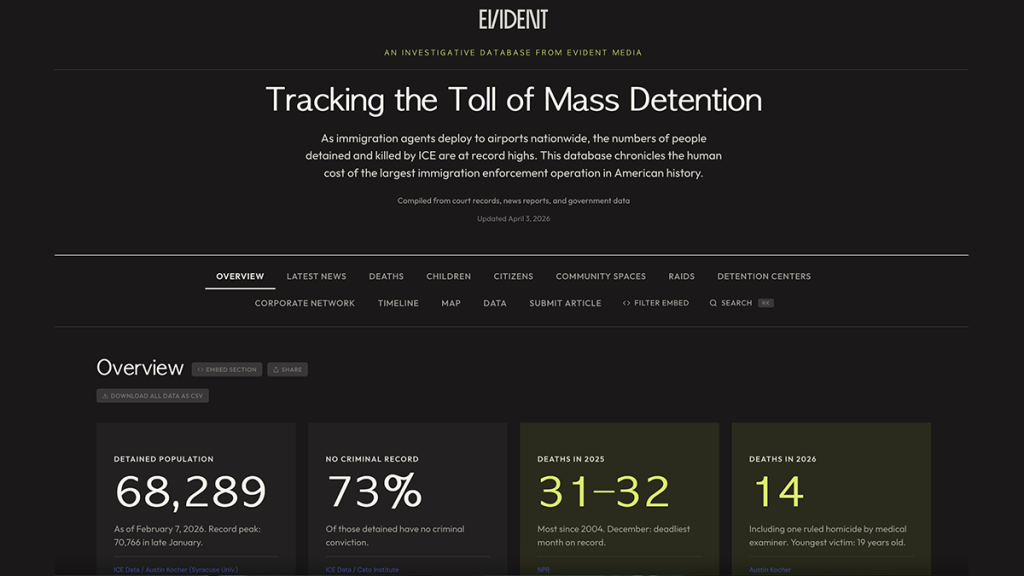
The information can be fluid and opaque, making it more difficult to extract meaningful patterns and delve beneath broad, aggregate data. But with the launch of ICEtracking.org late last month from Evident Media, journalists have a new resource that parses and organizes a wide range of information about mass detentions. In the form of a visually striking and carefully sourced database, it offers the fundamental numbers, such as more than 68,000 people currently detained, 73% with no criminal record and 5% with violent criminal convictions.
At the same time, it breaks down the data with maps showing the general locations of raids and detention facilities, an accounting of children detained and the length of detention, and an analysis of corporate entities profiting from the infrastructure of immigration enforcement.

According to Zach Toombs, Evident Media’s executive director and founder, it’s all designed to make investigative reporting on mass detentions a more efficient and user-friendly process, even when it comes to the presentation of the final product.
“Each element from the database is individually embeddable,” said Toombs, who earned a bachelor’s degree in political science from the University of Missouri — where the Reynolds Journalism Institute is based — in 2012. “So if someone is writing an article for a local newspaper in Mississippi about a new detention facility that’s coming in, they can embed a map in that article to show where it fits into the national picture.”
Also embeddable is a grim list of deaths in the custody of Immigration and Customs Enforcement, which provides surprisingly detailed information where possible. Alongside each person’s name, age and date of death, the database typically includes their nationality, the detention facility where they had been held and a summary of the circumstances surrounding their death.
This, along with the rest of the database’s information, is compiled variously from court and government records, news coverage and research from experts like Austin Kocher, a research assistant professor at Syracuse University described on his faculty page as a “political and legal geographer.” Data journalist Michael Sparks created the database and manages the collation and curation of its content.
The breadth and specificity of the data allows news organizations to zero in on areas of interest for potential stories, making the database a useful resource both for tracking large-scale trends and for identifying smaller or more location-specific developments.
“As we continue to build out partnerships and get a sense of how news partners are using this, we also will be creating aspects of the database that are regionally specific and even market specific,” Toombs added.
That approach is one reason Evident has partnered with the Institute for Nonprofit News (INN) to distribute the database to its network of more than 300 news organizations.
But interest is already extending beyond INN. Bellingcat, an investigative network specializing in open-source research with a presence in more than 20 countries, is increasingly publishing stories that use research to “zoom in” on local stories in the U.S. Last year, they partnered with Evident and nonprofit California state politics newsroom CalMatters to investigate immigration raids in the state’s Kern County. Soon, Bellingcat was not only looking at raids in Los Angeles but in Washington, D.C., Chicago, Portland and Minneapolis.
The result was more than a series of stories reflecting the reality on the ground; it was a rapidly expanding archive of factually verified social media videos. In Bellingcat terms, it was a dataset capable of revealing insights, such as when reporters noticed that Border Patrol agents participating in enforcement surges in California later showed up in Chicago, where they were involved in apparent altercations captured on social media.

It’s not clear whether that data set will eventually become incorporated into Evident’s database — though it would make sense, given Evident’s primary emphasis on visual journalism — but Bellingcat Lead Editor Eoghan Macguire said the experience has demonstrated the value of the kind of data collection that the database showcases.
“There’s so much that’s happened over the past year in terms of ICE and Border Patrol and all these federal agencies getting involved in immigration operations, these surges within cities and even beyond that,” Macguire said. “So much is there — the full story hasn’t been told yet. From our experience of collecting similar data, we’ve gotten some really strong and important stories out of it, so I can vouch that this is a good resource that outlets from different parts of the country will find useful for different things.”
For Macguire, launching the database now feels right. With the pitch of unrest having largely lowered over the last few months, there is perhaps room for journalists to dive deeper and more reflectively into the data.
“It seems to me that the surges are not happening in the same way that they happened until January or February,” he said. “You’re not seeing the same level of violence, the same level of confrontation between law enforcement and citizens. It’s maybe a time now to take stock and just consider what happened, because it wasn’t normal what we saw. In all the cities where this has happened, there are definitely things to dig into. There’s accountability reporting to be done on some of the violence we saw in the streets. So I think this database could be particularly useful in that sense.”
Cite this article
Fitzgerald, Austin (2026, April 7). Mass detention database puts trove of data at fingertips of investigative journalists. Reynolds Journalism Institute. Retrieved from: https://rjionline.org/news/mass-detention-database-puts-trove-of-data-at-fingertips-of-investigative-journalists/