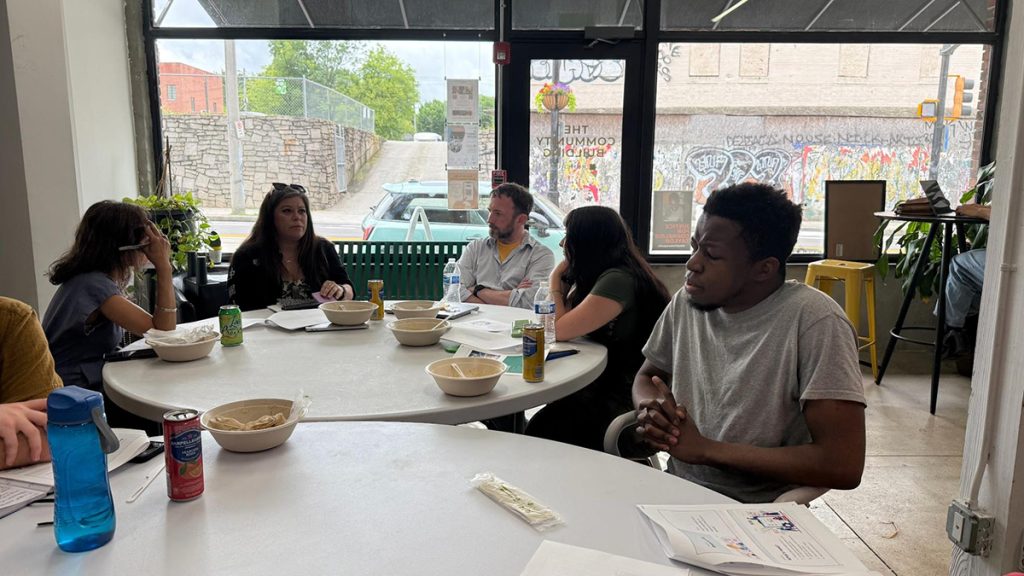
Journalists, nonprofit leaders and community members gather to provide input on what they would find useful in a civic collaboration hub. Photo: Mariann Martin
Building a civic information hub

Civic Strata: A shared foundation for data, documents and community reporting
Type “data centers” into Google, and you’ll get thousands of results, including an AI summary, the latest reporting from various news outlets, a Reddit thread, and a link to a Wikipedia entry.
What you won’t get is the FOIA request a nonprofit filed eight months ago, the zoning document a local journalist dug up last year, or the name of a hydrology expert who actually understands what a data center does to a regional water table. That information exists. It’s just scattered across individual inboxes, shared drives, and notebooks across dozens of organizations.
Civic Strata will make it easier to share that information and resources.
When I began working on this project, I initially thought of it as a journalism tool, a way for reporters covering the same beat to stop duplicating each other’s research and quickly find what had already been reported on about a specific topic. But as I talked to journalists, nonprofits leaders, and people who had worked on similar projects, I shifted to a broader focus. This will be a civic collaboration tool; a shared infrastructure for anyone doing the work of documenting and understanding an issue in their community. Certainly journalists, yes, but also nonprofit staff, community organizers, and activists.
Civic Strata is organized around a single issue that can be in a city, state, or across the country. For our pilot project, that issue is data centers, a topic drawing scrutiny from a myriad of organizations across the country, often in parallel and without each individual organization having access to the work that has already been done by others.
We envision that anyone wanting to use this tool will be able to contribute documents and access information from others. Membership is free, but it isn’t anonymous or unstructured. Members will be onboarded through a collaboration agreement that sets the terms of how information in the system can be used, shared, and credited. We also envision that some information will be available publicly to community members, but more sensitive information such as research and expert sources, might only be visible to members.
Once inside, members can contribute and access:
- Documents and data — reports, datasets, and records related to the issue
- FOIA results — public records requests, so no one has to file the same request twice for identical information
- Local, state, and national legislation, bills, and laws — more easily searchable than state databases and consolidated in one place
- Published articles and reporting — an archive of what’s already been written on the topic
- Expert sources — a directory of people with relevant expertise who are open to being contacted for interviews or insight
- Public-use photography — images available for use in stories or community contributed materials
Everything in the system is tagged and made searchable using AI, but approved by a human editor. The files will have a name, date, and a short summary. Content will be verified before it’s added, with links back to its original source.
To provide feedback and help shape this project, please take our survey. To learn more about the project, visit our website, Civic Strata.
I’ve spent the last ten years working in grassroots organizations as a project manager, co-founder, and editor. During that time, I’ve collaborated with dozens of organizations. I saw civic information and reporting that was duplicated, siloed, or lost entirely. Everyone ends up creating the same source list and filing the same records requests. Organizations want to work together, but most collaborations are built around a shared output, not sharing resources so everyone can add to work that is already being done.
That fragmentation is only getting worse. As the media landscape shifts toward more freelancers and more people working independently, fewer reporters have an institution behind them to do the slow, expensive work of building a source network and a research base. A shared resource hub — vetted, collaborative, and issue-specific — means a freelance reporter, a first-time community organizer, and a longtime nonprofit researcher can all draw from the information.
At its core, Civic Strata is built on the belief of collaboration over competition. It’s built on the belief that we produce better, more trustworthy information when we work together than when we work in isolation. And that communities are stronger when the people documenting and working to serve them have access to a shared, reliable base of knowledge rather than fragments.
The goal isn’t just a better research tool. It’s a more connected civic ecosystem, one where journalists, community leaders, and nonprofit organizers are working toward the same end: Communities that are better informed and better equipped to hold power accountable. Communities that are stronger and more equitable.
Any project is built on the shoulders of giants who help to inspire, inform, and give shape to new work. These are just a few of the organizations and people who I am indebted to for providing inspiration and structure to this project.
The co-founders, staff and communities who helped build Canopy Atlanta
The hive mind behind News Futures
The other RJI Professional Innovation Fellows
The Nieman Lab Predictions for Journalism 2026 series, especially the following articles:
Dale R. Anglin Local networks, not silver bullets, will sustain local news
Saba Long Collaboration becomes civic memory
Laxmi Parthasarathy Mission over masthead: The case for radical collaboration