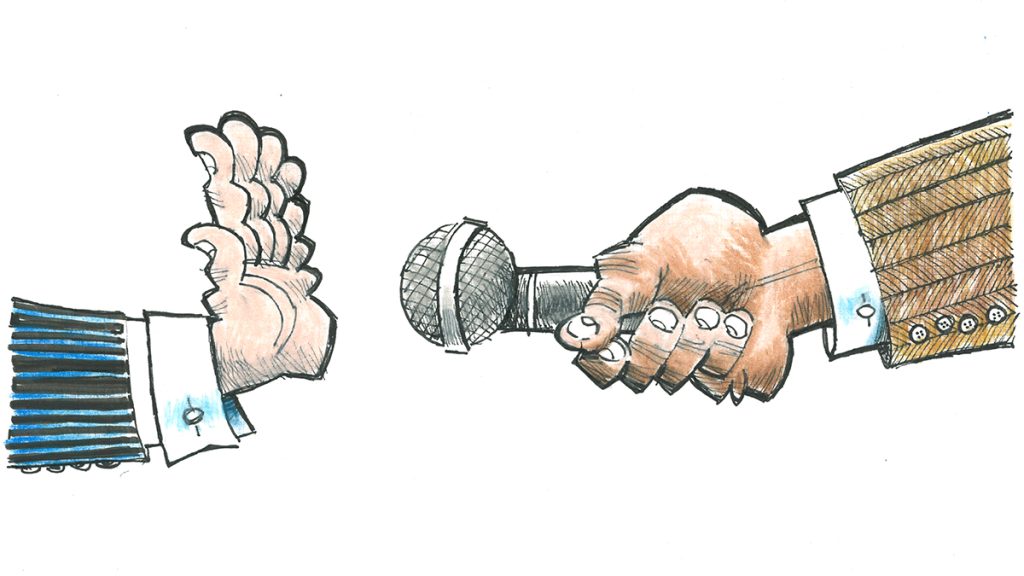
Image: John Darkow
Journalism must retire ‘no comment’ phrase, new survey from Reynolds Journalism Institute reveals

Addressing the rising tide of “no comment” could help the industry solve its dual crises of declining trust and rising hostility
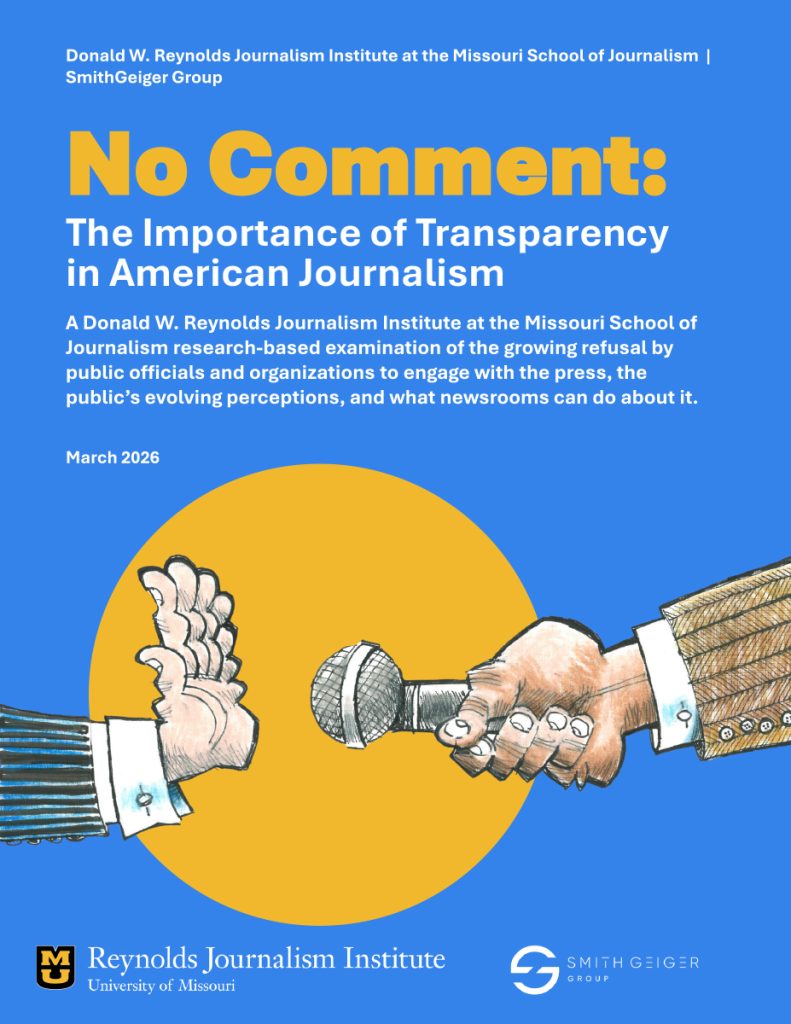
Public figures refusing to comment for news stories is now the norm — not the exception — according to the results of a new national survey.
Conducted by the Reynolds Journalism Institute in partnership with research firm SmithGeiger, the survey asked both audiences and current and former journalists about their perceptions regarding “no comment” responses from sources. It quickly became apparent to researchers that a comment refusal is not a benign reality of the industry but, in fact, a major point of convergence for the crises of trust and hostility facing journalism.
Nor is it just an occasional occurrence: According to the survey, nine in 10 current reporters have received a no-comment response in the last three years, and they agree that politicians, government officials and other public figures in particular are exhibiting increased hostility toward the press.
Among the most striking results was the immediate consequence of including the phrase “no comment” in a story: 20% of audiences said they trust such stories less than others. 39% believe the phrase indicates the source — whether it’s a person or an organization — is hiding something. This was paired with broad agreement from both news professionals and audiences that journalists should be more transparent about their efforts to contact sources.
“It’s clear that saying someone ‘had no comment’ doesn’t cut it anymore,” said Randy Picht, executive director of RJI. “We need a new approach that shows the public how hard reporters are working to collect the facts.”
The need for an alternative was supported by an experiment within the survey, which showed audiences two different versions of a television news story: one with traditional “no comment” wording and another with the phrase, “the story will be updated when we hear back.” Regardless of the order in which these videos were viewed, audiences preferred the latter option on every measure of credibility.
Funneled through a system
Major Garrett, chief Washington correspondent for CBS News, said the findings highlighted a gap in the public’s understanding of the challenges journalists face in the current climate.
“If you’re a young reporter now and you go to a crime scene, the chances that any lieutenant or sergeant is going to talk to you are almost zero,” said Garrett, who also hosts political podcast “The Takeout.” “That doesn’t mean you’re a bad reporter. It just means they won’t talk to you, and if they do, they won’t talk to you on the record. But the audience doesn’t know that.”
The vast majority of journalism professionals and 60% of audiences surveyed saw increasing hostility toward journalists as a threat to democracy, but Garrett said that while conflict between reporters and interviewees has risen alongside the no-comment phenomenon, he also sees the PR infrastructure around public figures as a significant driver of their disengagement from the journalistic process.
“Everything gets funneled through a system, a public information system,” Garrett said. “This has become routinized in government; even small city governments, county governments, state legislatures, the federal government. Fewer and fewer people are now empowered to say anything on the record, even though they might be directly involved in it. So, the no comment thing is reflective of that impulse. They want to have one story, and they want to put that story through an internal process before it goes out. As a journalist, especially a young journalist, what do you do?”
The answer seems at first glance to be rather complex. When speaking to industry figures for this announcement, we found that while news organizations are well aware of this issue, they have focused largely on examining behind-the-scenes processes — how reporters respond to sources who give them a “no comment,” for example (there is no rule that says the conversation has to end there, said Poynter’s Fernanda Camarena), or giving emailed questions another look for any potential biases that could lead to an uncooperative response.
But when journalists do point to a public-facing solution, it’s usually the same one: a transparent accounting of efforts the reporter made to obtain a comment, whether it’s a list of questions the source refused to answer or documenting the number of times the reporter reached out. This approach was also the preferred solution among audiences and journalists alike who responded to the survey.
“I think generally you’ll see that in spots, not in every article, and then hopefully more and more,” said Mike Abrams, deputy editor for trust at The New York Times. “We do want, over time, our staff to say more of what they’ve done in the reporting beyond ‘this person could not be reached for comment,’ just so we don’t assume that readers know why we were reaching out for comment.”
Camarena, who co-authored a 2024 report examining how journalists can address source disengagement, echoed that sentiment but added that reporters can add another layer of transparency by explaining “how the lack of access (to a source) affects the community,” or, put more directly, “Here is what the public still does not know because this office declined to answer.”
“That kind of transparency would be much more useful than a flat ‘could not be reached for comment,’” she said. “Otherwise, we do a disservice to the audience and give the sources who shut us down a free pass. It’s not only about stating facts as they happen but providing enough information on all aspects of our reporting.”
For Abrams and The Times, holding sources to account also extends to an increasing willingness to publicly respond to attacks on its reporting, matching the growing tendency of hostile sources to go directly to the public rather than provide a comment for a story.
“We will see people try to ‘front run’ our reporting, where we have put the questions to them and they don’t answer us, but they go public with, ‘Here’s what The Times is going to say, and here’s why it’s all wrong,’” Abrams said. “They take part or all of the questions you’ve sent out of context and put them out there. So if our journalism or journalists are being attacked and someone is saying it’s inaccurate or it’s wrong or it’s unfair, then if we have looked at our report and we feel good about it, we’re going to defend it publicly more. I think that’s one thing you can do.”
Learn more
To dig deeper and explore other findings from the survey, read the full white paper here. The report grapples with additional insights, including the fact that while audiences and news professionals agreed on many points in the survey, they diverged when it came to the question of whether hostility between sources and journalists goes both ways. 47% of the public agreed that the journalism is increasingly hostile to public figures, compared to only 18% of news professionals who felt the same.
As researchers continue to mine the data in pursuit of a path forward for the industry, reach out to Randy Picht to connect with or even partner with RJI to build on this work.
Cite this article
Fitzgerald, Austin (2026, May 12). Journalism must retire ‘no comment’ phrase, new survey from Reynolds Journalism Institute reveals. Reynolds Journalism Institute. Retrieved from: https://rjionline.org/news/journalism-must-retire-no-comment-phrase-new-survey-from-reynolds-journalism-institute-reveals/