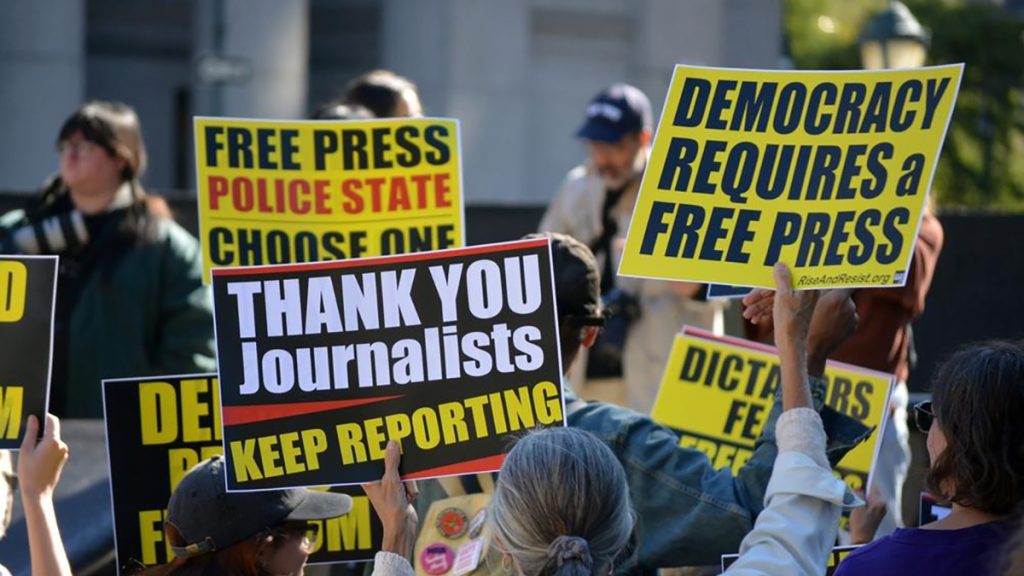
Photo: Christopher Penler | Shutterstock
Emergency grants to assist journalists in crisis

Lifelines for writers affected by layoffs, illness or war
Journalists are facing challenges on all fronts but the good news is that there are more resources available to help.
Philanthropic contributions to news operations are growing to bolster operations, but there’s also assistance to journalists whose work has been halted by industry layoffs, restrictions on press freedoms and cuts related to government cutbacks.
Organizations such as Reporters Without Borders Germany (RWB-G) and the taz Panter Foundation, for example, provide refuge for those who need to leave their countries due to persecution or oppression. Both the taz Panter Foundation and RWB-G, for example, have hosted journalists facing challenging work circumstances to Berlin for a six-month stay. Resident journalists can take a breather from their daily responsibilities, recover from stressful working conditions, and broaden their personal and professional horizons. Media Freedom Rapid Response provides residencies in Germany, with temporary shelter for journalists facing harassment and intimidation in Leipzig, and in Kosovo.
At the end of this month I’m launching Grants for Journalists, which includes a website and LinkedIn page to help journalists find funding for reporting projects and operational expenses.
To meet the moment, I’ve also compiled a list below of additional grants for journalists facing financial need, mental or several physical illnesses, or a need to relocate to a new country. It’s no secret that newsrooms need funding but journalists themselves are also facing challenges and could use assistance, too. Most of the funding sources were started by organizations that already have journalists or other writers as members.
For more info on the grants, join Grants for Journalists LinkedIn page
The COVID-19 pandemic brought a bevy of grants for journalists, particularly for mental health. At the height of the pandemic, New York independent journalist Sonia Weiser responded to widespread protests for racial justice in the United States. In May 2020, Weiser launched the Black Journalists Therapy Relief Fund (BJTRF) to provide assistance for Black journalists facing financial hardship to pay for mental health support. In June, the BJTRF teamed up with the International Women’s Media Foundation to expand the Fund’s reach and continue supporting Black journalists.
Weiser later founded the AAPI Journalists Mental Health Fund following the shootings of Asian American spa workers in Atlanta in 2021. The Fund, now run by the Asian American Journalists Association, provides direct micro-grants to AAPI journalists who want professional therapy. Donate to the fund here.
Now, journalists are calling on others to help in Minnesota with donations to purchase protective equipment. If you want to support, the nationwide Crisis Ready Media’s Protect the Press Fund provides body armor, trauma kits and safety training to independent journalists. For female journalists, the IWMF Emergency Fund provides rapid grants for PPE and other equipment.
It’s important to note there’s an intense demand for emergency assistance, particularly in this landscape. That means that once an application for funding is completed, responses can take a while. If you apply, resist the urge to call or write about the status. The Carnegie Fund for Authors advises applicants, “Do not contact us. That does not speed us up; it slows us down. We realize that it can be difficult to be patient, but please do so.”
Please note: I am not affiliated with, nor do I endorse, any of these organizations or their funders.

American Society of Journalists and Authors’ Writers Emergency Assistance Fund (WEAF)
WEAF offers grants to professional independent writers who, because of illness, disability, natural disaster or professional crisis, are unable to work. It cannot assist those experiencing financial difficulties because of economic downturns in publishing. WEAF has awarded more than 160 grants worth about $400,000.
For more than a century, IIE has helped people in crisis. That includes unspecified fellowship grants for threatened artists from any country or field. It places endangered artists at host institutions in safe countries for a year where they can continue their work and plan for their futures. Eligible applicants are facing or have recently fled from immediate, severe, and targeted threats to their lives and/or careers in their home countries or countries of residence.
Since 1917,The Authors League Fund has helped writers who have financial need because of medical emergencies, temporary loss of income or other misfortune. The fund assists authors, journalists and critics. The no-strings-attached “loans” have helped those facing health issues, eviction, utility shutoff or medical emergencies. Repayment isn’t required.
Broadcasters’ Foundation of America
The Broadcasters Foundation of America provides one-time emergency and disaster grants to radio and television journalists who have acute financial need and lack insurance to cover their losses after a natural disaster, such as a hurricane, wildfire, extreme flooding, house fire, or other serious misfortune. The group also gives monthly grants to broadcasters unable to work because of a severe illness or accident.
Carnegie Fund for Authors assists American authors “who have published at least one full-length work — fiction or nonfiction — that has been published by a mainstream publisher.” Applicants cannot have eligibility determined by work that they paid to have published. Documentation of need must be included with the application.
Committee to Protect Journalists
The Committee to Protect Journalists financially backs “at risk” journalists through its Gene Roberts Fund for Emergency Assistance. Financial aid may be awarded to eligible journalists who have recently faced a serious incident and whose safety is compromised. Funds may cover relocation, medical costs, mental health support, legal help and other critical needs.
Economic Hardship Reporting Project
The Economic Hardship Reporting Project provides grants to independent journalists working on stories related to income disparity, workers’ rights and poverty. The nonpartisan nonprofit wants to commission pieces from journalists who are themselves financially on the edge and can speak from their own experience. They are currently looking to help fund stories about housing and eviction, gig and frontline work, caregiving, parenting, unemployment and ICE raids, among other topics.
Grants range from $750 to $ 2,500. You must have a publication willing to publish your story before you apply.
Human Rights Watch Hellman/Hammett Grants
Human Rights Watch administers the Hellman/Hammett grant program for writers who have been victims of political persecution and demonstrate financial need. Hellman/Hammett grants typically range from $1,000 to $10,000. Nomination forms should be sent to Human Rights Watch’s New York Office by Feb. 15.
The International Federation of Journalists’ Safety Fund offers financial assistance in a range of emergency cases such as threats, violence and threats thereof, prosecution, settlement in exile and illness. They assist in a range of emergency cases, such as threats, violence, prosecution, settlement in exile and illness or medical crisis. There is no specified monetary limit.
The International Women’s Media Foundation (IWMF)
The IWMF has three funds, two of which are accepting applications. This organization provides rapid grants for helmets and protective gear, and trauma kits. It also helps female journalists in crisis.
PEN America’s U.S. Writers Aid Initiative
The U.S. Writers Aid Initiative, a segment of the PEN America Writers Emergency Fund, accepts grant applications from U.S. writers facing financial need after an emergency.
The funds are intended for professional American fiction and nonfiction authors, poets, playwrights, screenwriters, translators and journalists to address short-term financial emergencies.
Applications are currently closed but check back for funding opportunities here.
Reporters Without Borders offers financial and administrative aid to threatened or persecuted professional or citizen-journalists in the form of medical care after attacks, legal fees, help to find safe refuge or relocate, support for exiled journalists, replacement of equipment or resettlement aid. In 2023, the organization assisted 460 journalists in 62 countries.
Society of Professional Journalists
Members of the Society of Professional Journalists who have been laid off from their full-time jobs in the news industry or freelancers who have lost more than 30 percent of their income might be eligible to have membership fees waived for six months.
Writers’ Trust of Canada: Woodcock Fund
The Woodcock Fund is a last-resort emergency resource for Canadian writers facing an unforeseen financial crisis, including mental health burdens. Professional writers should have a publishing history and can receive grants from $2,000 to $12,000, depending upon the severity of the need or income loss.
H2
Cite this article
Williams, Monica (2026, Feb. 4). Emergency grants to assist journalists in crisis. Reynolds Journalism Institute. Retrieved from: https://rjionline.org/news/emergency-grants-to-assist-journalists-in-crisis/