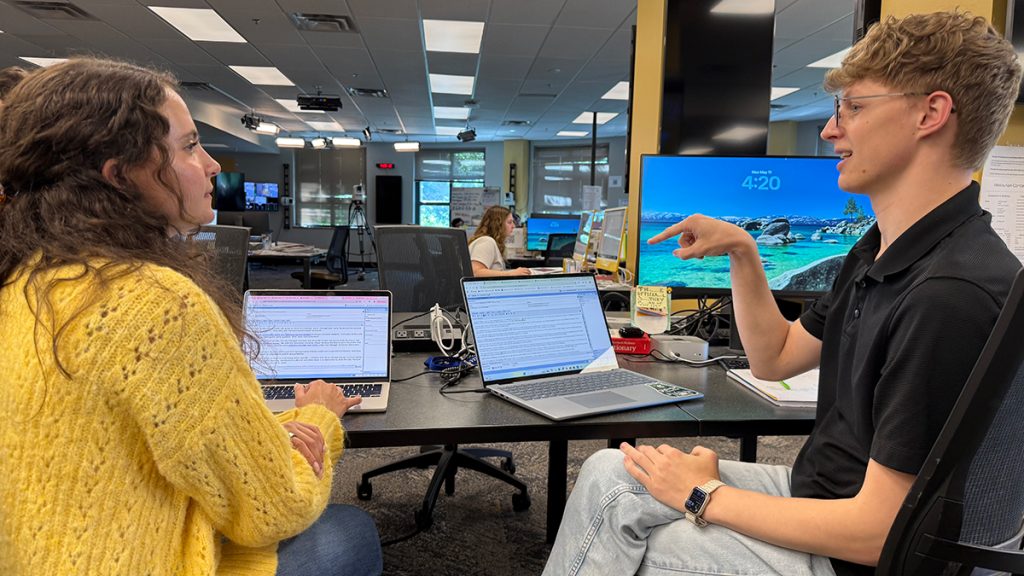
After participating in the research as assistant city editors at the Columbia Missourian, Amber Roldan, left, and Max Quinn, right, use tutoring techniques when editing each other's copy.
How editing sessions with writers can strengthen your newsroom

Research-backed tutoring techniques you might already be using
With fewer editors than before, newsrooms are left with limited resources to balance quality and speed in their work.
New research testing three tutoring techniques with eight editors offers some hope.
The experiment drew on strategies from the world of writing tutoring rather than traditional editing. In tutoring, it’s the tutor’s job not to be an editor but a teacher, coach and guiding light when words on a screen get fuzzy.
The editors working with student reporters were asked to open an editing session with a question, model and narrate their edits as they worked through a story, and use hand gestures to explain the changes they were making.
The experiment showed that these techniques helped lessons stick, preventing bad copy from hitting editors’ desks and prompting writers to self-edit. Early results also pointed to gains in the quality of the writing itself, in reporters’ understanding of what makes a story work, and in communication between writers and editors.
Now scarce, writing coaches used to be employed to nurture reporters’ writing ability by training them in the craft of writing through tidbits and tricks (many editors still remember these from their own days as young reporters), workshops and step-by-step dissection of what makes a story great and how to get it there.
While the role is less common today, the need for writing coaches has not gone away. Here’s how you can become your newsroom’s own writing coach.
Step 1: Sit next to the reporter
This is where the editing session begins. Once their copy hits your desk, sit beside your writer – not across from them – so you can look at their story together. This serves to physically put you both on the same team, and it makes it easier to follow along as you discuss edits.
Step 2: Ask a question
Opening an editing session with a question can offer several different opportunities for growth. Asking, “So, how did it go?” can be a social opener, letting you and your writer converse about any aspect of the pre-reporting, reporting and writing processes if that’s what’s appropriate for a slow news day.
Asking, “What went well with this story, and what didn’t?” can allow for discussion of the reporting and writing processes and provide guidance where your writer sees they need it.
For level three coaching on specifically writing (not reporting) coaching, ask, “Which aspects of your writing were strongest, and what did you struggle with as you were revising?” That last word hints at the fact that the writer ought to be self-reflecting, and eventually self-editing, to improve their work on their own. “Aspects of writing” focuses the conversation to discuss the anatomy of a story — structure, sentence length, quotes, the loathed endings and troublesome ledes — all the juicy things that editors don’t always have time to dig into. But with one question, you can.
Step 3: Narrate your edits
Modeling your editing process lets writers see not only what changes you’re making to a story, but what exactly you do to make it better.
While you’re going about your typical editing, tell your writer what you’re doing and why.
Did you shorten a phrase for concision, clarity, readability or all three? Did you omit jargon or opt to add an explanation to a specific term? What about the rest of the graf or section made you do so?
Walking through the changes you’re making can make the unconscious conscious, the mysterious clear, and a stronger story that much more within reach. Giving your writers tools to edit will help them self-edit in the future — saving you time and energy.
Step 4: Explain it another way
Numerous tutoring techniques are at your disposal here. The goal is to make sure what you want your writer to understand about their story is, in fact, what they’re understanding.
You can:
- Use an analogy or simile. Is there a different way you can explain your edit? Instead of, “use simpler language,” perhaps you could say, “Write this like you’re explaining it to your grandmother, and assume your grandmother is a little dumb.”
- Gesture. This is where you consciously use your hands to represent abstract editing notes in a physical, visual way and explain them in more than just your words. This could mean separating your hands to show that the writing needs more emphasis on the difference between two ideas. Or, you could indicate with your fingers how much more explanation is needed to strengthen a sentence or section: make a small gap between your forefinger and thumb to show that a brief addition is needed for smoothness, or list with your fingers the big chunks of information your reporter should add.
- Discuss a reverse outline. A reverse outline can be used to discuss structure, especially for lengthy, meaty stories you want to make sure are organized perfectly. With this technique, go through the story and say aloud the main idea of each graf or section. This checks that what the writer wanted to come across as the point of each graf or section was, in fact, what you as a reader took it to be. Reverse outlines help keep a story clearly structured, on pace and compelling to readers.
Step 5: Recap
Check for understanding. Does the writer understand why changes were made? More importantly, perhaps, do they understand how to avoid these mistakes in the future? I once had an editor ask what I do to make sure I spell a source’s name correctly. Ask me how many sources’ names I’ve spelled wrong in the two years since.
Zoe Naylor graduated in May with a master’s degree from the Missouri School of Journalism. This research was part of her thesis. She now works as a reporter at the Houston Herald in Houston, Missouri.
Cite this article
Naylor, Zoe (2026, July 22). How editing sessions with writers can strengthen your newsroom. Reynolds Journalism Institute. Retrieved from: https://rjionline.org/news/how-editing-sessions-with-writers-can-strengthen-your-newsroom/