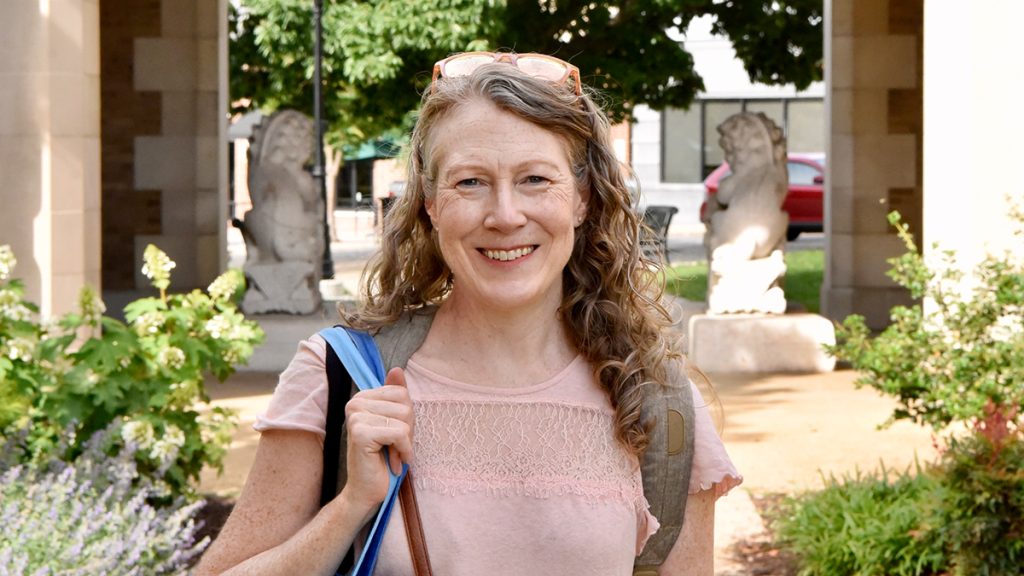
Rebecca Ritzel | Photo: Nate Brown
Launching the Arts Journalism Initiative

Faced with a declining landscape for traditional arts coverage, shrinking newsroom budgets and an explosive rise in digital influencers filling the vacuum, 2025-2026 Residential RJI Fellow Rebecca Ritzel set out to look for solutions that preserve the quality and integrity of arts and culture journalism.
Ritzel, a freelance arts and entertainment reporter and longtime contributor to The Washington Post, launched the Arts Journalism Initiative with two goals: to map out fresh philanthropic funding models and resources that can support independent arts reporting, and to develop a pilot program demonstrating how journalists can cover arts festivals while honoring editorial independence. It was the latter goal that forced her to confront the press junket, an arrangement that often offers journalists subsidized travel and special access at events like arts and music festivals.
On the surface, junkets look like mutually beneficial arrangements. But for journalists working for media outlets with strict ethical codes, accepting benefits in return for coverage is a no-go.
“It creates this stratified environment where sometimes ‘lower-tier’ journalists or trade publication journalists can accept these trips, and people who are connected to larger mainstream outlets cannot,” Ritzel said.
Ultimately, she came up with an idea that served all the goals of her fellowship: Critics in Columbia, a successful pilot program launched during a celebrated documentary film festival in Columbia, Missouri — True/False Film Fest — that offers an innovative roadmap for the industry.
Dismantling the junket: The Critics in Columbia model
For Critics in Columbia, five professional guest critics were selected from a competitive pool of 22 applicants to receive travel expenses and an educational stipend in return for working with student journalists covering the festival. Crucially, the funding was provided through a neutral intermediary — in this case, the Reynolds Journalism Institute — meaning the critics were under no obligation to review the festival’s films, interview specific filmmakers or otherwise provide positive coverage of the festival.
By framing the residency around education and community engagement rather than raw publicity, the program bypassed the ethical hurdles that tend to disqualify both staff writers and independent journalists writing for major news organizations.
The visiting critics spent much of their residencies directly engaged with students, including one-on-one time with students editing film and concert reviews and offering high school students some hands-on guidance through a free workshop.
Ritzel intentionally kept the critics’ schedules flexible for the weekend, allowing for unscripted drop-in visits to The Maneater, Mizzou’s student newspaper. She said the informal interactions proved to be some of the most profound of the entire fellowship.
During one of those drop-ins, guest critic Sam Adams of Slate brought along Alissa Wilkinson, a staff writer for The New York Times who was in town independently covering the festival. They “went around the table,” Ritzel said, offering practical guidance that left indelible marks on the students and their pieces.
![Ritzel moderates a panel discussion in RJI's Smith Forum with guest critics [from left] Jada Yuan, Pelin Çilgin, Marina Fang, Monica Castillo and Sam Adams. Photo: Matthew MacVey](https://rjionline.org/wp-content/uploads/sites/2/2026/06/ritzelr26060503-1024x768.jpg)
At one point, Adams sat down with a Maneater reporter working on a review of “How to Clean a House in 10 Easy Steps,” a film exploring the realities facing a Colombian immigrant and her family. He read through the draft and identified a compelling line hidden deep in the copy.
“He told the student that her lead was actually the second to last paragraph,” Ritzel said. “There was a really good line and he said, ‘That’s your lead. Move that line up to the top.’ It’s a good review anyway, but it’s a great review because it now has a really good lead and that student now has a really solid clip that she might not have had if it weren’t for Critics in Columbia.”
By the end of the festival, The Maneater published more than 70 distinct multi-platform stories, including deeply reported reviews and photo essays. And the benefits went beyond the stories themselves — the guest critics also met directly with students from the School of Journalism’s Vox Magazine, visited journalism classes and partnered with KBIA-FM, the school’s NPR-member radio station, to record an audio conversation. Separately, they also took part in a panel moderated by Katelynn McIlwain, KBIA’s managing editor, and attended by students and alumni.
“It was very illuminating for students to see how these accomplished critics have carved out careers,” McIlwain said. “All of them had different paths to get to where they are, and the students were able to learn that it’s okay to have an unconventional path to get to your dream job — that it’s okay if, in the middle of that path, you’re unsure about where you’re going. And some of the students were writing their own reviews for student publications, so it helped to turn around and apply advice to their own work right away.”
The community engagement also stretched further than the campus orbit. Ritzel said True/False Film Fest’s organizers and visiting directors were thrilled with the depth and sophistication of the student output. Furthermore, the program left national critics with an appreciation for the School of Journalism’s “Missouri Method” of hands-on journalism education.
“They had never had any connection to our J-School, and now they know how our J-School works,” Ritzel remarked. “They understand the Missouri Method. And I think that was really sort of an unintended but very good consequence that now we have these five people who are out in the field who now are going to, if they get a pitch or if they see a job application from a University of Missouri student, they’re going to have a positive association.”
Rethinking the broader arts ecosystem
While Critics in Columbia showcased the validity of localized residencies, the broader scope of Ritzel’s fellowship focused on structural, long-term survival strategies for cultural journalism. Throughout the year, she tracked emerging operational models across the country, highlighting creative funding partnerships that could save local culture reporting from extinction.
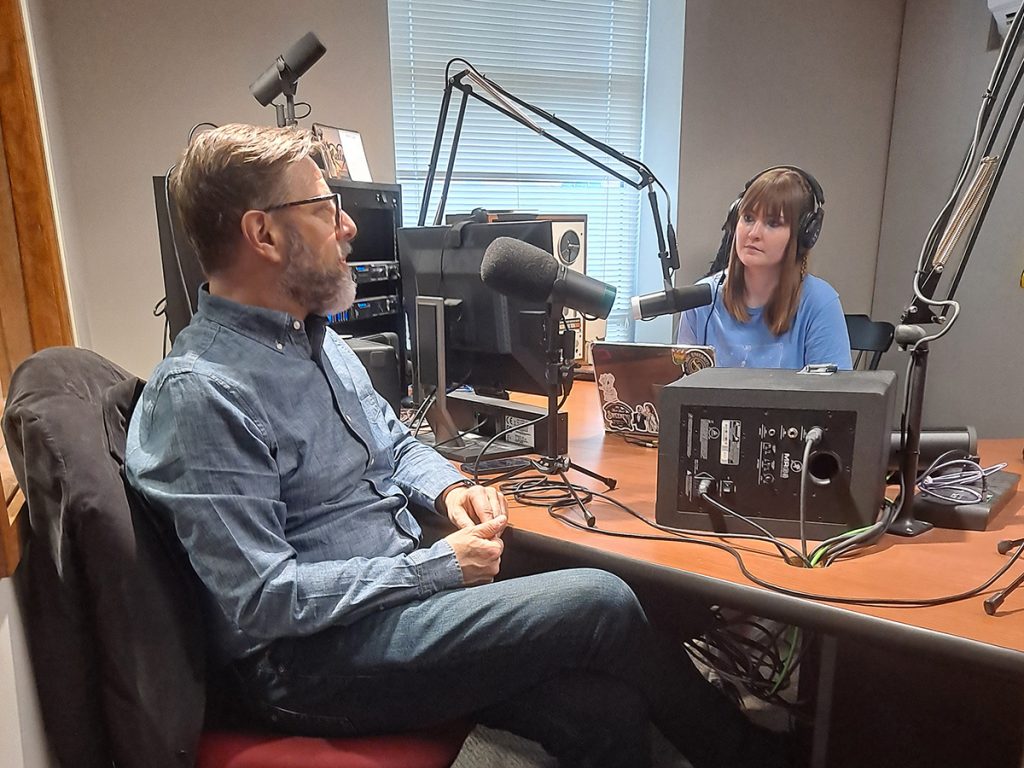
One path involves cultivating deep relationships with non-traditional arts philanthropies. Ritzel highlighted a recent landmark initiative by the Allen Whitehill Clowes Charitable Foundation in Indianapolis, which stepped out of traditional arts endowment bounds to issue its first-ever journalism grants to nonprofit news site Mirror Indy. The grant directly funds the salaries of the newsroom’s arts editor and art director, establishing a model for localized philanthropic backing.
Another model involves structural content-sharing agreements between legacy media and digital-native, hyper-local arts sites. Ritzel pointed to a collaborative agreement between ARTS ATL and The Atlanta Journal-Constitution as a prime example of a legacy newspaper leveraging the specialized expertise of a dedicated arts and culture news site to preserve coverage standards amid newsroom staff cuts.
For Ritzel, rebuilding these institutional frameworks is vital for journalistic accountability, as without independent, trained arts reporters, coverage can collapse into uncritical community boosterism or PR-driven fluff.
Open-source resources
To ensure the results of her fellowship translate into real progress for arts journalism in communities all over the country, Ritzel has launched an open-source hub at artsjournalism.org. The digital repository acts as a blueprint for journalists, newsrooms, and festival directors looking to build their own independent networks.
Available resources on the site include:
- How to cover festivals – A guide to replicating the Critics in Columbia project, allowing other communities to build ethical and collaborative critic residencies
- State-by-State Philanthropic Directory – A detailed, searchable guide listing arts foundations, philanthropic organizations and other sources of funding for arts journalism
- Ethical Frameworks & Q&As – Practical guides and templates designed to help nonprofit newsrooms and emerging digital culture sites maintain editorial independence and ethical standards while pursuing new funding streams
With her time at the Reynolds Journalism Institute at a close, Ritzel already sees potential opportunities for her or other arts journalism advocates to replicate her model on a larger scale. With the Sundance Film Festival planning a historic move to Boulder, Colorado, for example, she’s pursuing a new critics’ residency in partnership with Colorado Public Radio. Ritzel estimates that a basic festival residency requires roughly $10,000 to cover travel and stipends — what she considers a modest sum for community foundations or university systems compared to the many returns she believes the model generates.
And as McIlwain added, those returns aren’t limited to benefits for professional critics and community organizations when higher education is involved.
“A goal of journalism school is to prepare students to tell a compelling story in any medium,” McIlwain said. “My hope is that those skills are so transferrable that they not only know how to write a good story, but they can recognize a good story when they see one in a film. I truly believe it all works together — if you can tell a good story, you can identify and critique a good story, and with those building blocks you’ll have success in any arena you’re thrown into.”
Alongside the resources Ritzel has collated to assist with finding and utilizing new funding sources, the Critics in Columbia blueprint offers a path forward for arts journalism that is both collaborative and ethical. Learn more and peruse the available resources.
Cite this article
Fitzgerald, Austin (2026, June 8). Launching the Arts Journalism Initiative. Reynolds Journalism Institute. Retrieved from: https://rjionline.org/news/launching-the-arts-journalism-initiative/