New research reveals who young adults choose to deliver news when AI gives them control

Popular choices? AI anchors who look like the study participants and those who look like prototypical broadcasters
Elia Powers is a professor at Towson University where he teaches, among other things, podcasting and multimedia reporting.
Ever since a Chinese news agencydebuted AI news presenters in 2018, media outlets across the world have experimented with humanlike avatars with synthetic voices. Many journalistsare skeptical that AI presenters can replace them. Entrepreneurs see a future where fully AI-produced newscasts are the norm andusers can customize anchors that deliver them news. Companies are pinning their hopes onyoung audiences who don’t connect with traditional newscasts and culturally diverse audiences who feel underrepresented on the news.
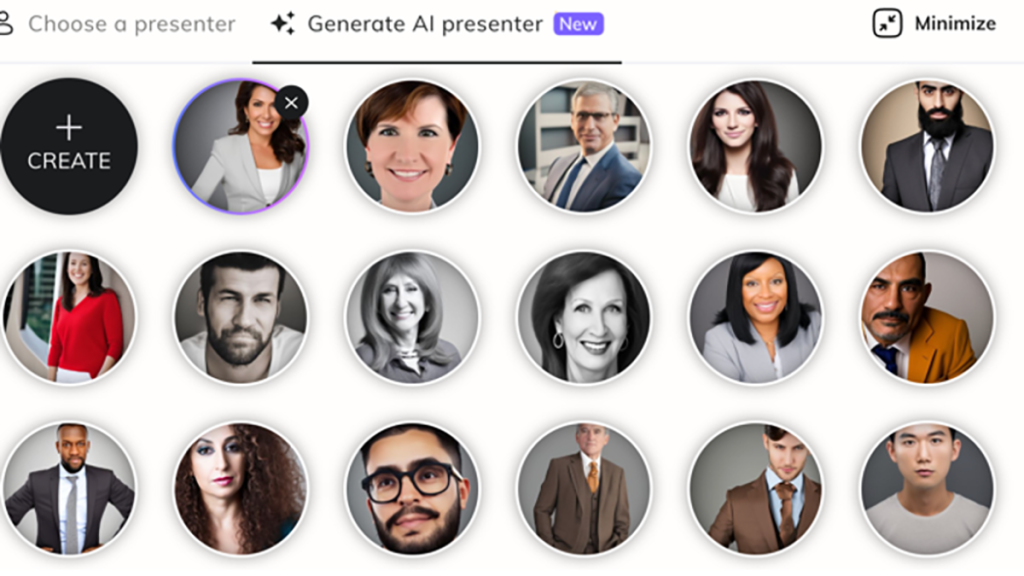
Researchers are increasingly studying audience perceptions of AI presenters. I wanted to know how young adults would go about creating a customized presenter, and what mental shortcuts, or heuristics, they would use to evaluate appearance and voice. So, I recruited a diverse sample of 46 undergraduates at my university (57% female, 39% male, 4% nonbinary; 59% students of color) to use an AI-generated video platform that creates talking avatars from still images.
Before the study began, few participants had ever seen an AI presenter. Within 20 minutes of using the platform, they had created one on their own .
Seated next to me or a graduate student moderator, participants in one-on-one sessions verbalized their thoughts and actions as they typed descriptions of their ideal presenter into a textbox and listened to pre-programmed voices reading a short news script. Most started by finding an avatar they liked because they felt it was easier to match a voice to a face than to do the reverse. Participants shared such insights with moderators in interviews at the end of the research sessions.
Results of this study, published in the Journal of Broadcasting & Electronic Media, have implications for news organizations and AI companies. Here’s what I learned about who young adults choose to deliver them news when AI gives them control.
A preference for familiar faces and voices
Many participants created presenters who resembled a real person. Some who grew up getting news from older relatives created AI versions of them because they seemed relatable and trustworthy. Others based their presenters on actors (e.g., Bruce Lee, Will Smith) whom they found entertaining or fictional characters (e.g., Wonder Woman) that inspired them.
Participants were also inspired by familiar media figures: YouTubers Stephanie Soo (known for her true crime podcast) and Andrew Rea (known for his food channel), local television journalists (a weatherman, a field reporter), and national nightly news anchors from the recent (Lester Holt) and distant (Walter Cronkite) past.
More participants regularly watched podcasts than television news, yet they generally associated podcasters with opinionated content and preferred (for this task, at least) that their avatars resemble “unbiased,” “experienced” journalists.
Many participants preferred familiar-sounding voices. A female who created an AI version of her mom selected a “soothing” voice that sounded like hers. The male who created a Bruce Lee lookalike selected a voice that sounded like his favorite video game narrator. Others selected voices that reminded them of newscasters. A male who chose a male presenter with a deep voice commented, “When I’d watch news as a kid, (journalists’) voices would be lower, which I liked.”
Those who envisioned their presenter as a podcaster who read “soft” news were open to high-pitched voices, uptalk, and vocal fry – attributes that are often associated with YouTubers or TikTokers. Yet some found such voices and speaking styles “not mature enough for news.”
Research shows that we often favor known commodities over less-recognized alternatives.
One explanation for participants’ reliance on the familiarity heuristic: Starting with a specific person in mind is easier than starting from scratch. Results also reflect the broader trend of young news consumers relying on friends, family, and prominent individuals with public platforms to stay informed.
Recreating the prototypical broadcast journalist
Many participants relied on the representativeness heuristic: judging someone (or something) by how well they match a prototype or stereotype that exists in our minds. Those who wanted to create a presenter who matched their conception of a prototypical broadcast journalist used generic prompts such as “news anchor behind a desk” and “middle-aged white guy dressed in a suit.”
Their sense of what a journalist looks like came mostly from exposure at their parents’ house, on social media or in film/television programs. A female participant typed “tall white male” because “that’s who I’ve seen on the news. That’s what I’m used to, and I guess that’s who I like.” A male participant selected a slickly dressed, well-groomed presenter who he felt looked most like “a news anchor guy;” a female selected a slender woman with “silky” hair, explaining, “usually on TV I see conventionally attractive people.”
Participants judged voices by how well they matched their conception of the prototypical news anchor voice. Those who imagined their presenter doing “hard news” like a television journalist generally selected deeper voices and flatter deliveries, with one saying, “I expect TV news presenters to be serious and feel disconnected from what they’re saying.” Yet others didn’t want their presenter to have a traditional television anchor voice, which they described as “too artificial” and “forced,” or an NPR voice, which they found too “monotone.”
The television news workforce is majority white and male but has generally become more diverse over time. That diversity was not reflected in many participants’ selections. Those who based their presenter on their conception of the prototypical newscaster often picked someone who is middle aged, straight haired, formally dressed, and more often than not a white male. The dapper, seasoned male anchor has been a mainstay in news and pop culture. Some participants who were familiar with this archetype viewed it as the standard.
“Someone who looks like me”
Participants weren’t focused on finding a voice that sounded like theirs, but many wanted a presenter who looked like them. “It’s easier to accept things from people who more or less look like you and relate to you,” a female participant said. “When someone who looks like me tells me something, I’ll take it more seriously,” another commented.
Most participants who specified gender chose a presenter who matched their gender identity, and most who mentioned race/ethnicity specified a preference for a same-race or same-ethnicity presenter. A Hispanic male who selected a Hispanic male presenter said, “Hearing the news from someone who is of the same background, I’d trust them more.” A Black/Hispanic female who typed “racially ambiguous, curly-haired woman” said “I’m basically describing myself.” Several other Black female participants selected Black female presenters with natural hair, which until recently was rare on television news.
Research on avatar selection has established the importance of self-resemblance. In this study, participants from historically marginalized groups found same-gender and same race/ethnicity presenters relatable and trustworthy. Participants were drawn to presenters not only because they resembled them but because they represented change (particularly with respect to natural hair).
News stations have been slow to embrace journalists who challenge traditional on-air presentation norms. This study shows that doing so might help them make inroads with young, diverse audiences who want to feel represented but more often have felt disconnected from news.
The more human-like, the better
Participants expressed a clear preference for AI renderings that “looked more like an actual person” than “something that’s fake looking.” Several commented on the “weirdness” of AI renderings of fingers and eyes. A female found it off-putting that only her presenter’s mouth moved rather than their entire face. “If someone looks more natural,” she said, “I trust them more.”
Participants selected AI-generated voices that sounded the most humanlike. They disliked “robotic” AI voices. Several said voices that “sounded natural” and “had some emotion” gave their presenter authenticity.
Some participants were skeptical that AI presenters would ever be humanlike enough to satisfy them (though technology has improved markedly in the time since data collection wrapped). Fixing what participants called the “weirdness of AI” should be a priority for companies promoting their lifelike AI characters.
Final takeaway
While few participants seemed fully satisfied with the product, many enjoyed the process of creating an AI presenter.
Comments such as “I like creating my own original character” and “I like that you can make whatever you want” suggest an embrace of customization. News stations have historically given audiences few options for who delivers them news. Customizable AI presenters — while not a replacement for human journalists — may be an attractive offering.
Cite this article
Powers, Elia (2026, June 2). New research reveals who young adults choose to deliver news when AI gives them control. Reynolds Journalism Institute. Retrieved from: https://rjionline.org/news/new-research-reveals-who-young-adults-choose-to-deliver-news-when-ai-gives-them-control/