Image: Theo Grace Quest
Put the stories of people with intellectual disabilities on stage
Using public storytelling to connect with the IDD community
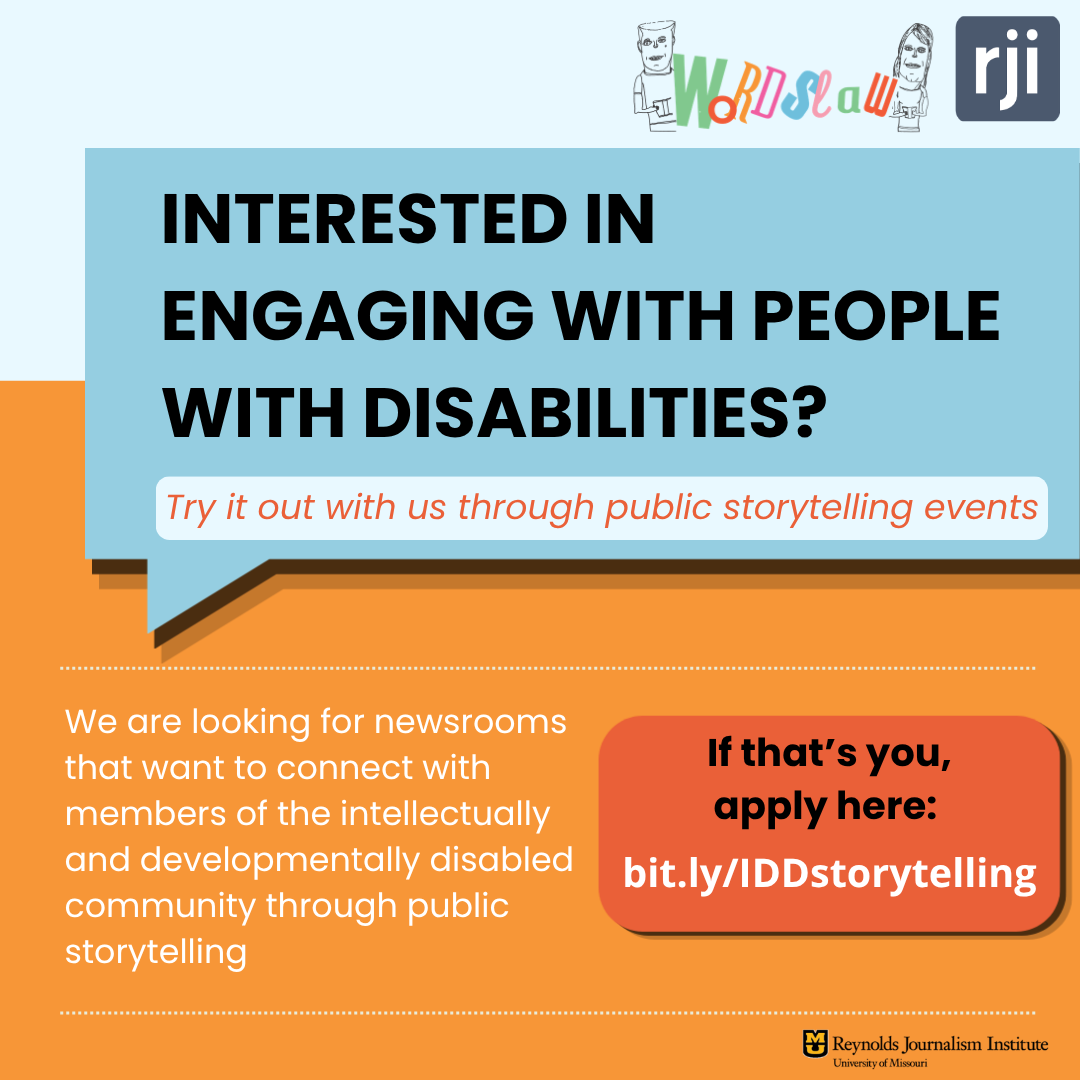
RJI and WORDSLAW are partnering to help newsrooms try a different method of connecting with their under-covered communities — public storytelling.
Public storytelling events allow newsrooms to work with people with intellectual and developmental disabilities (often called IDD), form a relationship, and encourage them to share their stories in their own words. It will provide newsrooms a structure on how to communicate with folks in this population, and give them an understanding of what they care about.
We have developed a program that can be replicated by newsrooms for their local communities. Our focus is on people with IDD, but you can certainly apply the principles and methods to other vulnerable populations that we don’t hear from often enough.
If your newsroom is accepted, we will provide support, coaching and will walk you through the steps of putting together a WORDSLAW event — from how to identify storytellers to how to find a venue, and, of course, plenty of direction on how to lead a storytelling workshop for people with IDD.
If you are interested in trying this method out, please fill out this application.
Why this work is needed
Too often, as journalists, we shy away from the person at the center of the story — particularly when we are covering vulnerable communities. As journalists we pore over records, and interview the people around the person with IDD — family members, paid caregivers, medical professionals, educators, bureaucrats, elected officials. But some journalists never even think to ask the person at the center of the story, the person with IDD, to speak for themselves.
Now, there are some pretty good reasons for that. Sometimes it’s impossible to even reach the person with IDD because they live in a group home or medical setting and the staff (or, sometimes, the law) won’t allow any access. Even if you do get access, sometimes people with IDD have guardians who must give permission for the individual to speak. We assume that people with IDD often can’t communicate in a way that we can comfortably understand. We don’t want to say or do the wrong thing.
And therefore it stays that way.
That’s why I’m so excited to be partnering with the Reynolds Journalism Institute on a project designed to put the stories of people with intellectual and developmental disabilities front and center in communities across the country and help newsrooms engage with and learn more about those communities.
Wordslaw and RJI will work with newsrooms through the process of hosting a public storytelling event step-by-step. We will be by your side through aligning goals, working with people with IDD and finding the right partners in your local communities.
How we got here
It seems like such a simple concept — but it took years to get here.
In 2020, I partnered with the Arizona Daily Star in Tucson on a year-long project in conjunction with ProPublica’s Local Reporting Network. The idea was to travel across Arizona and talk to people with IDD about their lives – and, specifically, about the Medicaid-funded Home and Community Based Services they received (or didn’t receive) in the state long considered to have the best such program in the country.
By mid-March the pandemic was official, and I was scrambling for other ways of reporting these stories. For many years I’d been running a storytelling show in Phoenix, where local writers and community members wrote and performed essays about their lives, based on a theme like PROMISE or DREAM. In January 2020, I’d held my first show featuring teens. My daughter Sophie, who has Down syndrome, asked to participate. I agreed, not knowing how it would go.
Sophie wrote a poem called “The Law of Words,” which reads in part:
What is going on with the laws of words
The words are kind to the people with disabilities
The people the words
Words speak to yourself
And what they say
The words can be bad
What is the law of words
The words like the r word
The musical that my highschool did was Hairspray
I went to the directors and say words can be bad take one out
Sophie told the story of how her high school theater teacher refused to take the word retarded out of the script for a show she had fought to be allowed to perform in.
And so in considering how to connect virtually to people with IDD in meaningful ways, I started thinking about storytelling. The audience engagement team at ProPublica was game, and we enlisted the help of a Disability Studies professor I’d worked with in the past. She helped create a storytelling event featuring Arizonans with IDD. Some never mentioned “services” at all – but what they did talk about was more enlightening. And hearing the stories allowed our audience to better understand what we were trying to get at with our reporting. We heard from other Arizonans who wanted to talk about their own experiences.
The following year I did a month-long visiting fellowship with the Nieman Foundation and focused on storytelling with the IDD population. I named WORDSLAW after Sophie’s poem and created a storytelling curriculum that we later used to put on events with the Center for Public Integrity and KJZZ 91.5, the public radio station where I now work.
And now, I’m thrilled to be bringing the work and community connection I’ve built here into your newsrooms and communities across the country.
Plain-language version
My name is Amy Silverman. I am a journalist.
I run a program called WORDSLAW. WORDSLAW does public storytelling events by people with intellectual and developmental disabilities (IDD). Public storytelling means events where people tell true stories about their lives to an audience.
WORDSLAW is working with the Reynolds Journalism Institute to teach newsrooms about public storytelling.
We want to teach newsrooms how to make storytelling events with people with IDD. These events can help newsrooms to:
- Make relationships with people with IDD.
- Hear from people with IDD in their own words.
- Communicate better with people with IDD.
- Understand what people with IDD care about.
Newsrooms can use storytelling to reach other groups too.
Your newsroom can apply to learn how to do storytelling with us. We will:
- Coach and support you
- Teach you the steps to put together a WORDSLAW event. These include:
- Finding storytellers
- Finding a venue
- Leading a storytelling workshop
Why do we need public storytelling?
Journalists don’t always focus on people. We avoid talking to or about people who are vulnerable, like people with IDD. We focus on:
- Paperwork and records.
- Experts like family members, teachers, and doctors.
- Elected officials.
Some journalists do not think to ask people with IDD to speak for themselves.
There are a lot of reasons we don’t hear from people with IDD in news. We may not be allowed to talk to the person. They may live somewhere like a group home or hospital that makes it hard to reach them. They may have a guardian who says they cannot speak to us. We may assume they cannot speak or communicate. We may worry we’ll say or do the wrong thing.
These problems mean that people with IDD do not get included in newsthese stories.
Storytelling can help change that. That is why I am excited to work with the Reynolds Journalism Institute. This project will help newsrooms learn more about people with IDD.
We will work with newsrooms to show you how to do storytelling. We will help you:
- Set goals.
- Work with people with IDD.
- Find partners in your community.
How we got here
Storytelling seems simple. But it took a long time for me to make this storytelling project.
I started a story in 2020 about people with IDD in Arizona. I worked with the Arizona Daily Star and ProPublica’s Local Reporting Network. I wanted to talk to people with IDD about Home and Community Based Services. I wanted to know what services they did and didn’t get. I was going to travel all over the state to talk to people.
At the same time, I was thinking about storytelling.
I run storytelling events in Phoenix. Writers and community members write and perform essays about their lives. I ran my first storytelling event for teens in January 2020. My daughter, Sophie, wanted to share a story. Sophie has Down syndrome.
Sophie told a story about her high school play. She fought to be allowed to perform in the play. The play had the word “retarded” in the script. Her high school teacher would not take the word out.
Sophie wrote a poem to perform at the storytelling event. It is called “The Law of Words.” This is part of the poem:
What is going on with the laws of words
The words are kind to the people with disabilities
The people the words
Words speak to yourself
And what they say
The words can be bad
What is the law of words
The words like the r word
The musical that my high school did was Hairspray
I went to the directors and say words can be bad take one out
The COVID-19 pandemic started in March 2020. I could not travel to meet and talk to people with IDD for my news story. I had to find other ways to hear these stories.
I decided to make an online storytelling event. I worked with the audience engagement team at ProPublica and a Disability Studies professor.
The storytellers were people with IDD from Arizona. They did not all talk about their Home and Community Based services. They talked about their lives. Their stories helped the audience understand why the news story I was writing mattered.
People with IDD in Arizona reached out to us during the event. They wanted to share their stories too.
In 2021, I worked with the Neiman Foundation. I focused on storytelling and people with IDD. I named WORDSLAW after Sophie’s poem. I made a guide for how to do storytelling events. We made events with the Center for Public Integrity and the radio station where I work, KJZZ 91.5.
I am excited to help bring storytelling to your newsrooms and communities.
Cite this article
Silverman, Amy (2026, April 13). Put the stories of people with intellectual disabilities on stage. Reynolds Journalism Institute. Retrieved from: https://rjionline.org/news/put-the-stories-of-people-with-intellectual-disabilities-on-stage/