
Katie Hawkins-Gaar continues to receive physical mail from her readers, a request that led to a wider mail-exchange project that has connected her community beyond screens.
Spreading hope and expanding community through physical mail

A conversation with Katie Hawkins-Gaar
Last fall, Katie Hawkins-Gaar, freelance writer, journalism consultant and author of the newsletter “My Sweet Dumb Brain,” felt lost. She said she always tries to be honest about how she’s feeling in her weekly newsletter, where she shares personal accounts of grief, community and moving through life. But with a doomful news cycle and an incessant desire to consume it on social media, she struggled to end her essays on a hopeful note.
So, she deleted many apps on her phone and turned to her readers.
“I reminded folks I had this P.O. box, I shared the address, and I said I don’t know exactly what this would look like, but if you have some kind of hope for me, I’d love to hear it,” she said. “I truly didn’t know how many letters I would get or what they’d look like.”
In return, she got everything from photography zines to postcards to handwritten letters.
“All of a sudden I feel better about the state of the world and better about people. I wanted to give that same kind of generosity and hope to other people,” she said.
In this conversation with the Innovation in Focus team, Hawkins-Gaar shared some early takeaways from the mail-exchange experiment she created for her readers, prompting them to send physical mail to another reader.

Goodykoontz: How did you start the mail exchange?
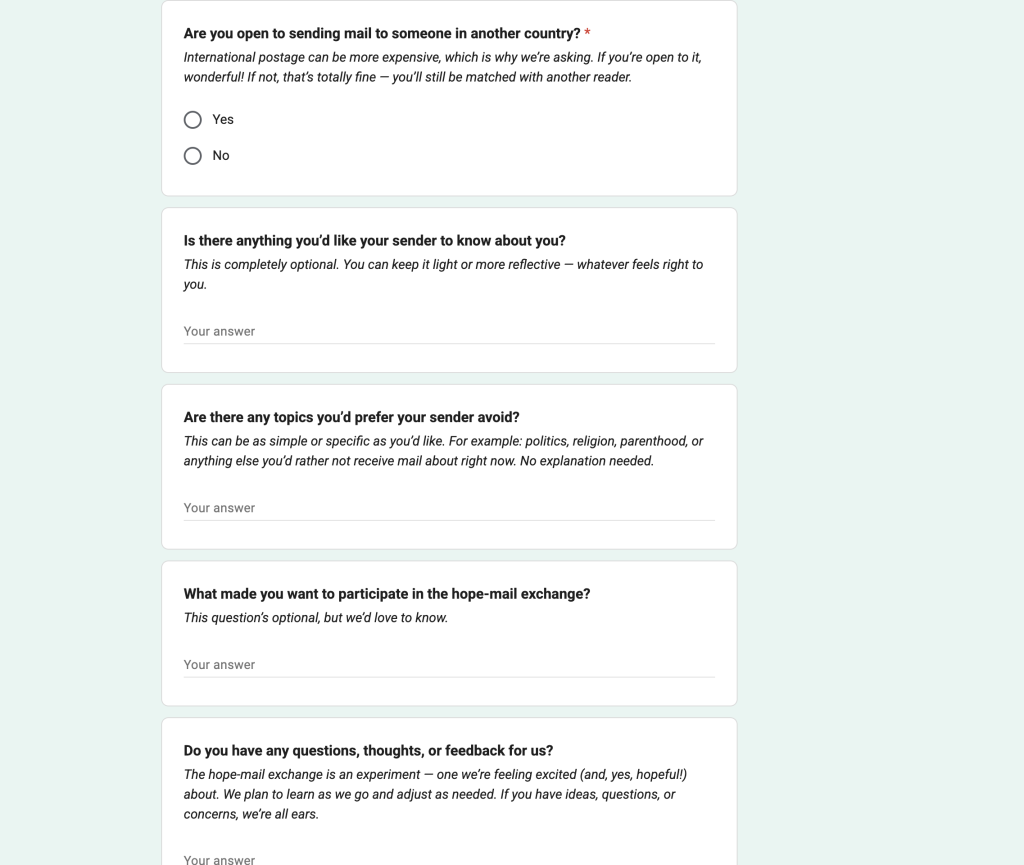
Hawkins-Gaar: I first created a Google Form and invited people to fill it out. I had a few different questions — name and address, all that good stuff. Then I asked some questions like if they were open to international mail, if there’s anything people would like the sender to know about them, if there’s any topics you’d prefer that they avoid, and then I just asked, “what made people want to participate in the project?”
There were 66 people in total who filled out the form. I used ChatGPT for help here [with matching], because there were so many. I did have to tweak a few on the list, but for the most part it helped me with the initial matching.
From there, I sent emails connecting the two people, blind copying them because I didn’t want them sending emails. I just wanted this to be letters. It’s been a little over a month, and I’ve heard from several readers that they’ve sent their letters, and they’ve received letters; it’s running on its own which feels like, really, magic.
Goodykoontz: What was it about receiving those physical letters that resonated with you? Do you think it would have been a different experience if it was just through email?
Hawkins-Gaar: I think if I asked people, “give me hope and send it over email,” first, I think it’d just be more email in my inbox, which would not be a gift. I also don’t think it would stick with me as much, right? There’s something about the tangible letters and knowing that people really had to take time to write it and take time to put that stamp on and go to the mailbox that made it so much more meaningful. And these letters truly have stuck with me. They just touched my heart in a way that I don’t think email ever has. Especially now, where AI is offering to write our messages and what not. These are real letters written by real people. It’s just so very real and human, and that feels particularly valuable right now.
Goodykoontz: Looking into the future, do you think this project will just keep going? Do you think you are going to add any other elements to it?
Hawkins-Gaar: I think that I very much framed this as an experiment, this first round. What I am going to do is encourage another round of signups because I imagine there are people who were feeling a little unsure about it. The people who participated in the first round can keep writing to their same pen pal, they could add another person on if they want to, but hopefully we’ll add some more folks.
Goodykoontz: As a journalist, have you seen other people using methods of alternate ways to connect with their readers?
Hawkins-Gaar: So this is not entirely off the digital sphere, but there are people who have done Zoom gatherings. I’ve experimented with that as well, which was great. I’d get a smaller group, but there’s been a bigger sign up for this, which sort of made me feel like people are hungry to get off screens and get offline, right?
Goodykoontz: Your newsletter is a little different and more personal than a completely news-based newsletter, right? How do you think an idea like this might translate to a news organization as a strategy for connecting with their audience?
Hawkins-Gaar: I think when you talk about there being a community around any kind of publication that can feel very vague, right? It’s hard to imagine. Actually connecting people, and saying “No really, there’s a real human here, and we’re going to connect you to another human, and you have this in common” is quite powerful. I think a local news organization, for example, they’ve got way more working for them, than (my newsletter). I mean, we’re essentially connecting people over hope and the fact that they’re interested in reading and talking about feelings.
I would love to see a local news organization ask people to write to each other: “What’s your favorite thing about the city, or a secret?” In the same way that people are hungry for this analog real-life mail, I’m also seeing so much discourse around people being hungry for community. Getting people together, whether through mail or in real life, is just incredibly powerful. If I’m able to do it with this one-person operation for this newsletter, then a newsroom, even a small newsroom could make something happen, too.

Goodykoontz: Is there anything that you’ve learned that you think other journalists would want to know to replicate something like this?
Hawkins-Gaar: The tools that I’ve used are all free and easy, right? It’s a Google Form, the auto Google spreadsheet, and ChatGPT was helpful. Then, I think the most time consuming thing was sending the emails connecting people, … there’s probably an easier way to do it than I did it. I think it’s a very easy model to replicate, and one that I think has a pretty strong payoff.
Goodykoontz: Can you talk a little bit about what responsibility you think journalists might have when it comes to building hope or community, and what that can look like in a practical sense?
Hawkins-Gaar: This is one of the hardest things I’ve found as a journalist. Journalists get a bad rap for the news being all doom and gloom, right? And I know, myself, I sometimes have to take a break from the news, or be mindful in the kind of news that I consume. There are plenty of stories out there that are hopeful, that include solutions that just really celebrate what make a city great, but those sometimes aren’t as loud as those doom and gloom stories. That’s why putting the effort into a project like this, or some kind of series that is just a little bit different, I think is 100% worth it. It’s taking action and celebrating a place and spreading hope and community, which I would think most local newsrooms want to do.
Goodykoontz: What advice do you have for people who are trying to carve out that time and advocate for that space to do that kind of work?
Hawkins-Gaar: This type of project isn’t just a nice-to-have, feel-good thing. I think it could be quite strategic too. Like, if I’m just looking at my own newsletter, I realized from writing, from receiving these letters, it gave me something to write about. I was able to write about the letters I’ve received, and then I was able to turn it into a project, right? And then I can write about how that project has gone. It leads to lots of content ideas. For a newsroom, let’s say they asked for people to send in letters. Then they’ve got stories to share. There are also [opportunities] just in terms of fundraising emails, showing end of year impact, getting quotes from readers. And so I think newsrooms absolutely could use this in a strategic way. It’s not just like a fun little project, it’s a more tangible way to show the community that they have.
Editor’s Note: This interview has been edited for clarity and brevity.
Sign up for the Innovation in Focus Newsletter to get our articles, tips, guides and more in your inbox each month!
H2
Cite this article
Goodykoontz, Annie (2026, March 11). Spreading hope and expanding community through physical mail. Reynolds Journalism Institute. Retrieved from: https://rjionline.org/news/spreading-hope-and-expanding-community-through-physical-mail/