
We are building a tool to help newsrooms listen to emergency scanners

The Public Safety Scanner Tool, or PSST, sends automated alerts of urgent scanner traffic in real time and will be free for newsrooms
Open Vallejo, our nonprofit newsroom in the Bay Area, has kept a police scanner running for most of its six years, as many local newsrooms do across the country. It is how reporters catch a shooting before the press release goes out, a chemical leak before it displaces residents, and what officers saw and said in the moments that matter most. More than once, something heard on the scanner has launched a front-page investigation in service to our community.
But a scanner is only useful when you hear the alerts, and in a small newsroom, no one can listen all the time.
So the Reynolds Journalism Institute Innovation team is partnering with Open Vallejo and its nonprofit parent, Informed California, to build the Public Safety Scanner Tool, or PSST, in collaboration with Big Local News at Stanford. Our developer for this project is Verso, an artificial intelligence studio for media based in San Francisco.
The Lenfest Institute for Journalism provided the seed money that started this idea, RJI is providing the funding and support to build it and Big Local News at Stanford University will host and maintain PSST after launch so the tool stays free and accessible to newsrooms.
What we are building
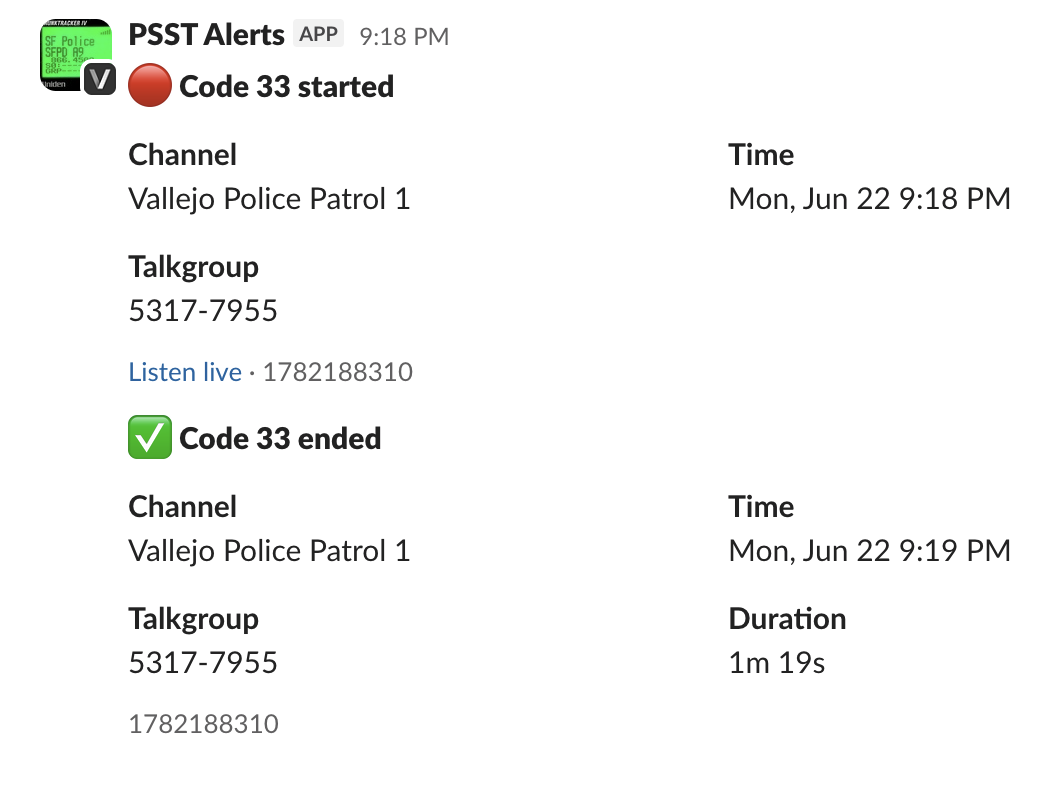
PSST will monitor scanner feeds around the clock for the tones that signal the most serious emergencies. When it detects one, the tool sends an alert to Slack or email with a preliminary transcript and a link to the audio. Journalists can then decide in seconds whether to pursue the alert for a story. The tool will work with Broadcastify, physical scanners and other online scanner options to provide an array of connection options for newsrooms to utilize with the tool.
In a later phase, PSST will add analysis to its alerts for newsrooms who want more data on trends in their communities. The tool will log, transcribe, and store dispatches, and a large language model will summarize patterns such as the neighborhoods where officers keep responding, the call types a department handles most or responds to the fastest, or the hours when uses of force cluster.
Why this, and why now
Listening to the scanner 24/7 takes time that most editorial teams do not have. PSST aims to give some of that time back and make pursuing important stories easier.
Public access to police radios is also in flux. In 2020, the California Department of Justice issued a bulletin instructing local law enforcement agencies to restrict the sharing of certain personal and criminal justice information over unencrypted radio channels. Many agencies responded by encrypting their entire radio feeds, cutting off public and press access to information that had been available for over a century, at a projected cost to taxpayers of millions of dollars. (Encryption keys for even a small-town department can cost upward of $170,000.)
Still, other agencies took a more nuanced approach. For example, the California Highway Patrol, the nation’s largest state law enforcement agency, kept much of its radio traffic in the clear while still protecting personal information flagged by the DOJ; dozens of other California agencies have done the same. Where scanner feeds stay open, PSST helps newsrooms make the most of them.
What comes next
Over the past few months our teams have interviewed representatives from a dozen newsrooms across the country to better understand how they actually use scanner audio and what features would help them most. We are incorporating what we learned into the first version of PSST, which already runs in our newsroom. The tool has saved Open Vallejo staff countless hours and freed up substantial editorial bandwidth; it has also drastically improved our overall situational awareness of what is occurring in our communities.
We plan to launch the first phase for public use, the alerts and transcription, this fall, and the pattern analysis layer later.
We will soon test the PSST with at least 10 partner newsrooms across the country. If your newsroom wants to beta test the tool, or if you simply want to tell us how you use the scanner for your reporting, please contact RJI Innovation Team Project Manager Sriya Reddy at sreddy@rjionline.org.
Cite this article
King, Geoffrey (2026, Aug. 3). We are building a tool to help newsrooms listen to emergency scanners. Reynolds Journalism Institute. Retrieved from: https://rjionline.org/news/we-are-building-a-tool-to-help-newsrooms-listen-to-emergency-scanners/