Why Tracie Powell is demanding a power shift in media funding

‘Upsetting the apple cart’: The Pivot Fund founder on her commitment to invest $500 million in innovative local outlets
Tracie Powell has always been ahead of the curve.
In the early 2010s, when most of the journalism industry was fixated on traffic, platforms and “pivot to video,” Powell launched AllDigitocracy, a digital platform examining the intersection of race, technology and media. At the time, conversations about digital media ownership, the digital divide, algorithmic bias and newsroom diversity data weren’t mainstream priorities. The industry caught up much later.
By then, Powell had already moved on. She was writing the white paper that launched the Racial Equity in Journalism Fund at Borealis Philanthropy. The donor collaborative provided unrestricted general operating support to independent news outlets, along with capacity building and technical assistance. The fund would support what have become some of the most successful and innovative news operations in the country, including Documented, Sahan Journal, Milwaukee Neighborhood News Service, Enlace Latino NC, Cicero Independiente, El Tecolote and others.
Others eventually replicated the fund’s blueprint, after recognizing the urgency of supporting independent local media.
That instinct for seeing what the field needs before the field knows it needs it and building it anyway is the throughline of Powell’s career, and the catalyst behind The Pivot Fund, the philanthropic organization she started in 2021 after studying funding models for BIPOC-led media as a fellow at Harvard’s Shorenstein Center. The Pivot Fund made its first round of grants to Black, Latino and Asian-led outlets in central Georgia the following year.
The Pivot Fund identifies, invests in and supports hyperlocal news outlets in under-resourced urban and rural areas. Powell’s goal is to direct $500 million into community news organizations. Its mission is informed by her years in journalism and her work in philanthropy but was catapulted by a 2020 report from the UNC Hussman School that analyzed the spread of “news deserts.” The report gave her pause.
“After that news desert report came out, I thought, ‘This isn’t quite right.’ I thought, ‘Well, they’re getting their information in some kind of way. People are sharing information, exchanging information, so let’s figure out who and how. Who do they trust? How do they access information? They may not have a newspaper in this community, but information is being distributed and disseminated.’ I wanted to understand why.”
Those questions led The Pivot Fund to conduct its first landscape report. Stacey Abrams’ Fair Fight invested in the research, to understand how information moved through Georgia communities ahead of Abrams’ gubernatorial campaign. (Consulting has since become one of the organization’s revenue streams, out of necessity.) The Pivot Fund has since expanded that work to the Great Lakes states and other parts of Georgia, with support from the MacArthur, McKnight and Joyce foundations.
‘I’ve been talking about Georgia Fort for years’
Georgia Fort is exactly the kind of journalist Powell has been fighting to support. Fort, a three-time Emmy-winning producer, launched BLCK Press in Minneapolis during the 2020 uprising following George Floyd’s murder, to document the grief and resistance that surrounded her. Rooted in community, BLCK Press is the type of innovative media organization The Pivot Fund was built to bolster.
When Fort was arrested in late January while covering an immigration protest at a local church, generating national attention, Powell had already been working with her for years.
Last year, Powell sat down with Fort for a podcast conversation funded by the Knight Foundation. They discussed what it takes to build a hyperlocal media empire in 2025. Fort spoke about how she acquired a radio station after losing $250,000 in corporate support when the retailer Target backed away from its DEI commitments. Fort had already created digital and video journalism platforms to cover marginalized communities of color. A radio station could help further amplify community stories and create a platform to pursue organizations for underwriting.
“I had that foresight,” Fort told Powell, knowing that funding for Black initiatives would soon fall out of favor. Foresight is something Powell recognizes in herself.
“It wasn’t until [her arrest] that people started actually saying her name, or that her work started mattering. It’s frustrating. I’ve been talking about Georgia for years and the important work she’s doing in Minnesota. Funders could not hear me because they couldn’t relate.”
The work is often tiring, she admitted.
I’m “struggling to figure out how to get money to Georgia Fort, who’s on the frontlines covering protests and out there getting arrested.” The Bush Foundation and the McKnight Foundation in Minnesota have been among the organizations providing support to Fort, she noted.
The problem with journalism philanthropy
Fort’s situation points to what Powell sees as a systemic failure in journalism philanthropy, something she’s encountered repeatedly.
“They were around for five minutes after George Floyd’s murder,” she said of funders who engaged only briefly with BIPOC-led media following the 2020 Minneapolis uprising, then moved on. Philanthropy, she said, tends to show up in communities only after a crisis draws significant public attention, but many of the outlets she supports are deserving of sustained investment.
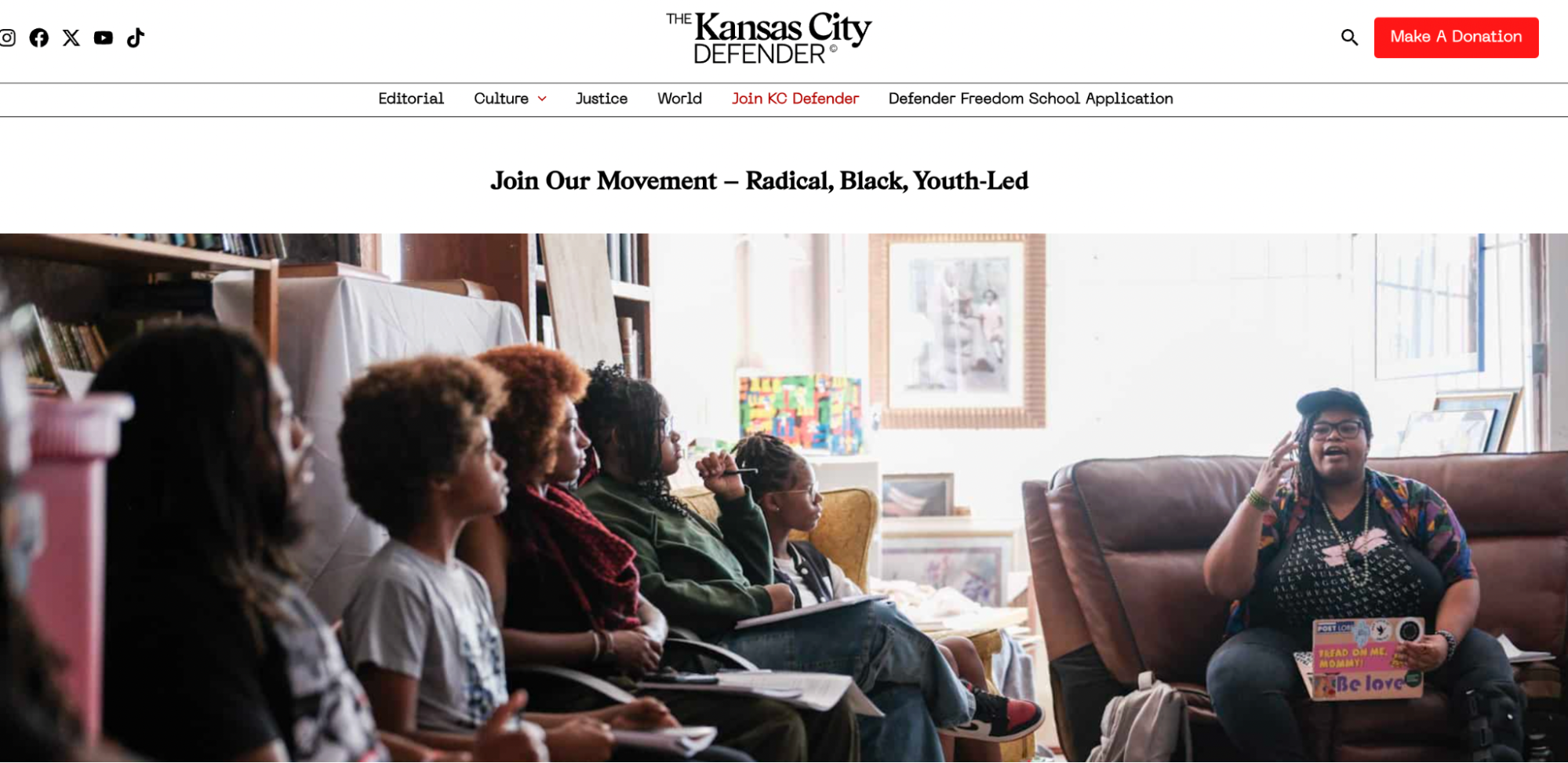
Ryan Sorrell, one of her grantees, launched The Kansas City Defender after Floyd’s death at the hands of police in 2020. The Defender, a nonprofit media platform by and for young Black readers, is as much a community organization as it is a news outlet, running free clothing and Grocery Buyout programs, hip-hop concerts and open mic nights. Last year, the outlet launched the Defender Handbook in collaboration with the RJI Innovation Team, to help other newsrooms replicate their community programs and their work. And they started a $500,000 capital campaign to acquire and preserve Willa’s Books & Vinyl, Missouri’s oldest Black-owned bookstore, to ensure it remains in the community.
Sorrell’s first big scoop was a 2022 TikTok video of an activist who contended that Black women were going missing from a desolate street in Kansas City.
“There are some well-meaning folks in philanthropy. I think they truly want to figure out how to reach audiences with critical, quality news and information. That said, philanthropy is still wholly reliant on people who are similarly positioned, so they listen to, trust and fund the people they rub shoulders with, in the same boardrooms.” Powell shared.
Powell said her goal is not just to support outlets in underserved areas, but to back those who work for and alongside their communities.
“They continue to fund the same ways and the same people, expecting different results. And that is the problem with philanthropy. They are unable – perhaps unknowingly — to share power outside their own comfort zones and networks.” she said.
Powell’s vision for change goes beyond grant dollars. The Pivot Fund pairs funding with wrap-around services, such as coaching, developing strategies for building audience trust, and selecting publishing platforms and CMS tools— and advocates for rethinking how journalism itself is designed, defined and supported.
“The industry now appears to have a deeper understanding that providing guidance and capacity-building to grantees doesn’t mean a funder is being prescriptive. It means the funder is being a true partner.”
Unfortunately, she sees in philanthropy the same competitiveness and gatekeeping she encountered in newsrooms as a reporter.
‘Upsetting the apple cart’
Four years into running The Pivot Fund, Powell is candid about how challenging it can be to bring about change.
“What systemic change looks like is persistence and determination. Particularly for Black women, it has always meant putting our bodies out on the line. I have felt that acutely. I have put my reputation out there. When you are creating systems change, it upsets the apple cart.” she said.
“It is taking a toll on me physically but I am so determined and persistent. People don’t understand how I continue to do what I do. It’s seeing the Georgia Forts out there on the frontline, the Ryan Sorrells out there.”
H2
Cite this article
Williams, Monica (2026, March 13). Why Tracie Powell is demanding a power shift in media funding. Reynolds Journalism Institute. https://rjionline.org/news/why-tracie-powell-is-demanding-a-power-shift-in-media-funding/