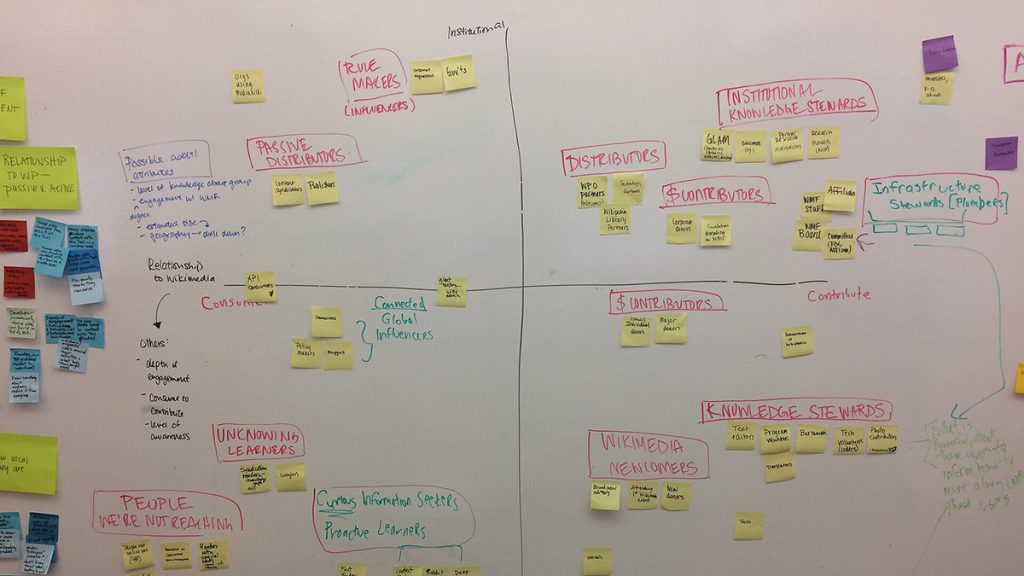
Information about this workshop is available here. Photo: Melody Kramer
First-party data is the most important asset a newsroom can build

How the direct relationships newsrooms already have become the strategic foundation for journalism in the AI era
For much of the past twenty-five years, digital journalism operated according to a simple growth formula: publish more, rank higher, attract more visitors, and work out how to monetize them later. The newsrooms that prospered were those most adept at capturing attention through platforms they neither owned nor controlled.
That era is drawing to a close.
Traffic is no longer the decisive lever. What matters now is the depth and durability of the direct relationships a newsroom builds with its audience. The raw material of those relationships is first-party data, which is quickly becoming one of the most strategically important assets a newsroom can build.
This shift is at the core of my Reynolds Journalism Institute fellowship where I am working with newsroom partners to build an audience intelligence tool for small and midsize publishers.
The aim is to turn the first-party signals newsrooms already collect into a coherent picture of who their audiences are, how those relationships are evolving, and what actions could strengthen them.
What first-party data actually is and why it matters
First-party data is information a newsroom collects directly through its own products and interactions with its audience. This includes newsletter registrations, memberships, donations, surveys, event RSVPs, stated preferences, comments, and on-site behavior collected in accordance with applicable privacy requirements. It is a record of the relationships a newsroom has built for itself, rather than the traffic a platform chooses to send its way.
Unlike a search referral, these signals emerge from relationships a newsroom can continue to develop independently of shifts in platform distribution. Google can change its algorithm. An AI-generated summary can omit a citation. A social platform can reduce the reach of publisher content. But those changes do not sever the newsroom’s connection to a reader who has subscribed to a newsletter, become a member, or registered for an event.
When organized and interpreted well, first-party data can help a newsroom answer the questions that matter most to its future: Who are our most committed readers? Which content builds lasting relationships rather than generating one-time visits? Which relationships are deepening, and which are weakening? What do our most engaged supporters value that we are not yet delivering? Who is at risk of lapsing, and what might persuade them to stay?
These are strategic questions, but they are also questions of product, editorial judgment, and revenue. A pageview dashboard alone cannot answer them. The uncomfortable reality is that many newsrooms already collect substantial first-party data but lack the ability to assemble it into a coherent view of their audience.
The strategic value is caught between the systems. A publisher may know who receives its newsletter, who donated last year, which topics produce sustained attention and what readers say in surveys. But it may not be able to connect those signals well enough to answer basic questions: Who are our most committed readers? Which relationships are deepening? Who may be drifting away? What does our community need that we are not providing?
My team at Newsroom Robots Lab worked with NPA to build an open-source tool that helps map disparate data into a common structure: the Audience Data Commons. By creating a shared framework for organizing first-party audience data, this tool began addressing the structural problem.
That work established an important foundation, but it also revealed the next challenge: structured data has limited strategic value if a newsroom lacks the time and expertise to interpret it and act on what it reveals.
The second challenge is the focus of my RJI fellowship.
I am working with newsroom partners to build an audience intelligence system for small and midsize news organizations. The goal is for this tool to consolidate and connect the first-party data a newsroom already holds, often scattered across multiple systems, and turn that information into a coherent view of its audience that can inform strategic editorial decisions.
Newsrooms will be able to bring together first-party data from the tools they already use such as newsletter, membership, donation, survey and audience analytics platforms. The system will help organize and connect those fragmented signals so users can identify meaningful patterns in their audience relationships and explore the questions most relevant to their organization.
The goal is not the dashboard itself but the strategic clarity about direct audiences that large publishers have long relied on enterprise vendors and in-house data teams to produce, delivered in a form suited to the scale, resources, and priorities of smaller news organizations most exposed to declining platform referrals.
This work will develop in partnership with newsroom leaders confronting these challenges. If your newsroom is working to understand its audience beyond traffic metrics, connect fragmented first-party signals, or turn disconnected data exports into a coherent strategic resource, I would love to hear from you at nikita@newsroomrobots.com.
Why this is important now
The industry’s decline in search traffic is already measurable, and publishers expect it to deepen. Aggregate Chartbeat data cited in the Reuters Institute’s 2026 Digital News Report show that organic Google search traffic to more than 2,500 sites fell by 33 percent globally between November 2024 and November 2025, and by 38 percent in the United States. Publishers expect search traffic to decline by a further 43 percent over the next three years.
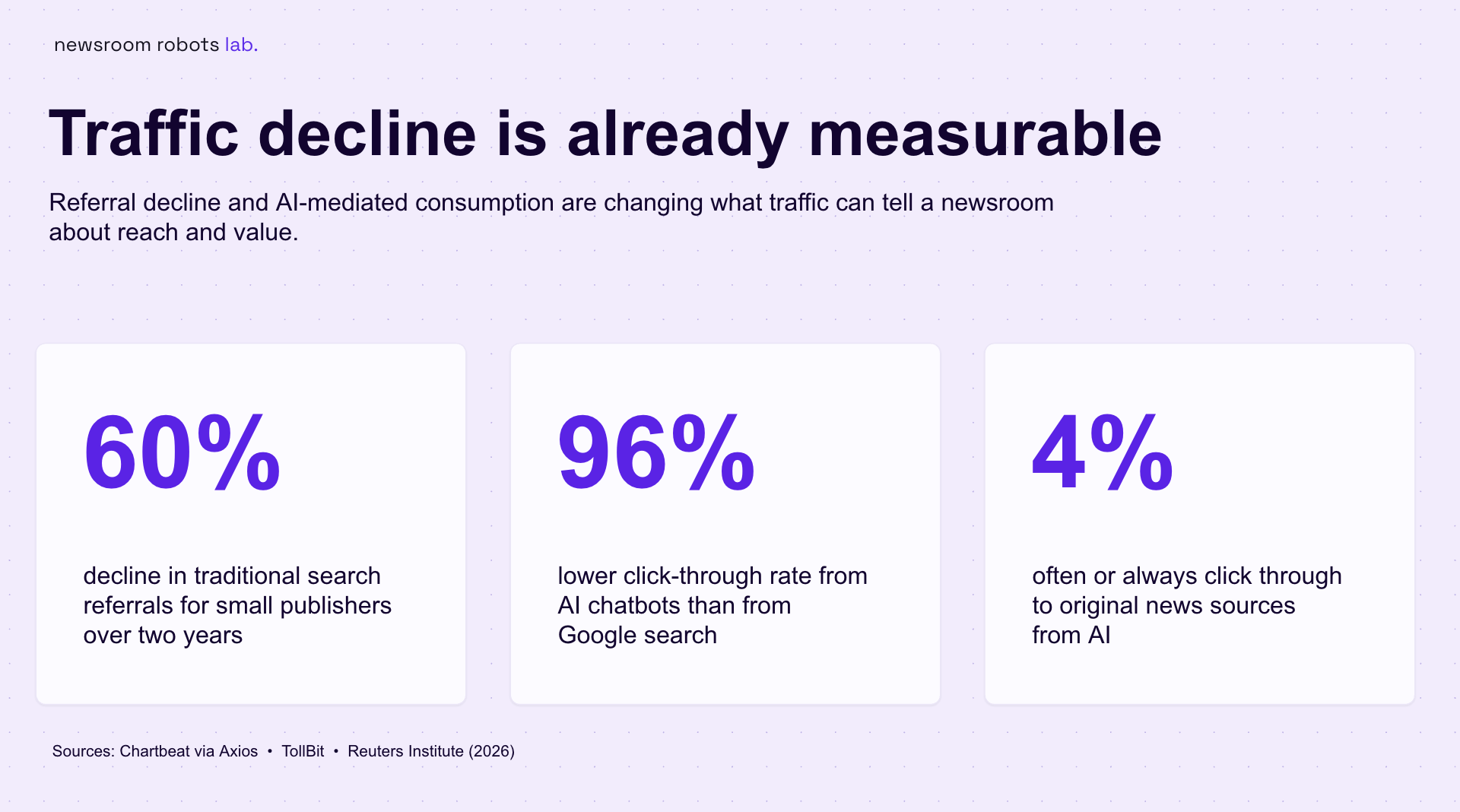
The decline is steepest among the smallest web publishers. According to Chartbeat data shared with Axios, traditional search referrals fell over two years by 60 percent for small publishers (averaging 1,000 to 10,000 daily page views), 47 percent for medium-sized publishers (10,000 to 100,000), and 22 percent for large publishers (more than 100,000).
At the same time, the mechanics of online news consumption are changing. TollBit’s State of the Bots data for the first half of 2026 detected more than 22 billion AI bot scrapes across its network, with nearly 2 billion of them bypassing or ignoring publishers’ robots.txt instructions. TollBit also reports that referrals from AI chatbots generate click-through rates 96 percent lower than referrals from traditional search engines such as Google. Cloudflare’s data point to the same shift. Among crawler requests it could identify by purpose, 52% of crawler requests across its network in June 2026 were associated with AI training, up from 22 percent in spring 2025.
Different datasets point in the same broad direction. Publishers’ work is being consumed by machines at growing scale, but comparatively little of that activity sends readers back to the source. In a Reuters Institute survey across 27 markets, just 4 percent of all respondents said they often or always click through from AI chatbots to underlying news sources, compared with 19 percent from search and 17 percent from social media. The institute cautions that this gap partly reflects the much smaller number of people who use AI chatbots for news and that the figures capture self-reported behavior rather than observed referral traffic.
All this points to a strategic conclusion that traffic can no longer serve as the stable foundation of a newsroom’s audience strategy. The more durable foundation is the direct relationship a newsroom cultivates with its readers.