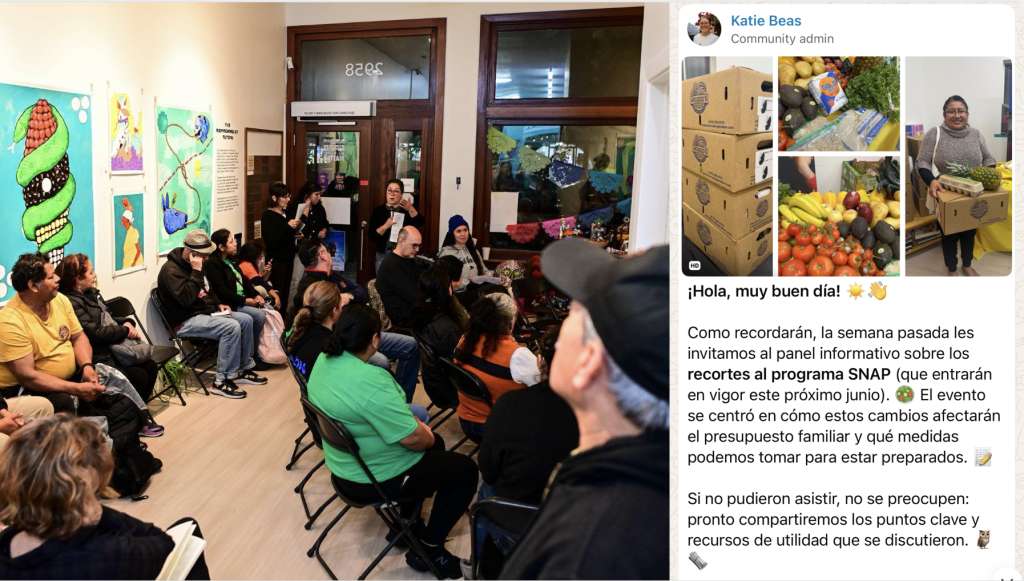
El Tecolote pairs their WhatsApp Community with in-person events and a biweekly print newspaper to reach monolingual Spanish-speaking communities in San Francisco. Photo: Pablo Unzueta
Four lessons for building a WhatsApp community from scratch

What one community newsroom learned about growth, retention and trust on WhatsApp
Curious about using WhatsApp for news and information? Increasingly, newsrooms across the country are turning to the platform to reach and engage Latino and immigrant communities, and for good reason: 56% of Hispanic adults in the U.S. say they use WhatsApp.
The pioneering work of organizations like Conecta Arizona and Documented has helped spark critical conversations around the value of listening to communities and responding to their information needs on the platforms they already use, and in the languages and formats they prefer.
When I joined El Tecolote as editor-in-chief, I had the opportunity to approach the problem from inside a bilingual community newsroom serving many of the residents I had struggled to reach at a large regional newsroom. We immediately experimented with different messaging approaches, including a private WhatsApp group for Latino residents living in RVs in San Francisco.
That work took on new urgency when our newsroom tried to find an answer to a key question: How could we build a direct and trusted information network for Spanish-speaking immigrants who are disproportionately affected by policy changes and local emergencies?
We launched our WhatsApp Community in April 2025. Growth was modest during the first few months, reaching nearly 300 members primarily through promotion on our own platforms: print, social media, email and our website.
After several live responses to events like mass school closures, SNAP cuts and primary election results, I began to see El Tecolote’s WhatsApp Community — and the broader newsroom around it — as an anchor within a broader community-centered model for emergency information for Spanish speakers, where people could receive verified information, bring us questions and rumors, and help us understand what the community needed to know next. Outside of emergencies, we sought to retain and deepen those relationships through hyperlocal civic and cultural news and information.
I stepped down from my role at El Tecolote in August, and I’m grateful for this opportunity to reflect on what I learned while building and testing this system. Below are some of the most important lessons about what it takes to build a WhatsApp Community from scratch, and what newsrooms should consider before trying it themselves.
A quick explainer on WhatsApp’s messaging infrastructure
Choosing how to use WhatsApp involves more than deciding whether to start a group chat. In just the last five years, the platform has expanded into products that support very different relationships with audiences:
- Groups invite many-to-many conversations
- Channels provide one-to-many broadcasting
- Broadcast lists provide one-to-many delivery that can open into one-to-one conversation
- Communities combine one-to-many distribution with many-to-many interaction
Here’s a brief breakdown of each.
WhatsApp Groups
The familiar group chat is best suited for smaller, conversational spaces where newsrooms can moderate and host interactions among members. The more specific the audience, the easier it can be to build a space around distinct information needs.
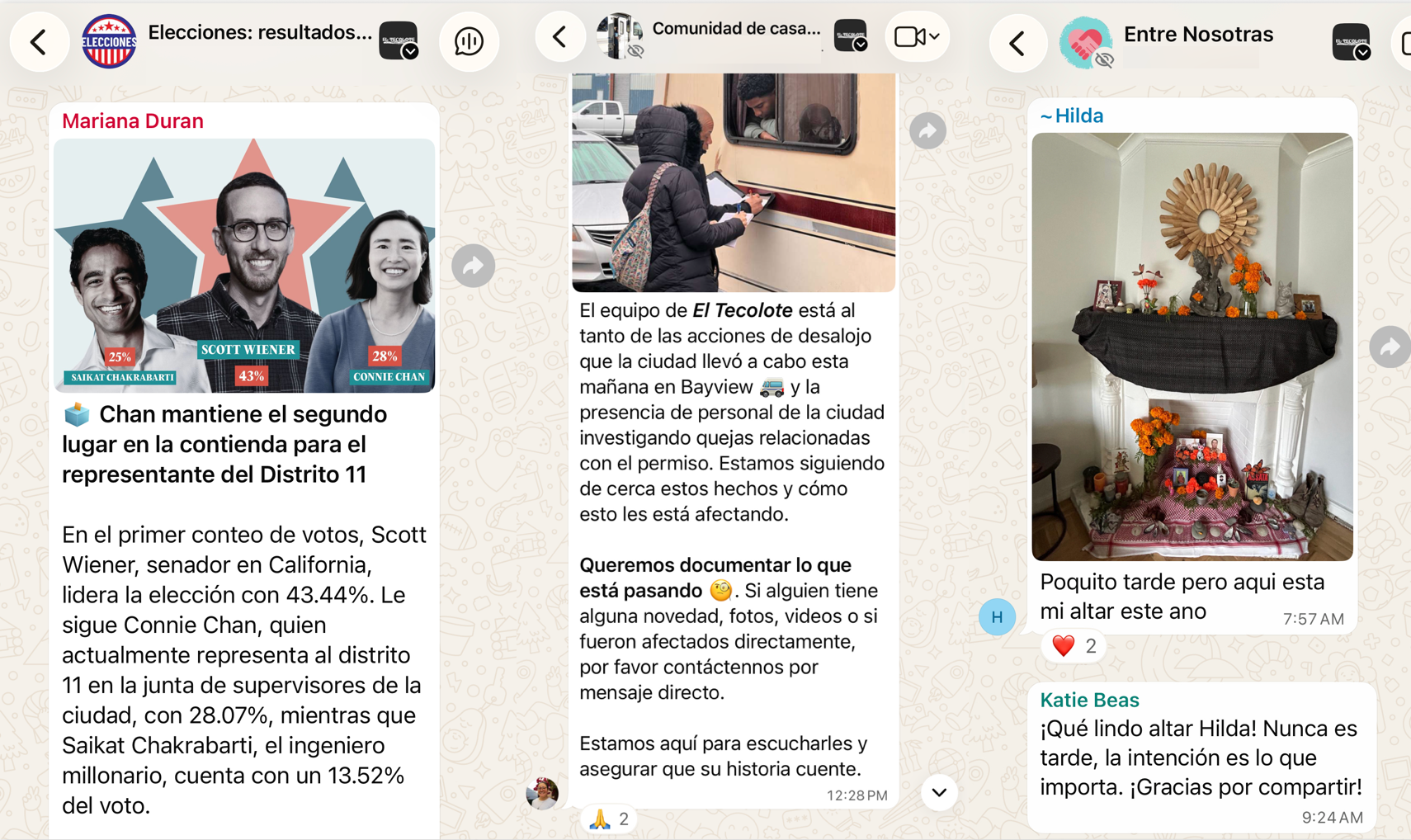
Conecta Arizona’s Hora del Cafecito, for example, hosts highly interactive group chats with hundreds of Spanish speakers for one hour every weekday that center on a specific topic or expert. The goal? Authentic community conversations that deepen the relationships between the newsroom and its readers.
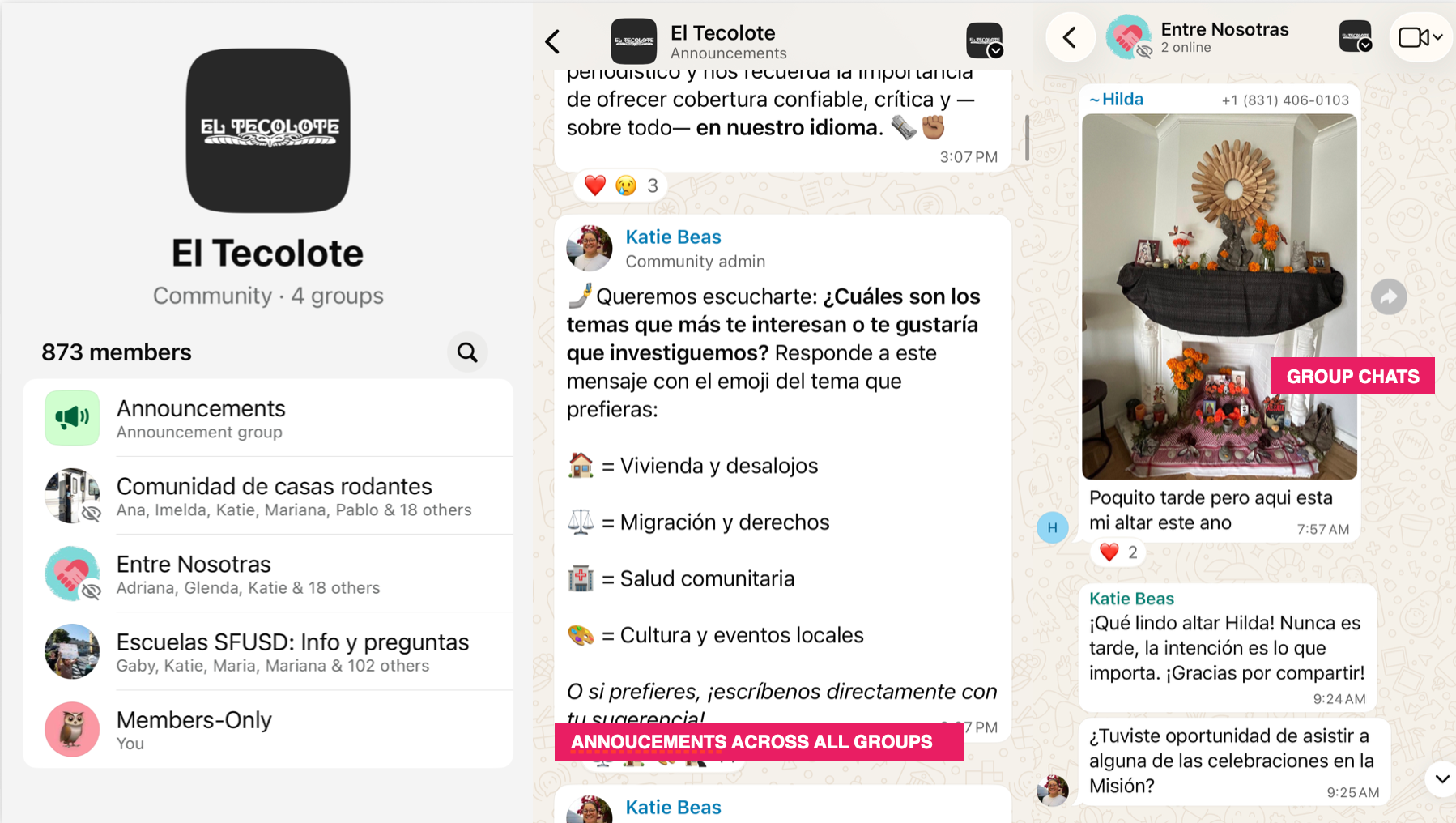
At El Tecolote, we created small groups for Latino residents living in RVs and for Latina immigrants through Entre Nosotras. We also launched pop-up WhatsApp groups for certain events like California’s primary election and a mass teachers strike. Because members may be able to see one another’s phone numbers depending on the setup, privacy and safety should be considered carefully when serving vulnerable communities.
WhatsApp channels
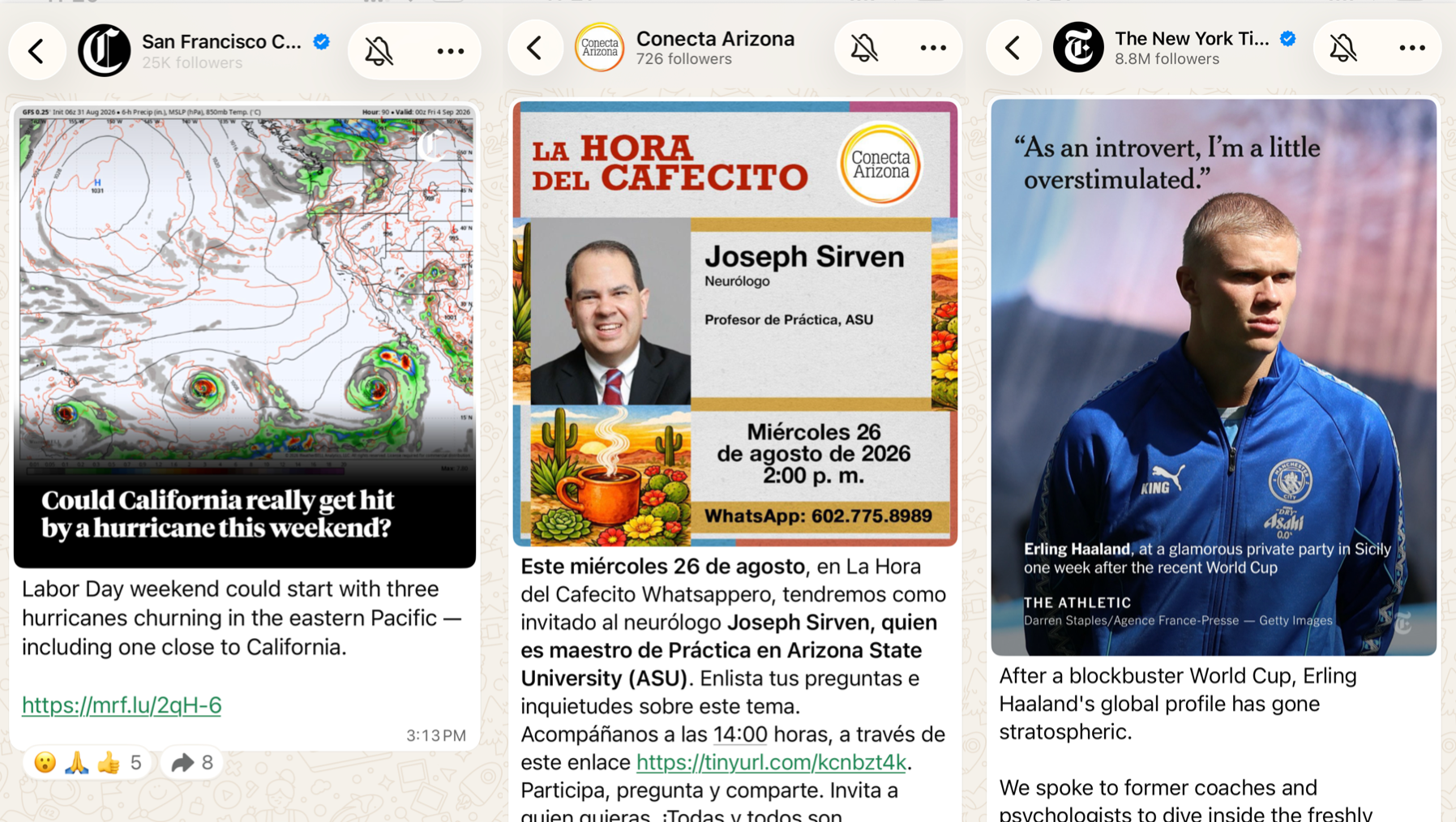
Channels are primarily a one-way broadcast tool. Newsrooms can publish platform-native updates, visuals and links, while followers respond through limited interactions such as emoji reactions. At the San Francisco Chronicle, we used Channels largely as a distribution tool for news and information, which provides the reach and immediacy of WhatsApp without taking on the moderation demands of a group chat or the expectation of one-to-one replies.
Broadcast list
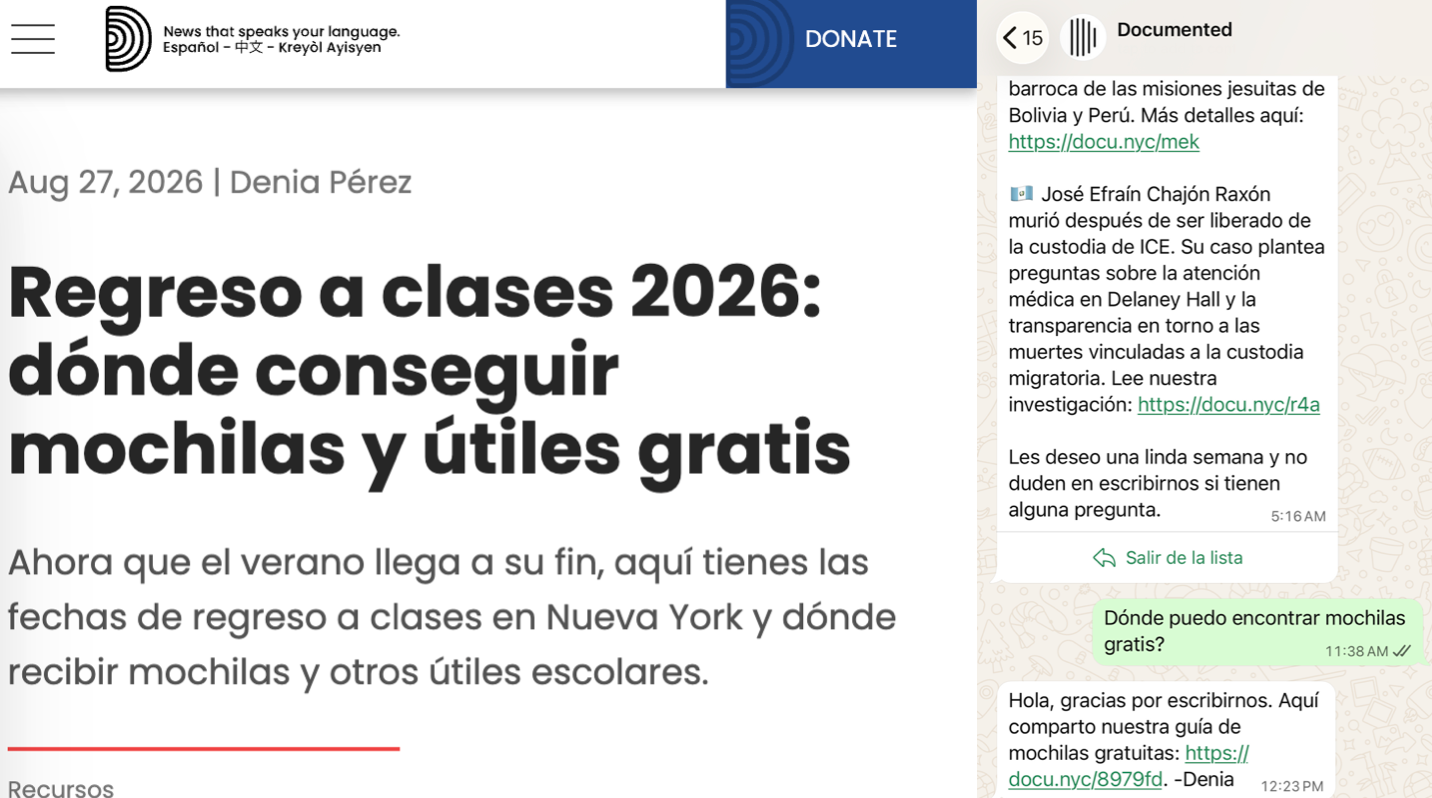
Broadcast lists combine mass distribution with private one-to-one replies. Instead of placing people into a shared group, a newsroom can distribute the same update to many people through individual direct messages.
Documented’s Semanal is one great example. The newsroom sends a recurring newsletter-style roundup of guides and resources to subscribers, who can reply privately in a one-to-one exchange with the newsroom. Documented says that by listening to people’s questions, they can identify community needs to generate explainers and investigations around topics that readers actually care about.
WhatsApp communities
Communities provide an umbrella for an announcement space and multiple linked groups, which can be public or private. At El Tecolote, the main announcement space became our primary channel for hyperlocal news, resources and cultural updates, while smaller groups supported specific reporting projects and communities.
During major emergencies we provided live updates through the announcement space. For smaller crises, such as mass school closures, we deployed temporary pop-up group chats for live questions and updates. That flexibility made Communities especially useful for us because we could maintain one central space for broad distribution while creating smaller conversational groups around specific community needs.
Advice for choosing how to use WhatsApp
If you’re starting from scratch, begin with networks that already have trust
One thing I never took for granted while stewarding El Tecolote was the more than 55 years of community trust the historic bilingual newsroom had built. Launching a WhatsApp product for Spanish speakers was significantly easier within an organization that was already recognized and trusted than it would have been starting completely from scratch.
If you are trying to build a WhatsApp network without that built-in, trusted relationship, begin by identifying the institutions and networks that already have it. Look to nonprofits, service providers, grassroots groups, libraries, cultural organizations and other spaces where the communities you hope to serve already gather. Don’t approach those organizations simply asking for access to their audiences. Instead, think about what you can contribute to the relationship and how the project can be mutually useful.
In San Francisco, for example, the grassroots organization Mujeres Unidas y Activas has built a large and trusted network among Latina and Mam immigrant women. Our managing editor attended one of their events and introduced El Tecolote’s WhatsApp Community as a space where we could share the organization’s news and resources with our audience while also providing participants with local information, civic news and community updates.
That event resulted in about 15 new signups. On paper, that may look like a small number. But those were high-touch and influential connections within a broader network of immigrant women who already had relationships with one another and with an organization they trusted. Building a trusted messaging network is a lot like building relationships in the rest of our lives: it takes time, consistency, care and reciprocity.
If you work in a newsroom and are advocating for Spanish-language coverage, consider partnering with nonprofits, ethnic media organizations and other groups that are already invested in serving those communities. Sometimes the most useful thing a newsroom can do is not build a new audience or platform from scratch, but make its reporting available to organizations that already have trusted ways of reaching people. If you find that your journalism is not being shared by the organizations you shared it with, it may be a signal to reconsider whether the product was actually designed around the community’s needs in the first place.
Emergencies and breaking news powers growth
At El Tecolote, we tried nearly every tactic we could think of to grow membership: QR codes in print, Instagram Stories, callouts within articles, signup events, tabling and more. Over our first six months, those efforts steadily grew the Community to roughly 300 members.
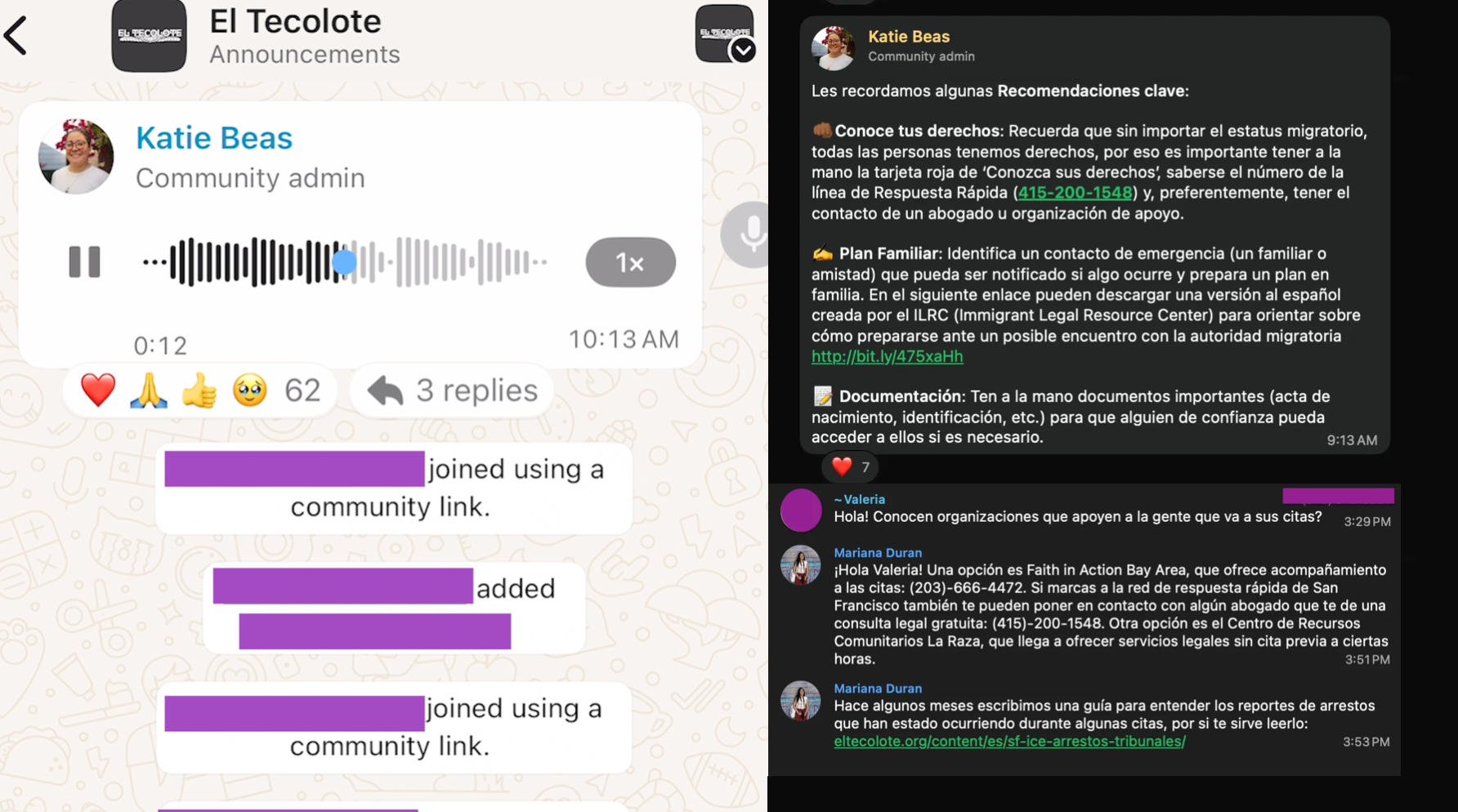
Our fastest growth, however, came during breaking news. During an ICE scare in October, we partnered with Mission Local on live coverage and promoted across both organizations’ platforms that Spanish-language updates would be available through El Tecolote’s WhatsApp Community. Amid widespread fear and a shortage of timely, trusted information for Spanish speakers, more than 700 people joined or were added to our announcement space, bringing the Community to nearly 1,000 members.
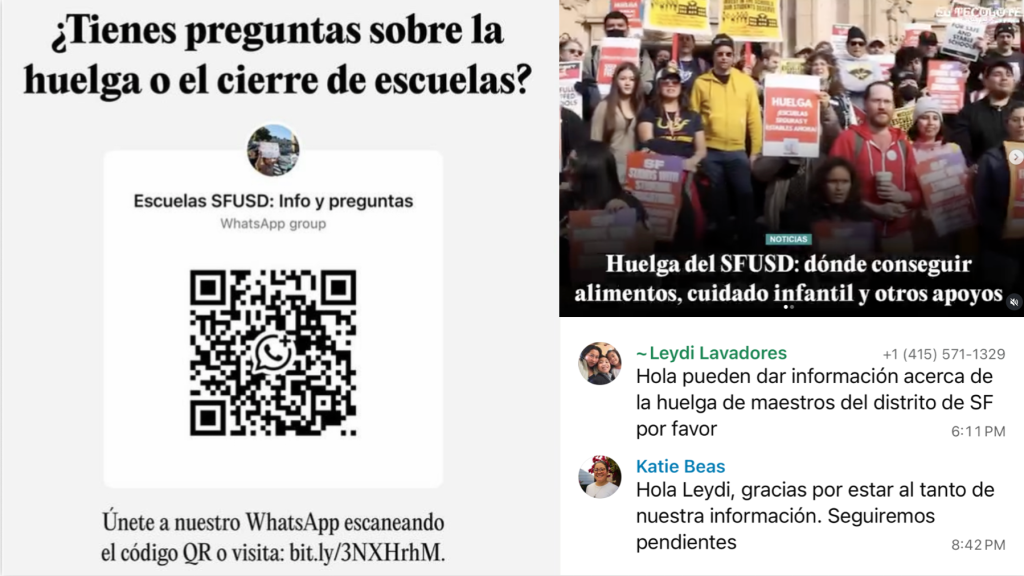
After seeing that response, we began experimenting with temporary WhatsApp groups around specific breaking-news events or periods of uncertainty. A pop-up group created during a historic San Francisco teachers strike — when many working immigrant families were scrambling to understand school closures, child care and meal access — generated more than 70 new opt-ins. A live Primary Election Day group generated more than 50. Those new members became part of a broader trusted network where we could continue reaching hundreds of people directly, including people otherwise underserved by mainstream media, after the immediate event had passed.
Many of the trailblazing messaging-based news products serving non-English-speaking communities were launched during the pandemic, when there was an unprecedented need for timely, accurate and trustworthy information about COVID. Those kinds of high-urgency moments make the value of opting into a direct messaging network immediately clear.
Outside of emergencies, growth is much harder to accelerate. Communities do not automatically opt into a new news product simply because it exists or is available in their language. Building that audience is slow, deliberate and rooted in community relationships. The challenge, then, is not only getting people to join during uncertainty, but giving them a reason to stay once the urgency passes.
Resonance and engagement are key to retention
At El Tecolote, breaking news and emergency response fueled audience growth, but retention depended on the relationships we cultivated outside moments of acute uncertainty. If people were going to turn to the newsroom during a crisis, we needed to remain useful and present in their lives when there was no emergency.
On WhatsApp, we shared a mix of hyperlocal civic news, immigration policy updates, cultural content, events and resources on our main announcement space on Tuesday and Thursday mornings, with additional posts during major news events.
We developed that formula partly by asking people directly what they wanted. Nearly every person who opted into the Community during its first few months received a message from me or our managing editor asking why they joined and what kinds of information they hoped to receive.
When serving immigrant and working-class communities, I found that culturally relevant content was often among the most resonant. Photos from a Bad Bunny lookalike contest, videos tied to Mexico World Cup games and a tribute to a deceased local danzante all generated strong engagement through emoji reactions, comments and poll participation.
We also saw strong engagement around local responses to major events in Latin America. In January, for example, after the United States captured Venezuelan President Nicolás Maduro in an overnight military operation, we asked community members to share their reactions, generating numerous replies and poll responses. Format mattered too: photographs, short videos and polls consistently drew some of the strongest engagement.
One of the clearest ways we measured resonance was by watching how many people left the Community afterward. A single post could lead to several people opting out. Highly engaged posts did not necessarily generate new members, but they often reduced churn.
Over time, that dynamic shaped our broader approach to WhatsApp. We wanted the information we shared to reflect people’s lives, their questions and their sense of place.
That relationship-building also extended beyond WhatsApp. It included community events, tabling and a biweekly print newspaper distributed in the places residents already frequented, including laundromats, taquerias, beauty salons, health clinics and other neighborhood spaces.
Measure trust signals like questions, comments and conversations
Before we launched our WhatsApp Community, the newsroom, despite its bilingual mission, did not have a reliable and accessible way for Spanish speakers to communicate directly with us. The people who did connect with the newsroom often did so by walking into our office in the heart of San Francisco’s Mission District or meeting us at community events. As editor, most of the reader feedback I encountered through our digital platforms came from English-dominant Latinos, including through social media and our newsletter.
WhatsApp became one of our most direct ways of hearing from Spanish-speaking immigrants. Within a space designed around their information needs, community members could see the journalists behind the posts and message them directly with questions, concerns, rumors or resources they thought others should know about.
I came to see those interactions as some of our most meaningful measures of trust. When someone sent us a question, shared sensitive information or brought us something they thought the broader Community needed to know, it suggested they saw the newsroom as a place they could turn to.