
How the Columbia Missourian took an issues-based approach to election coverage

A sortable voters guide allows readers to see candidate responses to key issues
Genevieve Smith is the municipal elections manager at the Columbia Missourian, a role she filled through an independent study at the Missouri School of Journalism.
The Columbia Missourian has been working to improve its coverage for the past two municipal election cycles. Ahead of the 2025 election, we discussed what Columbia voters really wanted out of election coverage, and decided we wanted to take an issues-based approach.
It’s a strategy you can use, too, with off-the-shelf digital applications.
In the past, there were two main components to the Missourian’s election coverage: quick-turn forum stories and candidate profiles.
The forum stories were constrained by late-night deadlines and space in the print edition. We were often getting only a couple of direct quotes per candidate, and the stories were typically anchored in the issues brought forth by the community groups hosting the forums.
We turned to a digital voter’s guide. Reporters still attended the majority of the candidate forums, but instead of trying to summarize multiple candidates and topics in a 700-word story, they added questions and candidate answers into a sortable chart for readers to review.
A former editor had taken a similar approach with candidate questionnaires addressing key issues, but the results were designed for print readers and weren’t easily accessible to online readers. The current project took a digital-first approach.
After experimenting for the 2025 municipal election, we took lessons learned to improve the user experience in the 2026 election.
For 2026, we used Airtable and Softr — both on the paid plans, given the size of the project. We used Airtable to insert all the questions, which then connected to Softr — the version that appeared online.
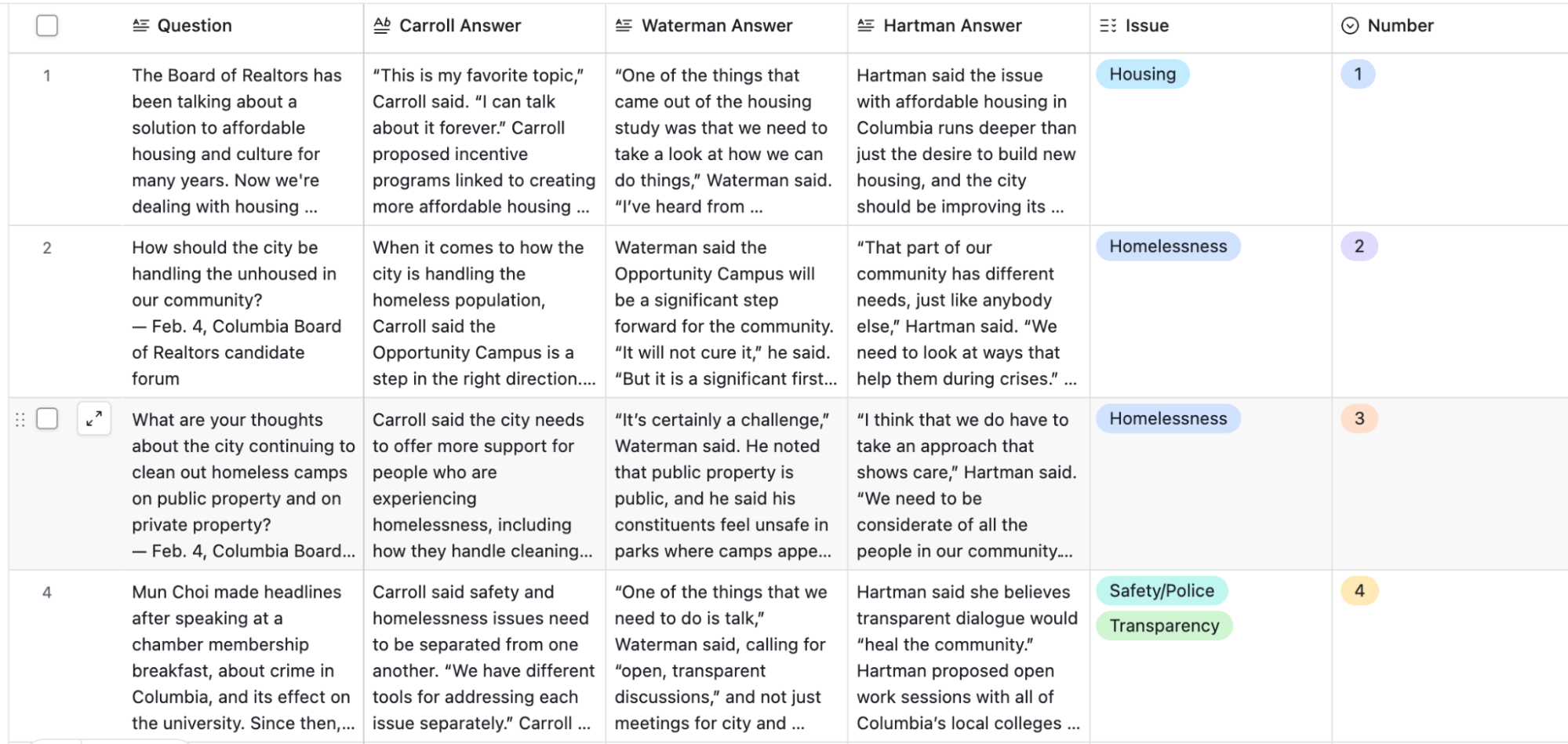
On Airtable, we added the question asked to the candidates, their respective answers and the issue it was addressing. The number on the far right was to show the order in which questions were asked. When we formatted it on Softr, we organized the questions by reverse chronological order so the more recent forums were at the top.
We included just about every question asked at the forums, disregarding ones that only applied to a single candidate, were repetitive or were not applicable to a general audience. We also focused on questions relating to issues. When we connected Airtable to Softr, it displayed the candidates answers to the questions and allowed readers to filter the responses by issue.
This new approach to forum coverage gives readers the opportunity to not only compare how different candidates responded to the same question, but it also lets them track what candidates have been saying throughout the campaign season and how their positions have evolved.
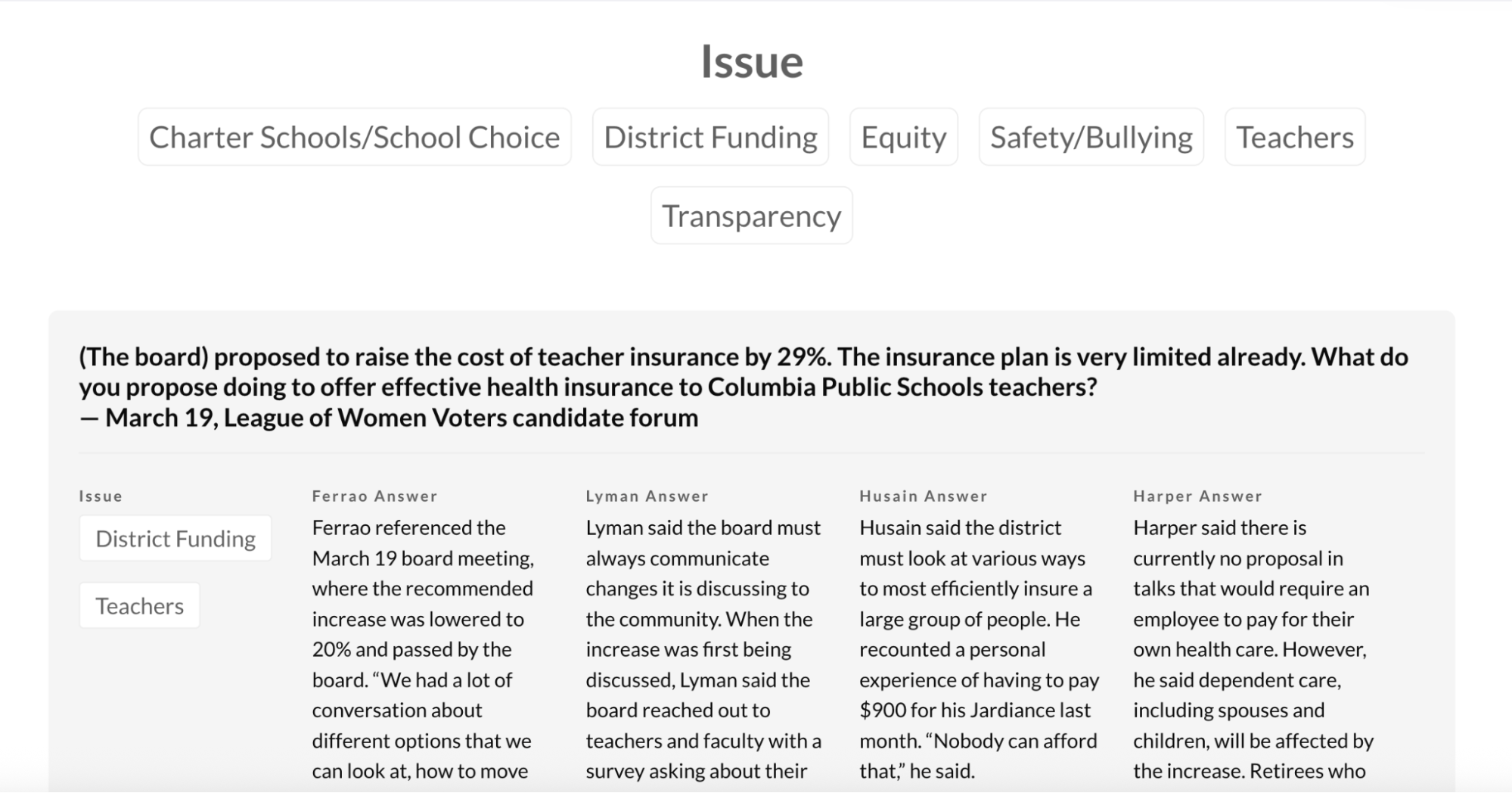
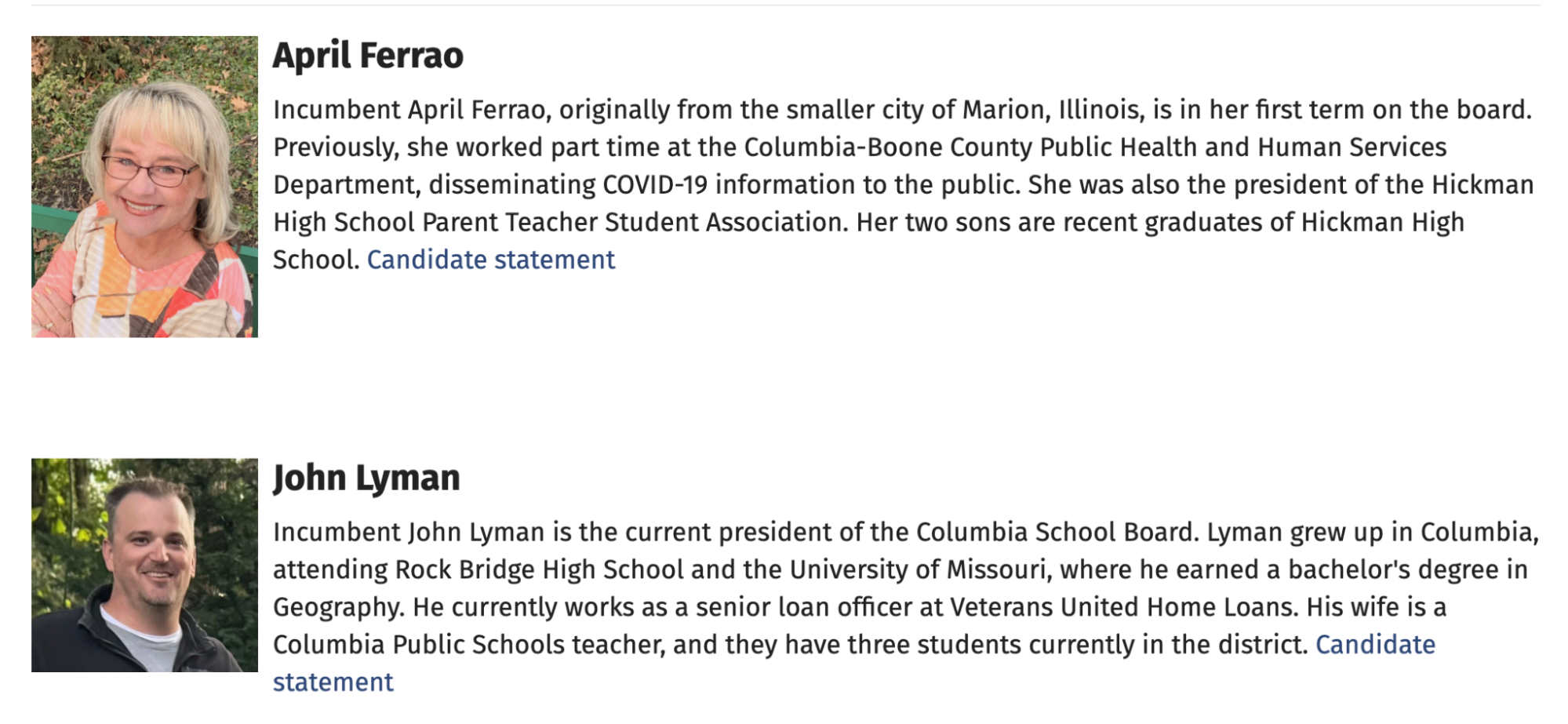
The chart was embedded into a page on our website that included short bios about each of the candidates, which we wrote, and links to candidate statements, which were introductions the candidates wrote. Since we were focusing primarily on issues in the voters guide, we wanted to give the candidates the opportunity to introduce themselves and share who they were, why they decided to run and what they will bring to their position.
The page also included links to any stories we wrote about the election. One of the stories linked was a list of the forums to give residents the information they needed if they wanted to attend or join a livestream, which was a recommendation from the Missourian’s community advisory board. We updated it throughout the election season, and after each forum, we included a link to a recording if one was available. The list of forums was pinned on the page, and it gave readers the opportunity to watch the full recording if they wanted to see the candidates’ complete answers.
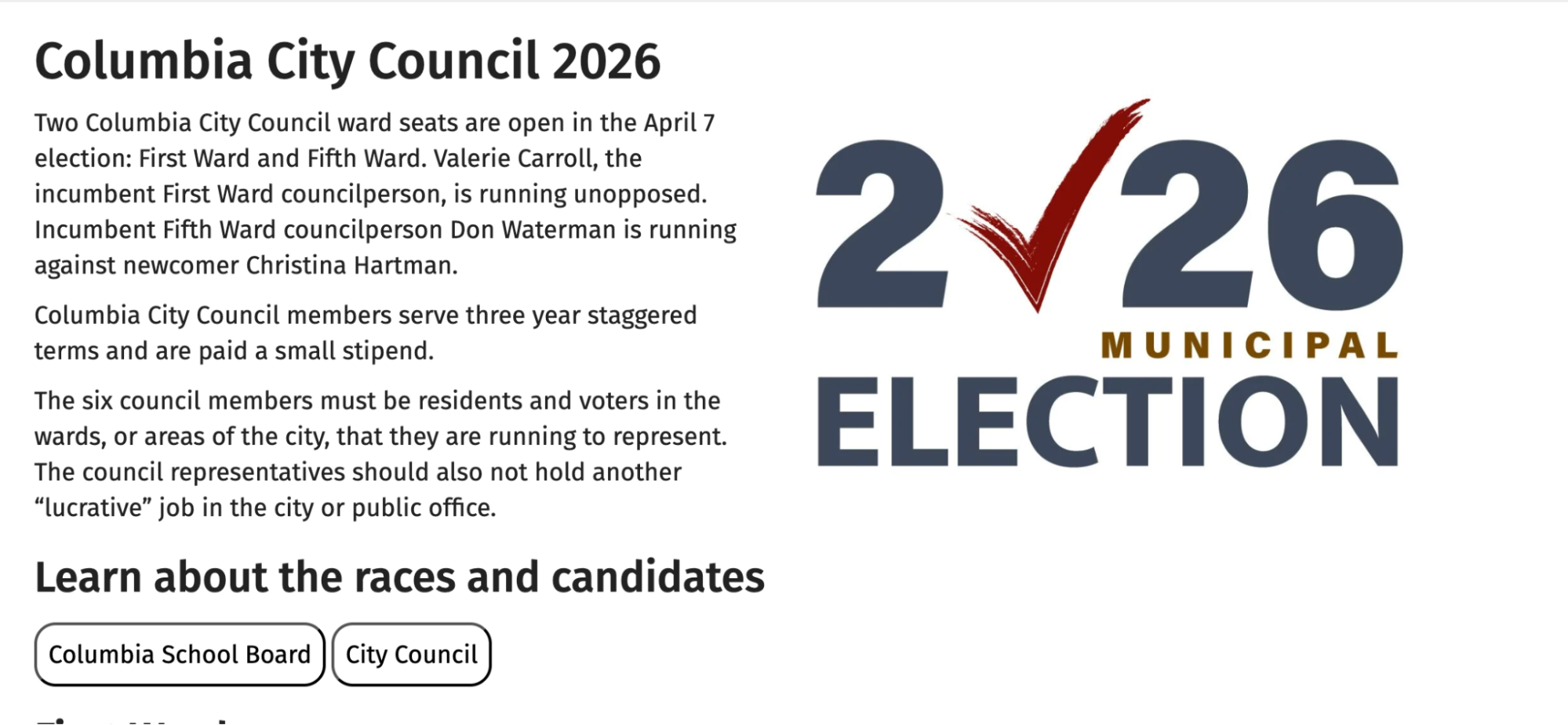
At the top of the page, we also provided general information about the race and who was eligible to run.
In addition to our forum coverage, reporters wrote a series of stories that focused on some of the key issues that appeared during the campaign season. In the week leading up to the election, we ran nearly a dozen stories on specific issues facing our community and schools. The issues-based stories replaced our candidate profiles and gave our reporters the opportunity to ask deeper questions that were not addressed in the forums.
While the stories focused on the candidates, they were informed by our past coverage and conversations with community members who wanted to see change. The goal was to highlight what the candidates would do if elected while also providing readers with the context behind why these issues matter and who they affect.
We wanted to build a product that was more useful for our readers — one that allowed them to follow the issues that mattered to them and better keep up with the candidates’ positions over time.
Our readers took to this new way of covering forums. The best performing forum story in 2024 had only 329 page views, and all other forum stories and candidate Q&As that year had less than 300. In 2025, the mayoral seat was on the ballot. It drew a larger turnout, and the voters guide had just under 5,000 page views. This year, the school board race was the only city-wide election and voter turnout was significantly lower than 2025, but the page had nearly 2,400 views.
Our community advisory board gave positive feedback to the overall guide, and we received a few reader emails complimenting the coverage, including one reader who said it was easy to show and discuss with her 88-year-old mother.
Our approach to covering the municipal election puts our audience and the issues they face at the center of everything.
Cite this article
Smith, Genevieve (2026, May 28). How the Columbia Missourian took an issues-based approach to election coverage. Reynolds Journalism Institute. Retrieved from: https://rjionline.org/news/how-the-columbia-missourian-took-an-issues-based-approach-to-election-coverage/