
RJI in 2025: The year in review

2025 at RJI has been a year of bringing people together to address the many challenges and changes facing the industry. As competitive as journalists can be, the future of news is not a race; it’s a collective effort to support a fundamental pillar of democracy and keep local communities informed, and never has that been more apparent than in this year’s body of work from RJI and its constellation of partners.
Take, for example, the Science Reporting Navigator, a collaboration with The Open Notebook to help journalists in any and all beats incorporate clear and accurate science into their reporting. Or the Early-Career Guide to Newsroom Success, a partnership with industry veteran Rachel Lobdell to help young journalists acclimate more quickly and easily to the unique pressures and expectations of the business of journalism.
RJI has taken part in many such collaborations this year, from a Public Policy and Journalism hub that charts how state legislatures are working in support of local news to projects built by the RJI Fellows — including a toolkit that helps reporters convert data into sound to provide audiences with an immersive and engaging experience. These resources are designed to serve not just as philosophical guidance or thought provocation but as tools that newsrooms can put into action to grow audience engagement, produce accurate and authentic reporting and improve the health of their bottom line.
Insights from all this experimentation, research and testing were shared through more than 150 posts on RJIonline.org, featuring contributions from people working all over the country to build a strong, sustainable future for local journalism. That work seemed to resonate: RJI’s newsletters and social media following grew in 2025, and Innovation in Focus — a monthly series dedicated to helping news outlets experiment with solutions to prevalent issues — shifted into overdrive to work with a total of 47 newsrooms. (For a breakdown of 2025’s Innovation in Focus highlights, click here.)
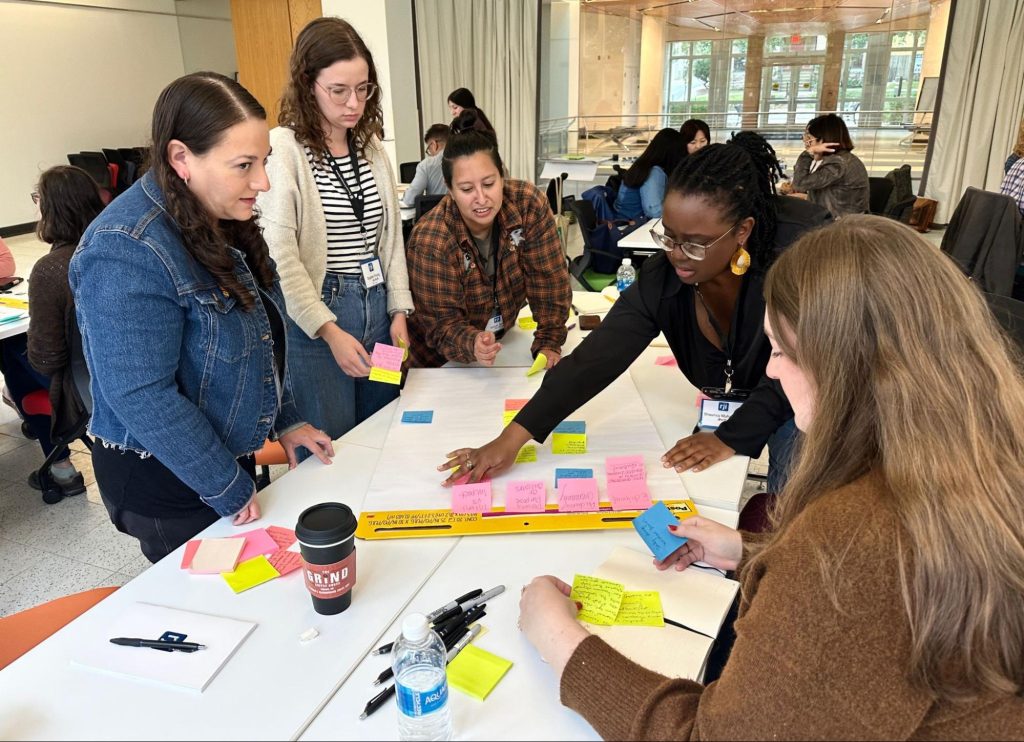
Uniting it all was an ethos that could serve as a blueprint for how local journalism moves forward at a time when divisions define public discourse: an embrace of the value in bringing bright minds together to turn challenges into opportunities. The Community-Centered Symposium brought together 30 journalists to brainstorm solutions for local news. A host of industry experts also met in October at RJI, where — under Chatham House rules — they discussed the future of journalism as it related to AI, business models and evolving audience behaviors.
And in March, broadcast managers shared their experiences with experimentation around four-day workweeks to spark conversation about a potential solution to burnout. The conference built on RJI’s research from last year — conducted in partnership with SmithGeiger — highlighting the need for more flexible shifts and a more supportive workplace culture.
Of course, RJI also reached out to meet people where they were. The Potter Digital Ambassadors program once again sent Missouri School of Journalism students to community newsrooms all over the state to build and execute stronger digital strategies. And behind the scenes, something bigger was brewing. Starting with the upcoming iteration in January 2026, the program will exist in four additional states: Iowa, Kansas, Tennessee and Vermont.
The program’s expansion adds to the list of projects that got their start at RJI before growing into larger-scale ventures. Last year, Trusting News — a research-driven effort to help journalists reconnect with their communities — went independent after eight years of growth with RJI, and Philadelphia’s Center for Gun Violence Reporting was incubated during founder Jim MacMillan’s 2019-2020 RJI Fellowship.
Another wide-reaching effort founded on collaboration was the News Media Help Desk, a hub for resources, expert assistance and fractional services for local newsrooms. Developed in partnership with the Local Media Consortium (LMC), the Help Desk launched in December and features the RJI Learning Center’s case studies, how-to guides, expert articles and a tools database alongside the LMC’s existing Digital On-Demand Services program.
With 2026 on the horizon and the challenges facing community journalism as pressing as ever, there is work ahead. But thanks to a growing number of partners and stakeholders invested in the future of a well-informed public, RJI is well-positioned to make even bigger impacts in the coming year.
Cite this article
Fitzgerald, Austin (2025, Dec. 23). RJI in 2025: The year in review. Reynolds Journalism Institute. Retrieved from: https://rjionline.org/news/rji-in-2025-the-year-in-review/