Worker-friendly newsrooms are not all the same

Co-ops, staff-run nonprofits and democratic newsrooms take a mix-and-match approach to how they operate
In 2021, a group of colleagues and I relaunched The Appeal as one of the nation’s first staff-run nonprofit newsrooms. In the years since, there’s been an exciting explosion of non-traditional, worker-friendly newsrooms — where journalists have a voice and a vote — launching across the country.
“Having worked for corporate media… the people who are best positioned to make decisions, not only editorially, but also in the fate and the running of the business that supports the journalism, are the people who are here on the ground who are actually doing the work and are the ones who are actually affected by it,” said Corinne Colbert, a co-founder of Athens County Independent which launched in 2022.
I interviewed a dozen similar newsrooms for my RJI Fellowship which illuminated that, despite a shared ethos, the actual internal structures of these news organizations are incredibly varied. Yet the way we talk about, and media reporters cover, these newsrooms often conflate their legal structures (non-profits cannot be worker-owned!) and oversimplifies their operations. If we’re not able to accurately talk about this corner of the news industry, it makes it harder to build resources to help them launch, grow, and succeed.
From my research, not only are there 3 overarching categories — co-ops, staff-run nonprofits and other democratic newsrooms — they have different ways of governing their organizations, overseeing daily work, and making team decisions.
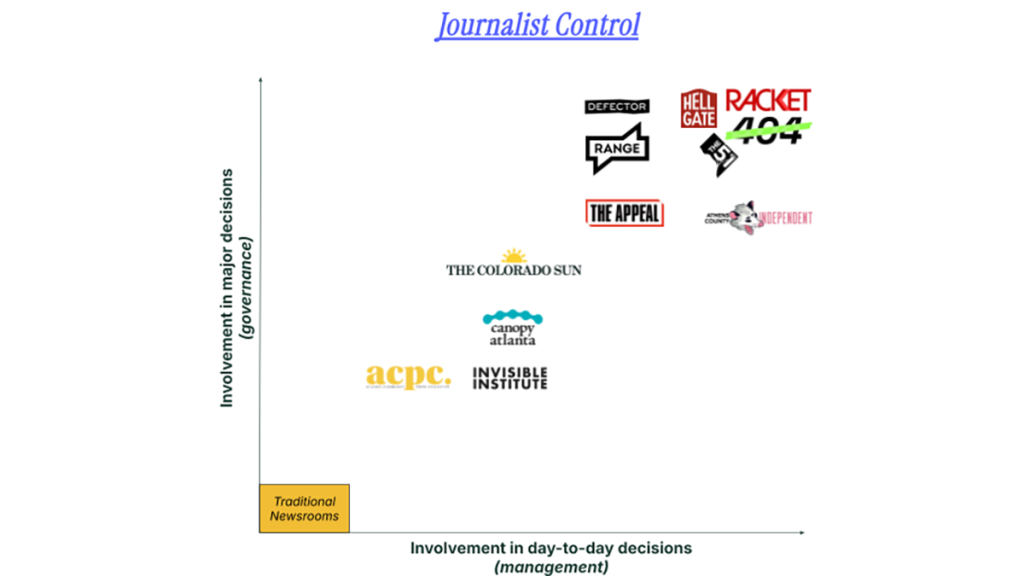
To capture this variety, I plotted these newsrooms on the above matrix (which is intended to be illustrative of their differences, not a definitive account).
In the top right corner are co-ops (Hell Gate, Racket, 404 Media, and Tone Madison) and staff-run nonprofits (The 51st) with small teams where journalists are the ones making all the decisions, big and small. Just beyond those are co-ops (Defector and Range) and staff-run nonprofits (Athens County Independent, The Appeal, and The Colorado Sun) where journalists vote for representation on their boards but still make key decisions. Finally, there’s other democratic newsrooms (Canopy Atlanta, Invisible Institute and Atlanta Community Press Collective) that informally involve their staff in decision-making.
But even this doesn’t capture their full intricacies. While each newsroom describes itself in particular terms, there are three main ways to think about the internal structure of non-traditional, worker-friendly newsrooms: governance, management and decision-making approaches.
Governance
This is the way major decisions are made.
- Worker board: Staff have governance authority by serving as the full board.
- Internal elected board: Not all staff serve on the board, but instead they elect a smaller number of colleagues to serve on a governing body.
- Mixed board: Staff elect one or several representatives to serve on the board that also includes community members or external experts.
- External board: Staff do not serve on the board, which comprises only community members or external experts.
Management
This is about the way day-to-day operations are overseen.
- Collective: The workers or staff oversee their own day-to-day work.
- Executive team: This is a smaller group, like a leadership team, that oversees daily work.
Decision-making
- Consensus: Everyone is in agreement.
- Majority/ Modified consensus: Most people are in agreement.
- Consent: Agreement is found through a lack of objections.
If we look at the dozen or so newsrooms I interviewed, here’s how their internal structures breaks down:
| Newsroom | Type | Governance | Management | Team Decisions |
|---|---|---|---|---|
| Defector | Co-op | Internal elected board | Collective | Critical decisions by ⅔ majority |
| Hell Gate | Co-op | Worker board | Collective | Most decisions by consensus (75% majority, if needed) |
| Racket | Co-op | Functions like a worker board | Collective | All decisions by consensus |
| Range | Co-op | Mixed board(staff representatives + investor/s) | Collective | Most decisions by consent |
| The 51st | Staff-run nonprofit | Worker board | Collective | Most decisions by consent |
| The Appeal | Staff-run nonprofit | Mixed board (external + 1 staff representative) | Executive team | Most decisions by consent |
| Athens County Independent | Staff-run nonprofit | Mixed board (external + 1 staff representative) | Collective | Almost all decisions by majority (50%+1) |
| The Colorado Sun | Staff-run nonprofit | Mixed board (external + 3 reps) | Executive team | n/a |
| Atlanta Community Press Collective | Democratic | External Board | Executive team | Most decisions by consensus |
| Canopy Atlanta | Democratic | External Board | Executive team | Most decisions by consensus |
| Invisible Institute | Democratic | External Board | Executive team | Most decisions by consensus |
Note: The Appeal staff voted to close its staff-run nonprofit newsroom in 2025, and its journalism is now published by Truthout.
What becomes clear here is the way we talk about and flatten these newsrooms often just as “co-ops”, or ignoring some altogether, does a disservice to the hard work of building the mix-and-match approaches these newsrooms have taken to involve journalists in the organizations beyond just their journalism.
So if you’re wanting to launch a non-traditional, worker-friendly startup, not only must you choose between being a for-profit co-op, staff-run nonprofit, or a democratic for/non-profit, it’s critical to think through who and how decisions will be made.
“The most evergreen advice is, a business can be whatever you want. Don’t be held down by conventions, you can do whatever you want,” said Defector co-founder Jasper Wang.
Cite this article
Chan, Tara Francis (2026, Feb. 11). Worker-friendly newsrooms are not all the same. Reynolds Journalism Institute. Retrieved from: https://rjionline.org/news/worker-friendly-newsrooms-are-not-all-the-same/