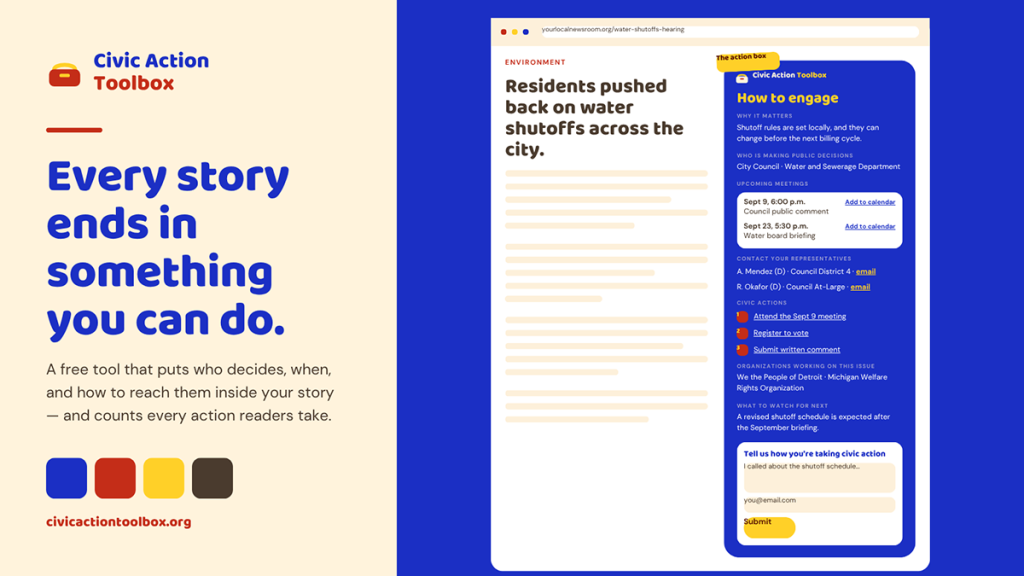
Journalism tells people what’s happening. This tool helps them take action.


The Civic Action Toolbox connects local reporting to public meetings, comment periods and the officials who make decisions
If you’re a journalist, you’ve undoubtedly gotten this email. A story publishes about a utility rate increase, a rezoning, an industrial permit, and a reader writes back with the question: What can I do about this?
At Planet Detroit, our environmental and health newsroom focusing on Southeast Michigan, we decided to start answering that question with civic action boxes. For the first year, it was a manual process. Nina, managing editor Dustin Blitchok and our reporters spent 45 to 60 minutes per article figuring out which government body had jurisdiction, when it met next, whether a comment period was open and which community organizations were already working on the issue. We formatted all of it into an action box at the bottom of the story.
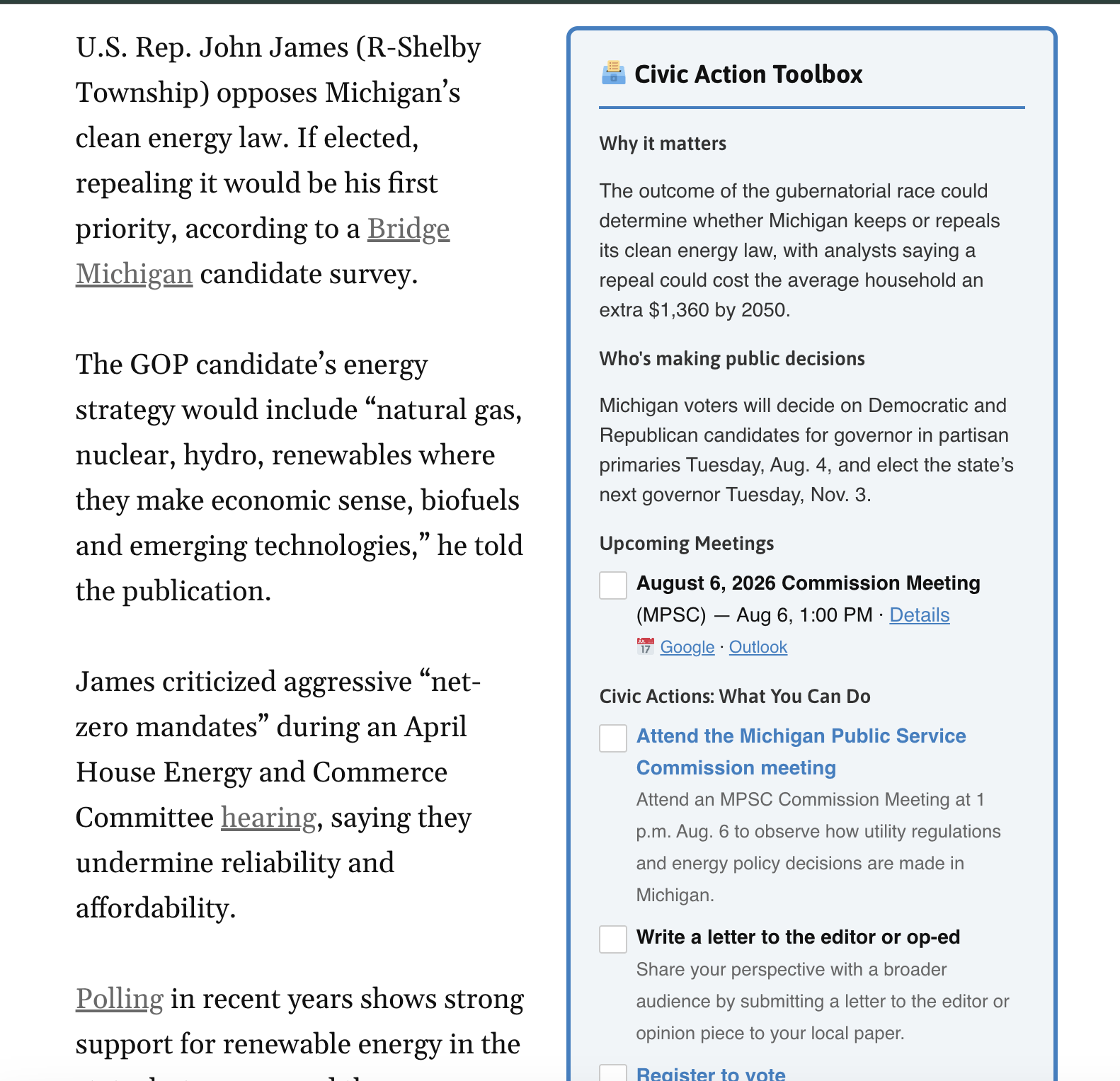
They took time, but readers used them. They submitted comments to the Michigan Public Service Commission, showed up at water authority board meetings and wrote to tell us they hadn’t known they were allowed to participate. The boxes worked. But the workflow didn’t — not for a newsroom as small as ours.
The Civic Action Builder is the tool we built to close that gap, and it’s what we’ll spend our RJI fellowship year making usable for any newsroom or journalist.
Here’s how it works today. An editor pastes an article URL into the tool and the tool uses AI to analyze the story against a structured database of local civic infrastructure: 35 automated scrapers tracking 95 government bodies across metro Detroit, plus a directory of more than 600 Michigan community organizations tagged by issue and geography. It drafts a plain-language sidebar showing the upcoming meetings, open comment deadlines, responsible officials and organizations connected to the story. An editor reviews it, edits it, and decides whether it publishes. Nothing goes live without human review and approval.
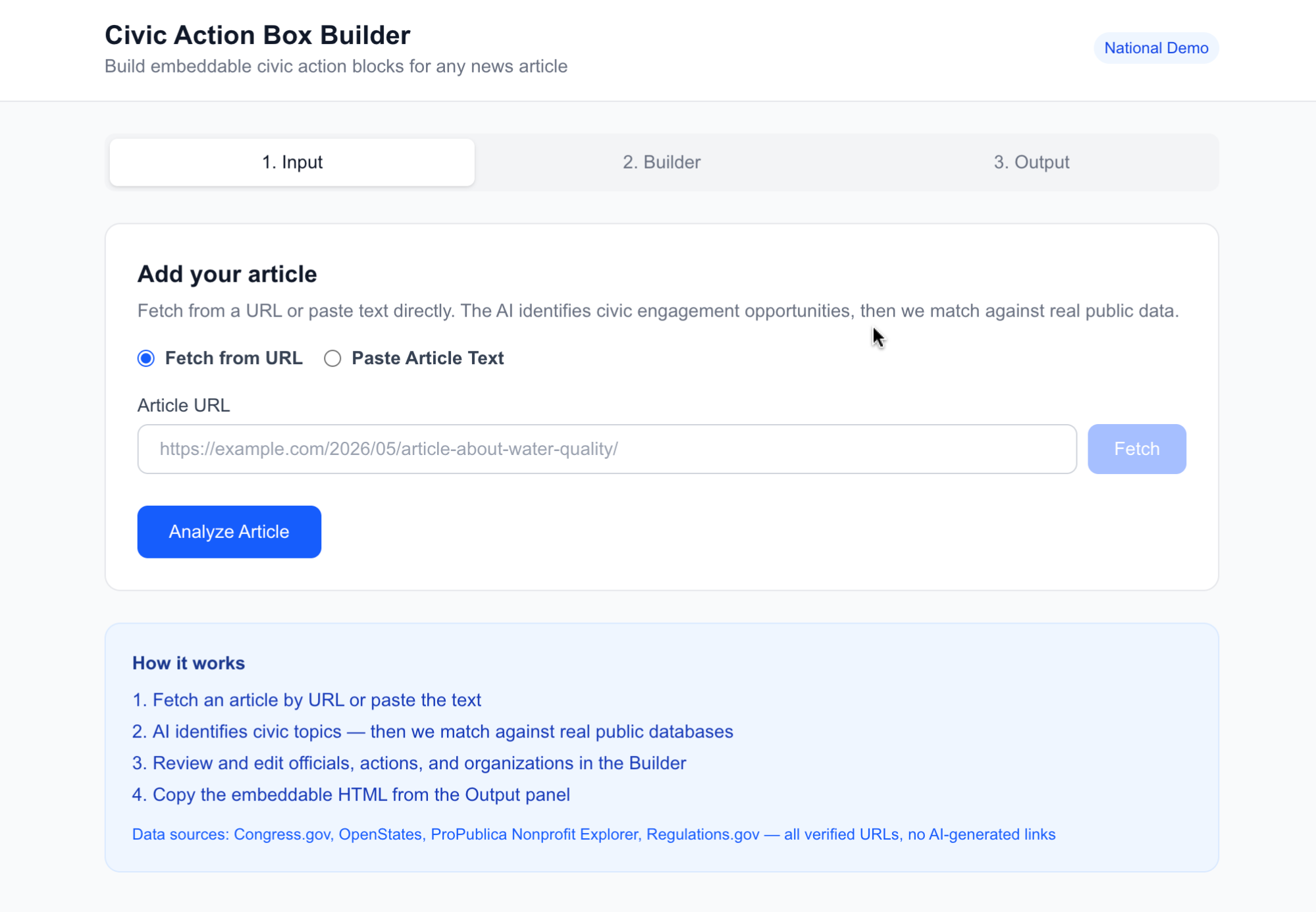
Importantly, the box never tells readers what position to take. It shows them where the decision is being made and how they might take action. And it makes it easy for them to access information that is often hard to find – where to make a public comment, which elected official to contact with their email and what organizations are working on the issue. The tool is built to lower the barrier to civic participation and make action easier.
The team behind the tool
Before founding Planet Detroit in 2019, Nina spent 15 years as a community planner for Oakland County, Michigan. She knows from the inside how public meetings, comment periods, and regulatory dockets actually function. She built the working prototype through AI-assisted development and learning enough Python, React and database architecture to make real decisions about how the system should work. The tool now cuts the time to produce a civic action box from 40 minutes or more to under ten minutes.
Ashley, a former journalist who has spent the past decade helping independent newsrooms build audiences and revenue, leads the work of getting the tool into other newsrooms’ hands and figuring out a sustainable business model for civic infrastructure tools like ours.
The part of this project we suspect will matter most to other newsrooms isn’t the sidebar. It’s the measurement. Every civic action box notes analytics when a reader clicks through to a meeting, an official’s contact page, or a comment form. In a recent 28-day window, we tracked 300 civic actions from 100 unique readers on our site.
We want to be careful about what that does and doesn’t prove. A click on a meeting link is not confirmed attendance. But it is article-level behavioral evidence of readers moving toward participation, and that’s a kind of impact data most small newsrooms have never been able to measure regularly until now.
Perhaps most importantly, readers can (and many do) write to us through a form on the site to tell us exactly what action they took. Recently, readers told us they contacted their legislator, signed a petition, attended a city council meeting, spoke during public comment, organized an advocacy day, connected with an organization, and more.
We call these readers our “civic actors,” and they represent a growing segment of our audience that we can engage with more deeply on civic engagement issues.
We think that this data is as useful to newsrooms as the boxes are to readers, because nearly every nonprofit or local newsroom is being asked by its funders to demonstrate civic impact.
Over the fellowship year, we’re testing how to make this work for other newsrooms. We’ll deploy the tool with a small group of pilot newsrooms across the country, adapt the scrapers to new regions, and document the process as we build out our tool.
If you are part of a newsroom and want to raise your hand for pilot testing, please fill out this form and we’ll be in touch! If you’re building or funding civic information infrastructure and want to compare notes on measurement, we’d love to talk.