Bay City News Election Playbook, Part 2: Newsrooms can vibe code their way to automated election night dashboard

Election night is a high-stakes, labor-intensive operation — and not just for the candidates. As voters wait for returns, community journalists fight an uphill battle to make sense of data released in disparate formats from different sources.
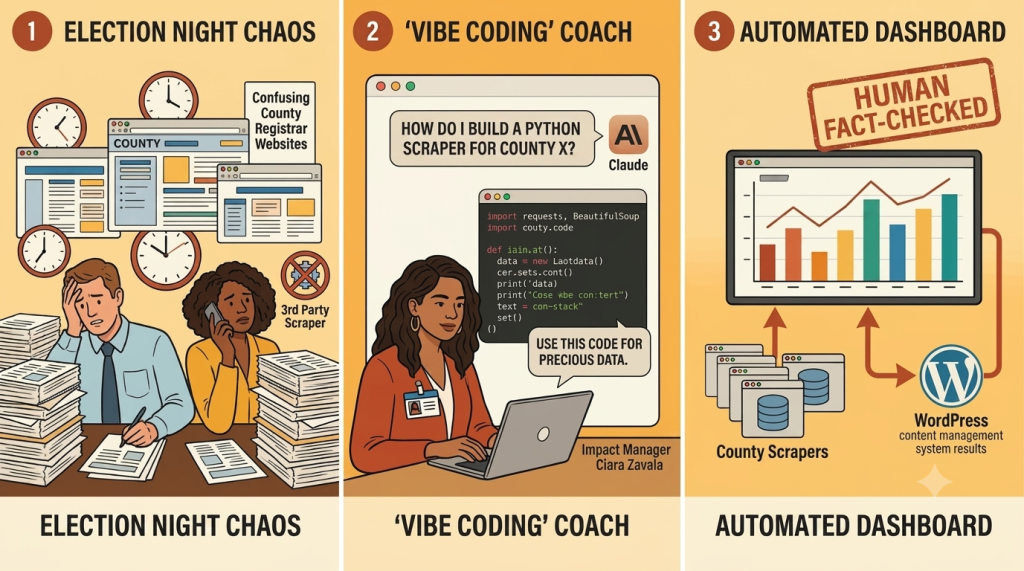
But a breakthrough experiment at Bay City News provides a new blueprint for success. By leveraging generative artificial intelligence not as a data processor but as a real-time vibe coding coach, a small team (just two people on election night) successfully automated their live election night results dashboard without a single software engineer on staff.
In an effort to help other news organizations replicate their success, the Bay City News has launched the second iteration of its Election Playbook, a step-by-step operational guide.
“Every local newsroom in the entire country has this problem,” said Kat Rowlands, executive publisher of Bay City News. “It’s a huge lift on election night to do this data crunching. So when we finally land on something that works well, we want to share it.”
The first version of the project began during the November 2024 presidential election. The initial goal under an ambitious civic engagement hub project was to build an all-inclusive voter platform containing resources, dropbox locations, registration timelines, FAQs and live results. Unfortunately, the third-party coder hired for the project was unable to successfully scrape the election data live.
When the November 2025 cycle arrived, the team faced a lighter ballot, and Rowlands and Impact Manager Ciara Zavala recognized this low-stakes election as the perfect testing ground to experiment and pivot.
Initially, they attempted a completely no-code approach using Zapier, an automation platform. The idea was to capture scheduled screenshots of county registrar sites, then feed those images into ChatGPT, which would convert the varied formats into consistent, dashboard-ready data.
However, the plan hit immediate roadblocks. Commercially driven software platforms had little financial incentive to partner on low-budget, civic-good projects. More critically, when Bay City News tested the AI bots outside their native chat interfaces, the models struggled with consistency. The team faced a constant threat of data hallucinations — not an acceptable risk when providing audiences with important election data.
Turning to ‘vibe coding’
Faced with a failing system the night before the election, Zavala and her partner made a radical strategic pivot. Removing AI from touching or interpreting the live data, they instead used large language models like Claude and ChatGPT as interactive coding instructors to teach them how to build traditional Python scrapers from scratch.
“I don’t come from a computer science degree, so I don’t have the exact tech terminology,” Zavala said. “I just prompted Claude a lot and built something from scratch just from vibe coding.”
By shifting the AI’s role from a data parser to a software development coach, hallucinations were no longer an issue. The AI guided the journalists through writing highly precise, traditional scrapers that acted like human users. This allowed them to bypass the bespoke, high-security layouts of in-house registrar sites like San Francisco and San Joaquin counties, which do not use standard election vendor software.
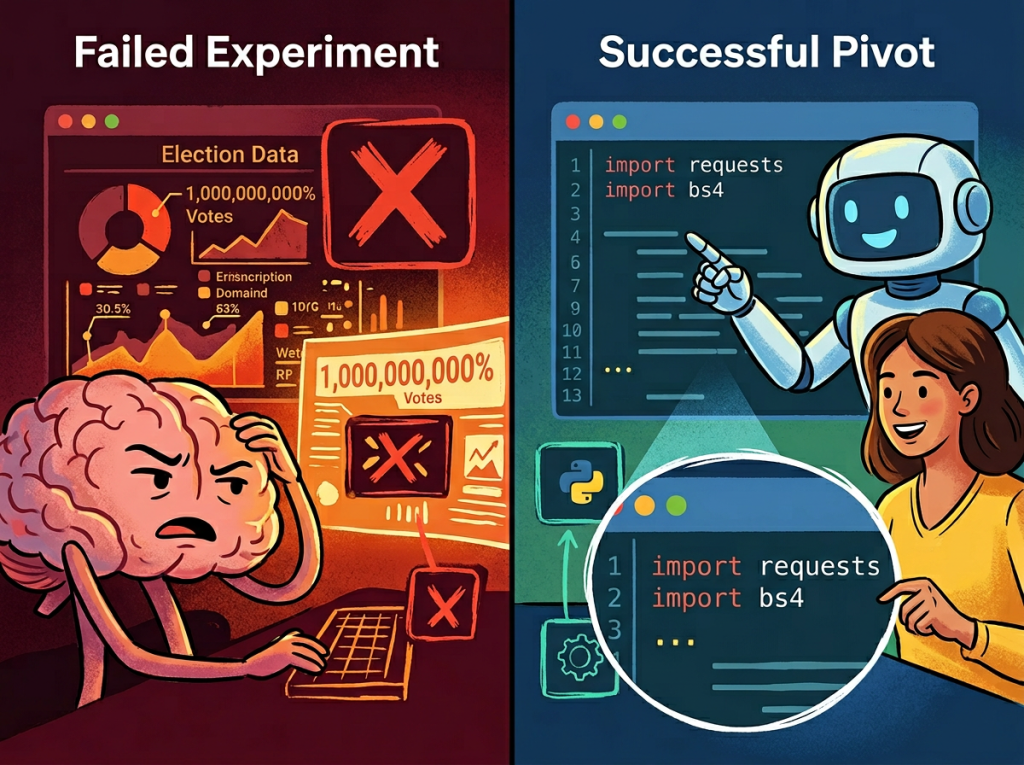
Just twenty minutes before 8 p.m. on election night, the team was still refining and training their bots. But when the first drop of results occurred, the scrapers functioned perfectly, scraping data from half a dozen key counties.
At the beginning of June, another local election allowed the team to experiment with adding more automation to the process. They established an automated thread connecting generated code directly to WordPress, avoiding the tedious manual copy-pasting of HTML blocks. Now, the data — always fact-checked by humans — moves directly into the content management system with a click, already meeting a goal that the playbook described when it was released in late April.
“Every little election has really taught us we can and can’t do,” Zavala said. “The AI evolution is really the craziest part, because during the first election we had somebody who was knowledgeable about code, and they still weren’t able to scrape live. And now the scrapers have become so much better that it wasn’t even a problem.”
Key takeaways for newsrooms
For news organizations looking to replicate the Bay City News model, the Election Playbook emphasizes several key points:
- Don’t use AI to process raw data: Asking AI models to read or interpret numbers directly is currently a recipe for generating hallucinations. However, AI is a great tool for writing the code that powers scrapers and dashboards that can process the data via more traditional methods.
- Embrace the rapid pace of AI evolution: AI capabilities shift weekly. “If you try it in January and it doesn’t work, try it again in February and it might,” Rowlands noted. Rapid improvements in model reasoning mean that previous technical limitations are constantly evaporating.
- Maintain a Strict Human Verification Layer: Technology can alleviate the manual burden of formatting and data collection, but final verification must always rest with a journalist to safeguard audience trust.
To formalize this work, Bay City News has launched an entrepreneurial arm called Bay City Labs. This enables the newsroom to treat technical failures as data points on the path to innovation, applying lessons from election scraping to other automated products like newsletters and podcasts.
And the work is resonating.When Zavala presented this project at a recent data journalism conference at Stanford University, she was swarmed by journalists from across the country who reported feeling “PTSD” from their own grueling election night experiences.
“This project really is for the small newsrooms who are dealing with this,” Zavala said. “It’s meant to be a blueprint for other newsrooms to follow, so we can pass on our playbook and have other people build their own projects from it.”
Bay City News has proven that a small newsroom can harness AI responsibly and efficiently to deliver comprehensive election night results to its audiences. To replicate and iterate on their success, view the Election Playbook here.
Cite this article
Fitzgerald, Austin (2026, June 12). Bay City News Election Playbook, Part 2: Newsrooms can vibe code their way to automated election night dashboard. Reynolds Journalism Institute. Retrieved from: https://rjionline.org/news/bay-city-news-election-playbook-part-2-newsrooms-can-vibe-code-their-way-to-automated-election-night-dashboard/