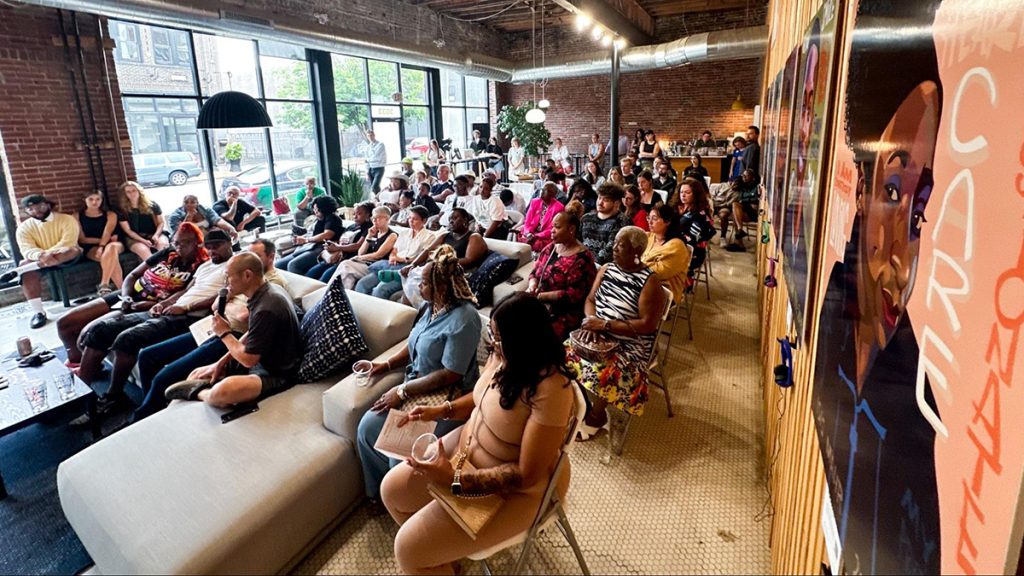
St. Louis residents gathered to discuss Remember Me, an art and reporting project that honors the lives of the city’s unsolved homicide victims. Photo: Brian Munoz | St. Louis Public Radio
How we created resources for families of victims of unsolved homicides in St. Louis


The Marshall Project used alternative story forms to directly connect with the people at the center of the story
My job at The Marshall Project is to make work that is both resonant and accessible to people affected by the justice system. Sometimes that means translating our investigations into the system’s dysfunctions for the communities that are the center of an investigation.
This work reflects a simple idea: When we produce an investigation, the people experiencing the abuse, harm or wrongdoing we are exposing already know it’s happening, for the most part. Documenting their experiences is a critical step for creating change and improving conditions. And we have an opportunity to create useful resources alongside our investigative work that are geared towards helping people address the challenges we uncovered.
So when APM Reports, STLPR and The Marshall Project found last year that nearly half of the 2,000 homicides in St. Louis between 2014 and 2023 went unsolved, I knew we had an opportunity to make work that directly addressed the experience of grieving an unsolved homicide or working with the police during an investigation for the thousands of families that were left behind.
I am sharing a few of the things I learned during this process, including how to:
- Bring communities into the reporting process
- Create resources that are most relevant to them and deliver information in ways that are most effective and accessible
- Find metrics of success that center the community
Bring communities into the reporting process
This project was led by Marshall Project engagement reporter, Ivy Scott. When she joined the team, we talked through the initial investigation and some of the rough ideas I had about what kinds of resources we could make. I didn’t want to just assume I knew what the community needed, so I asked Ivy to talk to some of the families that were featured in the investigation to find out what might be helpful to them and what resources already existed. Here is what she found, excerpted from an email we sent to our members:
…when I met with families of those lost to the violence in St. Louis, Missouri. They described a sense of isolation and hopelessness in their grief, a feeling that no one understood what it was like to wait indefinitely for justice — and a daily fight to keep their son or daughter’s memory alive.
She continued:
In the course of my reporting, it became clear that these families’ experiences could also serve as critical wisdom for others in the community. As they told me, there weren’t enough resources to help them when they needed it most, and they were eager to help fill that gap.
As editors we are used to making decisions about the shape of the work based on our own instincts. But our work can be more impactful if we ask the community what they need and what is most important to them. This doesn’t have to be a time-intensive process. You can encourage your reporters to identify a few people you’re hoping to reach and have them ask a few specific questions.
We almost always want to know some variation of the following:
- After sharing our loose ideas, we ask: What do you think about these ideas? Is there something I missed or something else I should be focused on?
- If we make a few resources to address these issues, what would make them most useful to you or others?
- If you had a magic wand, what would you create for yourself? Or for others in your shoes?
Ultimately, honoring their loved ones’ memory in a way that helped families lessen their hopelessness and isolation became a key mission of this project. And we knew we had to let the families voices shine through the work.
Picking what stories to tell and how to distribute them
Can a reporting project really address the hopelessness resulting from violence? Yes. It takes some audacity to believe that information is that powerful. Of course, information alone is not enough to move the needle. The information has to be packaged and distributed in a way that reaches people and helps them actually engage with the resources you’re providing.
Here’s how we brought that idea to life, excerpted from an member email:
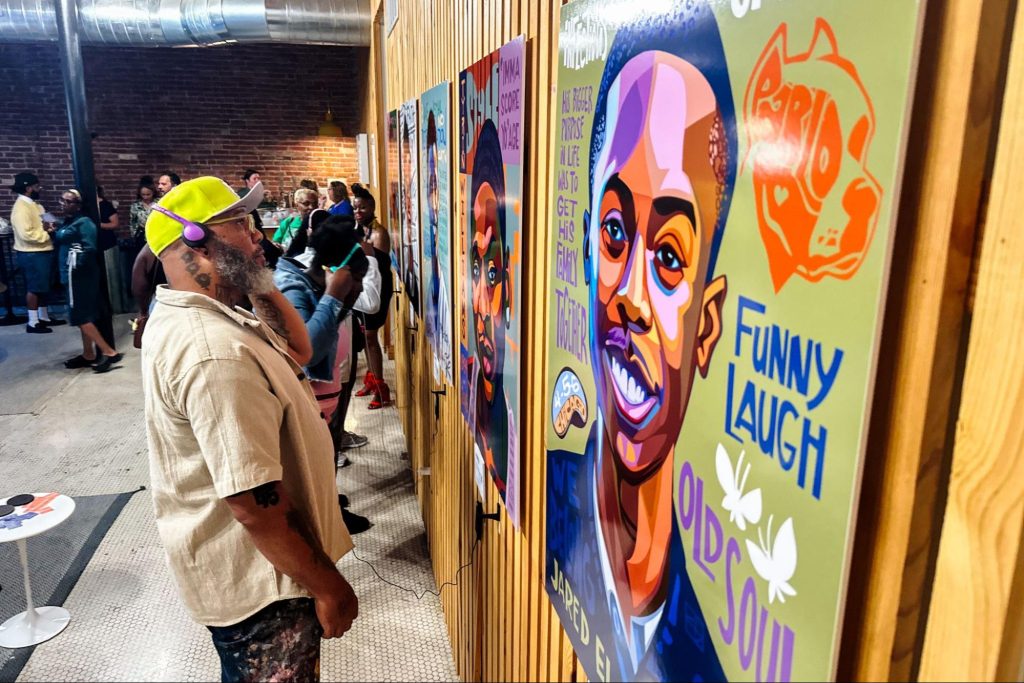
To help the community honor the memory of the many people lost to unsolved homicides, we, along with our colleagues at St. Louis Public Radio, created Remember Me, a community art and engagement project. It features six portraits, beautifully illustrated by local artist Cbabi Bayoc, that depict victims of homicide as their families told us they’d want to be remembered: in laughter, strength and love. Accompanying the portraits are audio recordings of their family reflecting on what they loved most about their child.
We also made a series of resources that distilled the wisdom of families who had lost someone to violence. These resources were guided by the initial investigation and family input. The investigation pointed out some obstacles that hampered police trying to close cases. And we used those obstacles as a starting point for the resources we could create. For example, if the communities lack of trust in the police is a major barrier, could we create a guide that helps facilitate trust by either demystifying homicide investigations and/or finding a way for families to tell police exactly what they want from them?
We made three resources. One includes tips for dealing with grief, crowdsourced directly from families who have lost people to violence. The guide includes grief support organizations around St. Louis that were directly recommended by the families. Another set of resources makes clear how important community engagement is during a homicide investigation and outlines what families need to know when working with police. We also created a guide geared towards law enforcement, detailing what police need to know when working with the community.
During the reporting process, Ivy connected with community organizations in St. Louis that serve people affected by violence and grief. These community partners helped us get our work in front of the people who needed it most. Today, the resources are available throughout the St. Louis Public Library system and in the St. Louis Office of Violence Prevention.
They have also been shared with several local community organizations, including Mission STL, The BRIC, Homicide, Ministers & Community Alliance, Life Outside of Violence (a Washington University School of Medicine initiative), Freedom Community Center and The Ethical Society of Police. Organizations outside of the St. Louis area have also requested the guide as a model/resource for their work, including: Alabama Appleseed Center for Law & Justice.
To reach families directly, TMP and STLPR co-hosted three community-events that brought families and others together to view the art work and discuss how the community can move forward after tragedy.
Measuring success
In our last article for RJI, Lam Vo shared one of her favorite frameworks for measuring impact that was developed by Reveal and classified impact on four levels:
- Micro: individual
- Meso: group
- Macro: government, institutions
- Media: other outlets
With Remember Me, we knew that most of the impact from our engagement work was going to be at the micro level. It can be easy to dismiss this impact as not as meaningful as the macro impact that changes laws and policies. The thinking reflects a misunderstanding of the way change happens in the world. It comes from the bottom-up and the top-down and the two inform each other. Bottom-up change is when individuals take action by organizing around an issue. Top-down change is when people already in power take action. Often, it’s the community experiencing a problem that can put the most pressure on the people in power to act.
We tracked how our work impacted individuals by listening to them. During the community events we took notes on what people said. Here are some of the family reactions from the first community event:
“I applaud you for what you did in creating this space for my daughter.”
“Thank you for giving us this platform to be able to speak to you guys and let everybody else know how [our children’s deaths have] taken effect on us every day.”
“When we did the interview, I was able to watch a video [of Courtney] for the first time. It used to hurt to look at a picture.”
“We don’t see our child, we don’t hear them, we don’t get to do any of that. What you published… is what we have.”
“Thank you… for always giving us parents a platform to come and speak about our hurt and how the police have basically just washed us away.”
Several of our impact metrics at TMP focus on individual or community benefit. So we gather these anecdotes into our impact tracker and tag them with the appropriate metric. We will also connect with the community orgs to gather any feedback they heard about the resources, find out how many people they reached, and gather any lessons learned about how they can be improved. We can use the feedback and personal anecdotes to explain our impact to funders, our members, and even the community itself.
Cite this article
Lewis, Nicole; and Vo, Lam (2026, Jan. 7). How we created resources for families of victims of unsolved homicides in St. Louis. Reynolds Journalism Institute. Retrieved from: https://rjionline.org/news/how-we-created-resources-for-families-of-victims-of-unsolved-homicides-in-st-louis/