Introducing the Journalism Source of Safety (J-SOS) app

Building the journalist safety app I always needed
Journalists today navigate an increasingly hostile world with tools that were not built with them in mind. Traditional safety resources are static, siloed, and structured around the imagined foreign correspondent of decades past. The platforms journalists rely on for secure communication are owned by corporations whose bottom lines have little to do with press freedom. And the reporters who need the most support — freelancers, student journalists, those working in the Global South, and journalists from historically marginalized communities — are the ones consistently left without any. The Journalism Source of Safety (J-SOS) app is being built to bolster the organizations and individuals working to change that.
In 2022, as an RJI Fellow, I premiered Source of Safety as an online toolkit and spent the year publishing and building resources for what journalists are actually facing. I wrote about reporting in spaces of civil unrest — which our preliminary analysis for a forthcoming Reuters Institute for the Study of Journalism (RISJ) report on conflict journalism (co-authored with Adrian Hadland, Martin Smith-Rodden, and Zaza Tsotniashvili) confirms is the #1 conflict environment journalists are currently navigating. I discussed the safety needs of reporting in environmental disasters — an area where the same RISJ survey has found that a majority of journalists say they are increasingly having to work in extreme natural environments, from heat waves to flooding to storms. I also reported on why digital security is often the hardest safety domain to access while being the front line for much of our physical and psychological safety, especially for journalists from marginalized backgrounds. I documented the urgent, then-underrecognized need for trauma-informed practices and psychological first aid. And I made the case — grounded in the 2022 State of Photography Report and a decade of scholarship — for why we must specifically prioritize resourcing the most marginalized journalists.
In the time since the introduction of J-SOS, the journalism safety field has moved with intention. ACOS Alliance premiered its Assignment Safety Checklist and Editors Safety Hub (both co-produced with Aegis Safety Alliance, the organization where I am a co-founder and Associate Partner). A CUNY-developed AI safety chatbot (JESS) has recently entered the space, as have a variety of much-needed pro bono workshops and trainings from IWMF, CPJ, PENAmerica, and a growing ecosystem of organizations receiving Knight’s Press Forward seed funding for safety and legal-support infrastructure, including RCFP’s Local Legal Initiative, and both Global Center for Journalism and Trauma and Vita Activa’s expansion of mental health care access for journalists. Aegis joined several other safety-focused organizations in providing identity-aware, trauma-informed security advising during the Knight Foundation-funded Election Safety Hub work from 2024 to 2025. All of this work and funding indicates the direction of the industry is on track and yet some critical gaps remain.
What we’re building
A core principle guiding our work is this: journalists deserve a safety tool built by and for journalists, outside the reach of Big Tech. So much of the infrastructure our journalism runs on is owned by corporations whose priorities are not aligned with protecting democratic information, journalists’ lives, or their sources.
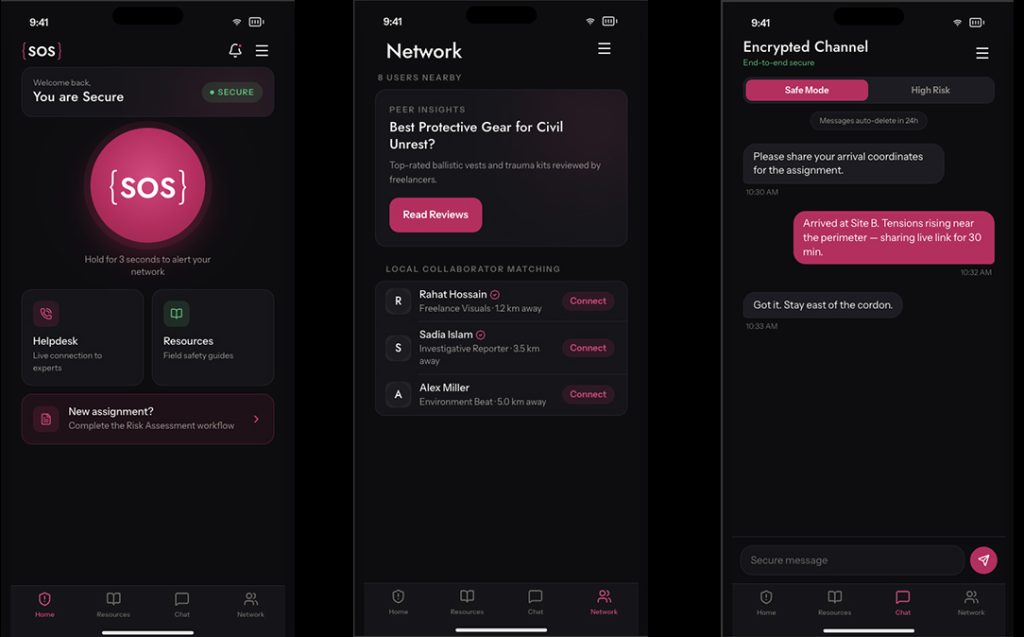
J-SOS is built on the end-to-end encrypted Signal platform — whose nonprofit creators share our commitment to privacy, security, and free expression as foundational values. We are building a place to learn about safety practices that is also a space to be safe while doing the actual work of journalism: communicating with sources, sharing sensitive files, coordinating in the field, and building community with other journalists — all within a single secure, journalist-centered space. To our knowledge, no existing tool does all of this together. (And if something similar exists that we haven’t encountered, we want to know because we believe in collaboration over competition, and we welcome any opportunity to build a better industry together.)
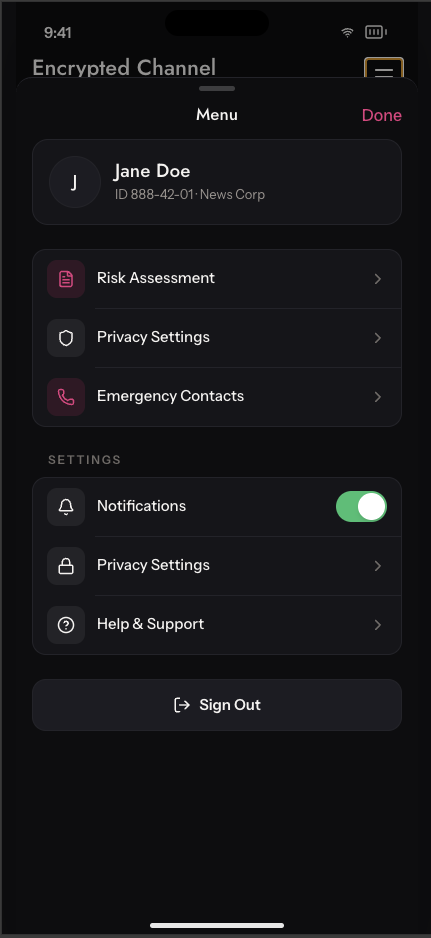
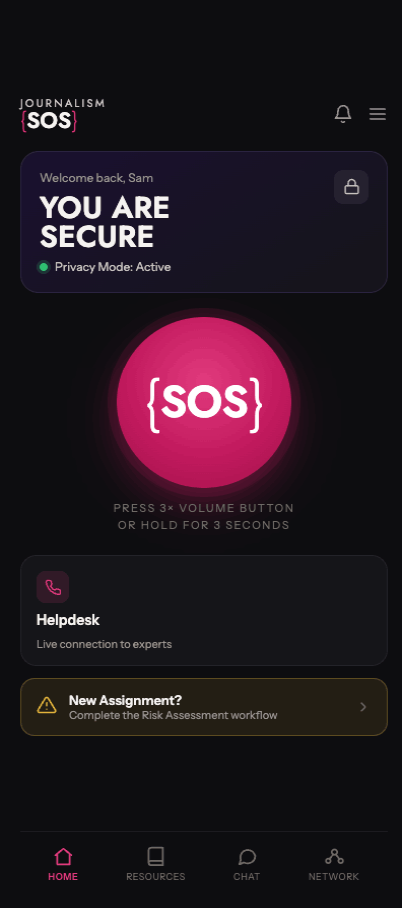
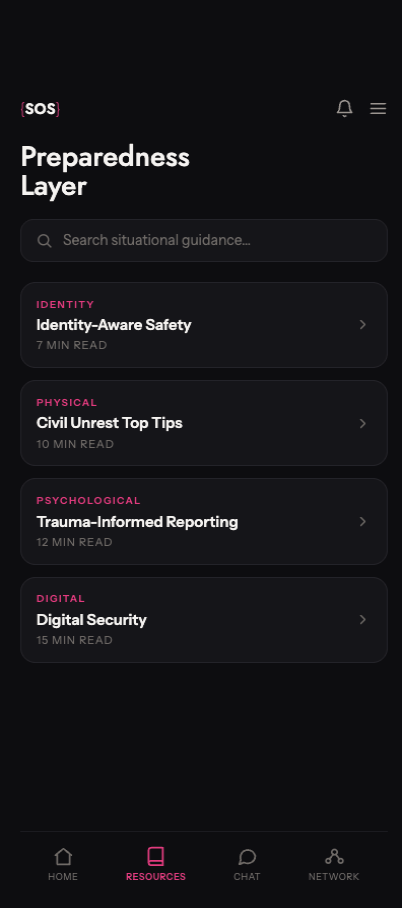
Rather than a curated links page, static resource or standalone checklist, J-SOS will be a unified, mobile-first platform with five integrated elements:
- on-demand, environment-specific safety resources and checklists
- a direct-access expert helpdesk
- end-to-end encrypted communications and secure location sharing built for assignment workflows
- risk-assessment and newsroom collaboration tools
- a community hub for peer knowledge-sharing and safety gear reviews
Core features will always be free for freelancers, students, and journalists in low-resource contexts. The resources will be directly responsive to the needs of working journalists and informed by mine and other journalism studies scholars’ ongoing research.
Grounded in real need
These features are not arbitrary, they’re grounded in documented need. As a first-phase of building this app, I conducted practitioner research with 75 media professionals globally and a listening session and survey with student journalists at Temple University.
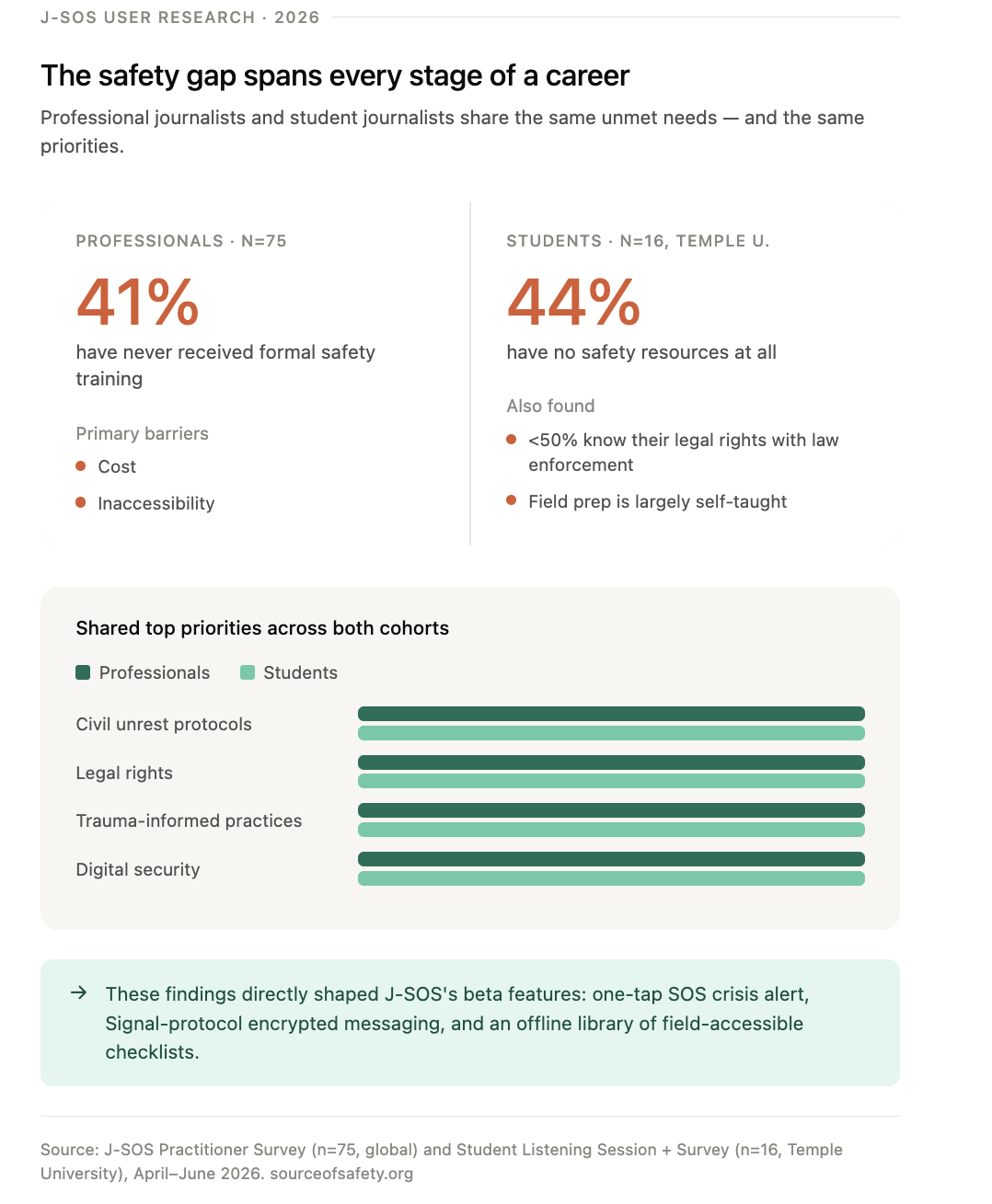
The findings were striking: 41% of professional respondents have never received formal safety training, with cost and inaccessibility as the primary barriers. The top reported risks were psychological trauma from difficult reporting environments (64%), arrest or detention by government actors (53%), and online harassment or doxxing (48%) — exactly the areas that conventional hostile environment training tends to skip. Among students, 44% reported having no safety resources at all, and fewer than half clearly understood their legal rights when interacting with law enforcement.
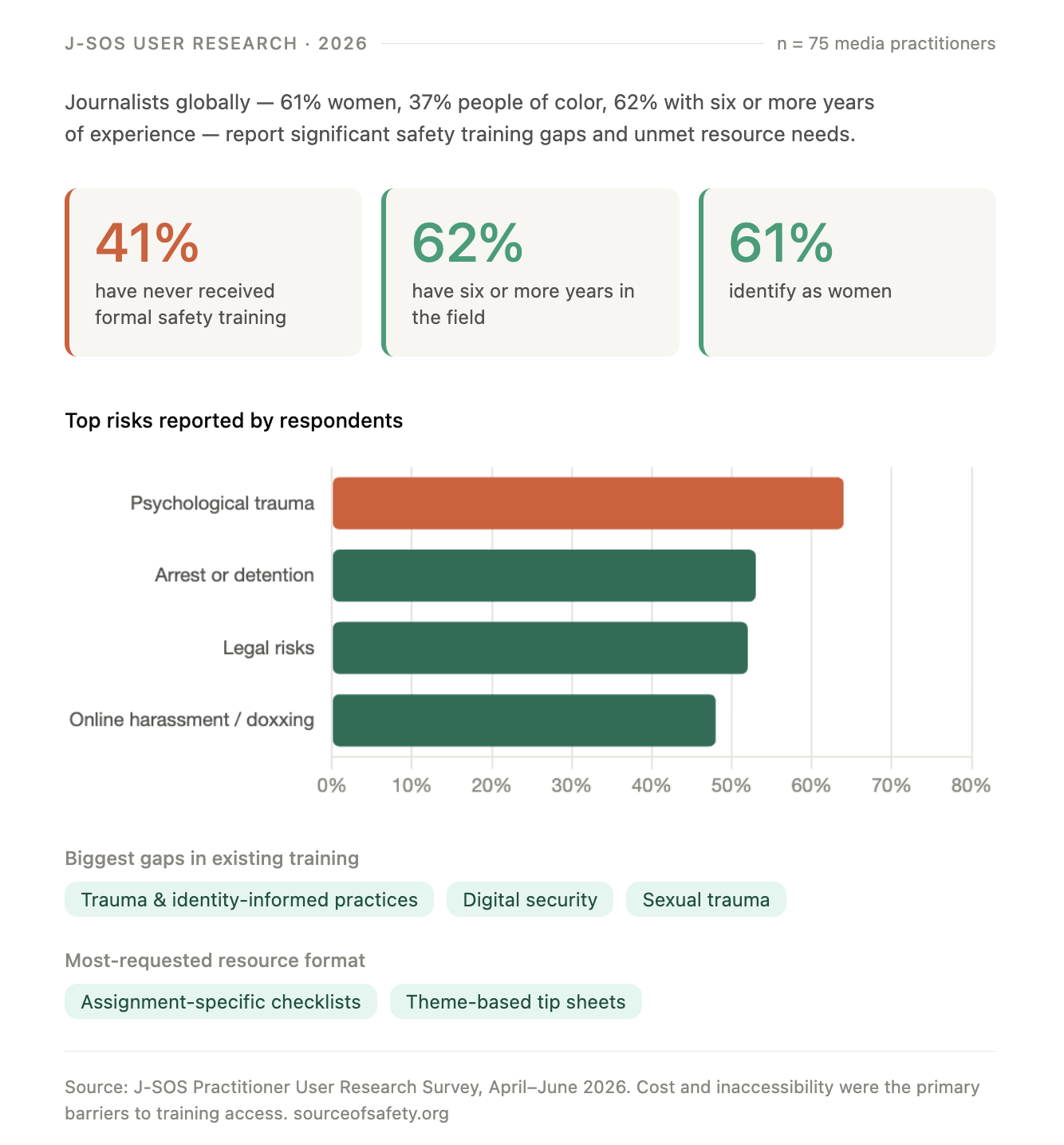
Across both cohorts, the most-requested format was the same: practical, field-accessible preparation tools — assignment-specific checklists and theme-based tip sheets. The research also identified trauma and identity-informed safety practices as a clear content priority that must be present at launch, a need that represents a meaningful differentiator for J-SOS in the current safety-tools landscape. These findings echo nearly a decade of documented need: the 2017 Dart Center for Trauma in Journalism survey found that only 3% of journalists had received online harassment training and our 2026 research confirms those gaps remain largely unfilled.
We are in active user research right now, and we need the input of journalists. Please take our user research survey as it directly shapes what we build. And if you want to be a beta tester of the app as we build it, please reach out to me at tara@authoritycollective.org.
Meet the team behind J-SOS
J-SOS is a collaboration between RJI Director of Innovation Kat Duncan and our journalists, educators, and technologists who bring to the project a rarity of direct experience on all sides of the problem. Kat Contreras, a visual storyteller and full-stack developer with two decades of experience building human-centered, mission-driven digital infrastructure — including the Black Designers Database, LA’s Black Image Center, the website and community directory for Authority Collective, and the original J-SOS digital tool — is the project’s technical lead and architect.Forhad Sikder, a journalism technologist and Head of Broadcast and IT at CPLUSTV in Bangladesh, brings more than ten years bridging newsroom operations and digital systems; his Crisis Alert project — a mobile-first one-tap SOS system for journalists in high-risk environments — is a central component of the app’s emergency safety functionality. And I am Tara Pixley, the project founder and lead.
We want this project to be an open collaboration with anyone in the industry who is excited about its mission and potential. We aim to make this app interoperable with a variety of existing and in-process tools, resources and safety efforts. So, for all those building tools toward a safer, more transparent and inclusive journalism industry for all: join us!
The next article in this series will feature interviews with people shaping the future of journalist safety around the world. If that’s you — or someone you think I should talk to — I’d love to hear from you.
Cite this article
Pixley, Tara (2026, July 27). Introducing the Journalism Source of Safety (J-SOS) app. Reynolds Journalism Institute. Retrieved from: https://rjionline.org/news/introducing-the-journalism-source-of-safety-j-sos-app/