Spread, a new method for connecting newsrooms and social media creators, wins grand prize in Student Innovation Competition

The Reynolds Journalism Institute awarded $13,500 in prizes Thursday to the top three teams in its annual Student Innovation Competition, which focused this year on creating collaborative partnerships between news organizations and social media creators.
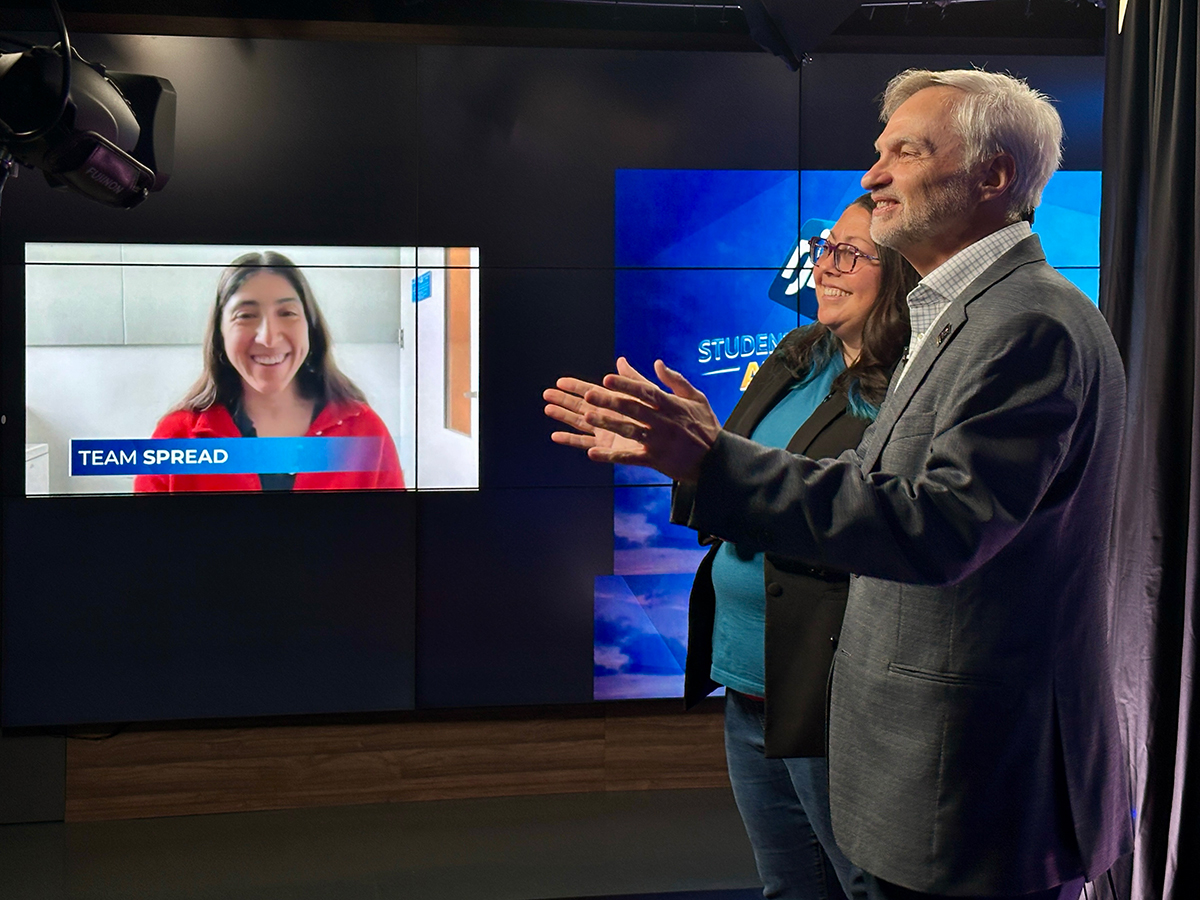
The grand prize of $10,000 went to Lauren Harris, a graduate student at Columbia University. Harris created Spread, a model for connecting social media creators and newsrooms at live journalism events — in this case, listening tours held by statewide newsroom New York Focus.
“All of the teams in the competition were really doing incredible work, and so it was a very tough decision for us to come to,” said Liz Kelly Nelson, founder of the Project C newsletter and one of three independent judges who evaluated the finalists. “But we were really impressed with the test and learn approach that [Lauren] took. The iteration, the piloting, and then adjusting a little bit to make each experiment possible. And one of the really interesting things that this team discovered was what they thought would be a technological solution actually turned out to be a human solution.”
Indeed, while Harris’ initial plan was to facilitate digital connections between the two types of communicators using resources like Tiktok’s internal marketplace for creators, she ultimately found that live events offered stronger opportunities for human connections and the forging of beneficial relationships.
This advantage was thrown into sharp relief when creators and journalists extended their relationships beyond the live events, with one creator even staging a debate with an economist he met at a New York Focus event.
“[That influencer] really proved that if you can get these people together, they can build authentic relationships,” said Harris, who competed solo under the name Team Spread. “It was the cherry on top.”
Harris’ efforts led to New York Focus taking up the practice of inviting creators to its offices for coffee, indicating a desire to further develop relationships within the social media sphere beyond the short term.
“I think it’s great,” Harris added. “If that can serve as a model for more newsrooms, that’s awesome. The more people having coffee, sharing ideas, sharing their methods, whether they’re journalists or creators — whichever way that information is flowing, I think it’s a good thing for journalism.”
But despite her big win, Harris’ project was not the only success story. Team Newsfluencer Academy from the University of Southern California earned second place and $2,500 for their partnership with historic Black newspaper the Los Angeles Sentinel, which involved creating and testing a curriculum for journalists to learn how to think like social media creators.
Taylor Nicole Price, Lizbeth Solorzano, Maricruz Villalobos and Rosaura Wardsworth found that the Newsfluencer Academy helped journalists realize the importance of personal branding on social media, where building one’s reputation “from the inside out” matters as much or more than the prestige of the newsroom they work for.
Third place and $1,000 went to Team News Dawgs, which succeeded in what some might have considered an impossible task. Shad McMillan, Maura Potvin and Makenna Reavis developed Bridge, a training program that educates social media creators about newsgathering and ethics guidelines. Upon completion of the program, creators were given permission to brand their content with watermarks from WSB-TV, one of the largest television stations in Atlanta.
News Dawgs also earned the Fan Favorite prize based on public voting, netting them free travel, lodging and registration for a U.S.-based journalism conference.
“Each of these teams produced something significant that spoke to the importance of opening up lines of communication and collaboration between journalists and social media creators,” said Randy Picht, executive director of RJI. “All three have the potential to change the way we think about how news reaches modern audiences, and I look forward to seeing how they continue to develop after the competition.”
In fact, the competition proved so tight that the judges found themselves referencing additional teams when summing up the best ideas that came out of the process. Anna Almendrala, an audience engagement manager at CalMatters, spoke about Solomon Omondi of Southern Illinois University Edwardsville and his insightful perspective on modern news consumption.
“He said that news travels through people, and I thought that was such an interesting and true way of explaining this rise of creators in the news space,” Almendrala said, pointing to a theme also highlighted by Team News Dawgs’ focus on personal brands.
But uniting all the projects was a sense that the dynamic between these two groups — between news organizations and the people audiences come to for news and community on social media — is bound to play a key role in shaping the future of the industry.
“I think we noticed that there’s still a blending and a tension between journalists and creators, but that they are essential to the future of journalism,” said Liz Worthington, director of product strategy at the American Press Institute. “So I thought that each team approached the project in a unique way that spoke to that tension.”
Cite this article
Fitzgerald, Austin (2026, May 1). Spread, a new method for connecting newsrooms and social media creators, wins $10,000 grand prize in Student Innovation Competition. Reynolds Journalism Institute. Retrieved from: https://rjionline.org/news/spread-a-new-method-for-connecting-newsrooms-and-social-media-creators-wins-10000-grand-prize-in-student-innovation-competition/